


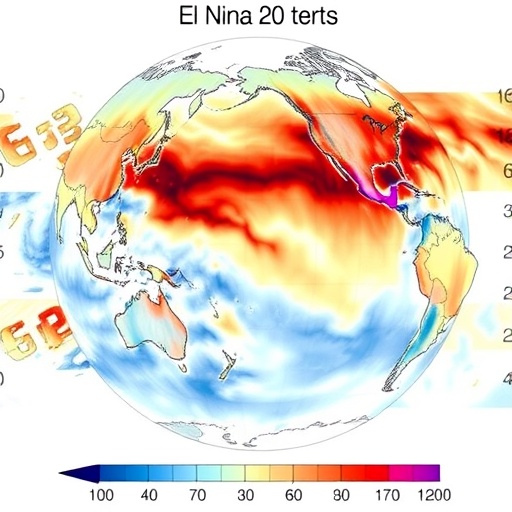
In a groundbreaking study set to be published in 2025, researchers Huang, Yang, and Lu, along with a distinguished team, delve into the persistent El Niño-like conditions that characterized the western Pacific during the significant geological period known as the Bølling–Allerød interstadial. This interstadial period, which occurred approximately 14,700 to 12,700 years ago, is crucial for understanding the Earth’s climatic transitions and patterns. Recognizing the mechanics behind these remarkable climatic conditions can illuminate our comprehension of today’s climate dynamics, offering insights into the potential future implications of ongoing climatic shifts.
The researchers employed a multi-faceted approach, utilizing both paleoclimatological data and advanced climate modeling techniques, to analyze the climate dynamics during the Bølling–Allerød interstadial. They synthesized evidence from sediment cores, ice cores, and marine records to piece together the climatic puzzles of this era. Their analysis suggested that the El Niño-like conditions were not merely occasional anomalies but a sustained state that played a fundamental role in modulating global climate systems.
At the core of their findings is the assertion that the Bølling–Allerød interstadial saw alterations in oceanic currents and atmospheric circulation patterns reminiscent of today’s El Niño phenomena. By comparing current climatic behavior with historical data, the researchers underscore the parallels between past and present El Niño-like events, reflecting on how these patterns could inform future climate outlooks. This historical perspective is vital for scientists seeking to draw correlations between ancient climatic conditions and contemporary climate anomalies.
In evaluating the implications of these findings, the researchers highlighted the impact of persistent El Niño-like conditions on global weather patterns. Their research outlines how sustained warm sea surface temperatures influence atmospheric pressure systems, creating ripple effects across continents. This leads to extreme weather events such as droughts, floods, and altered precipitation patterns that can reverberate through ecosystems and human societies.
Moreover, the study articulates the potential repercussions of ongoing climate change in the context of these historical patterns. As baseline temperatures rise due to anthropogenic influences, the researchers warn of the likelihood that the western Pacific may shift into a state that mimics the persistent El Niño-like conditions observed during the Bølling–Allerød interstadial. Such a transformation could catalyze unprecedented weather events, aligning with increasingly frequent reports of extreme climate phenomena globally.
The implications of these findings extend to ecological systems as well. Ecosystems are notably sensitive to climate variations, and understanding past trends in El Niño-like conditions assists researchers in predicting how current and future climate change may affect biodiversity. The study serves as an essential reference point for conservationists and policymakers, urging them to consider historical climate fluctuations in their planning and adaptation strategies.
In their analysis, Huang and colleagues emphasize the role of feedback loops in maintaining these El Niño-like states during the interstadial. They discuss how initial warming can trigger atmospheric and oceanic responses that further exacerbate temperature increases, reinforcing the El Niño-like conditions. This intricate web of interactions offers a cautionary tale for modern climate models, which often struggle to accurately predict the compounding effects of climate change.
Another critical revelation from the study is the timing and duration of these climatic events. By correlating various data streams, the researchers have identified specific timeframes during the Bølling–Allerød when these El Niño-like conditions were most pronounced. Their work shines a spotlight on the episodic nature of climate change, highlighting the importance of considering both long-term trends and short-term fluctuations.
As the world grapples with the effects of climate change, the study’s findings provide a timely reminder of the necessity for a historical context in understanding current climatic shifts. The intersections of past and present climatic phenomena serve as a clarion call for researchers, policymakers, and the global community to take heed of the lessons encoded in the Earth’s historical climate records.
The team’s research methodology is comprehensive and innovative, employing cutting-edge technologies coupled with traditional paleoclimatology methods. By not only relying on historical data but also integrating predictive models, they have developed a framework that could be instrumental in forecasting future climatic states. Such an interdisciplinary approach underscores the necessity of collaboration across fields, where climatologists, oceanographers, and geologists can collectively contribute to a more nuanced understanding of Earth’s climatic past.
As the study progresses toward publication, it has already garnered attention in the scientific community for its potential to reshape discussions around climate resilience and adaptation strategies. With climate-related disasters becoming more frequent, the need for robust, historical frameworks to inform current practices is more critical than ever. This research positions itself at the nexus of climate science and public policy, potentially influencing how communities prepare for and respond to the impacts of climate change.
Huang, Yang, and Lu’s work is not only an examination of a past climatic phenomenon but also a powerful diagnostic tool for understanding the present and a roadmap for anticipating future climatic realities. As they prepare for publication in Commun Earth Environ, their research promises to inspire further exploration into the connections between ancient climates and the present-day climate crisis, advocating for proactive measures in sustainability and climate action.
In summary, the study illuminates the persistent El Niño-like conditions in the western Pacific during the Bølling–Allerød interstadial and its profound implications on our understanding of climate dynamics. With climate patterns becoming increasingly unpredictable, the research presents a crucial narrative that calls for reflection, adaptation, and a deeper understanding of how our planet’s climatic history may repeat itself in the face of ongoing change.
Huang, J., Yang, Z., Lu, Z. et al. Persistent El Niño-like conditions over the western Pacific during the Bølling–Allerød interstadial. Commun Earth Environ (2025). https://doi.org/10.1038/s43247-025-03053-y
Cite Scienmag News
Violet Maxwell. (November 29, 2025). El Niño Conditions Persisted in Western Pacific During Bølling–Allerød. Scienmag. https://scienmag.com/el-nino-conditions-persisted-in-western-pacific-during-bolling-allerod/
Violet Maxwell. "El Niño Conditions Persisted in Western Pacific During Bølling–Allerød." Scienmag, 29 November 2025, https://scienmag.com/el-nino-conditions-persisted-in-western-pacific-during-bolling-allerod/. Accessed 3 September 2026.
Violet Maxwell. "El Niño Conditions Persisted in Western Pacific During Bølling–Allerød." Scienmag. November 29, 2025. https://scienmag.com/el-nino-conditions-persisted-in-western-pacific-during-bolling-allerod/


