


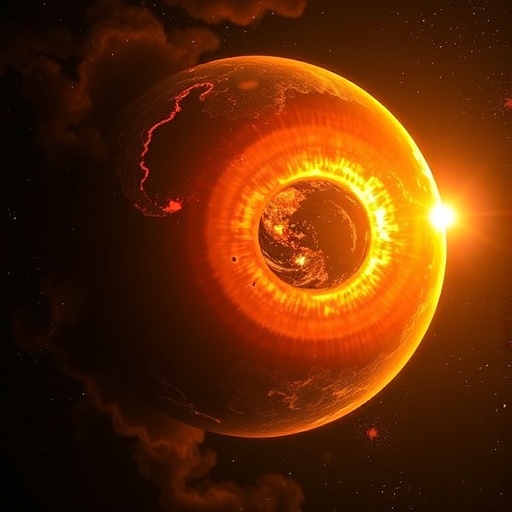
The story of Earth’s earliest atmosphere and hydrosphere is not merely a chapter in planetary history; it is the foundation upon which the complex chain of life was forged. Recent advances in geochemical studies, supported by cutting-edge numerical models and evidence extracted from meteoritic material and ancient rock formations, have given scientists profound new insights into the redox state of Earth’s early environment. This redox state—essentially the balance of oxidation and reduction processes—shaped not only the planet’s habitability but also its capacity to host the primordial origins of life itself.
At the dawn of Earth’s history, during the Hadean eon spanning from 4.567 to 4.0 billion years ago, the planet underwent a series of transformative phases. The initial atmosphere was not a static shell but a dynamic system formed from multiple sources: primordial volatile elements delivered during accretion, volatile release from the cooling primary magma ocean, and subsequent outgassing episodes after the solidification of the magma ocean. These components combined to create a volatile environment whose chemical nature dictated the conditions for life’s earliest emergence.
Intriguingly, the presence of an initial hydrosphere—large bodies of water—could trace back as far as 4.4 billion years ago, offering a potentially early cradle for life’s molecular precursors. However, this early hydrosphere likely faced repeated challenges from intense late accretion impacts, episodes during which vaporization of surface water could have occurred. Such conditions would create turbulent and intermittent aquatic environments, significantly influencing the chemistry and physical settings available for prebiotic reactions.
The sedimentary record provides evidence that more stable and subaqueous environments—ones fully submerged beneath water—had been established by approximately 3.7 billion years ago. This timeline pushes the origins of steady water bodies much earlier than previously believed, suggesting Earth’s surface was hospitable to life during the early Archean eon. The complex interplay between evolving volcanic activity, ocean chemistry, and atmospheric processes underpin this transformative period.
Central to understanding Earth’s habitability is the mantle’s redox state—the balance of oxidized and reduced elements deep beneath the planet’s crust. Current research suggests that the mantle gradually transitioned to a redox state resembling what we observe today between 4.4 and 2.7 billion years ago. This shift profoundly influenced the nature of volcanic gases released at the surface, thereby impacting the composition of the atmosphere and the hydrosphere.
One of the long-standing puzzles has been the delay between the advent of free oxygen in water and the dramatic rise of oxygen in Earth’s atmosphere. Molecular oxygen (O₂) appears in the hydrosphere by around 3.0 billion years ago, but only much later—between 2.5 and 2.3 billion years ago—does the Great Oxidation Event (GOE) mark a significant atmospheric oxygen increase. This gap signifies a complex web of processes controlling oxygen’s balance, suggesting that oxygen production and consumption in early Earth were finely tuned and not a simple linear accumulation.
The factors controlling this delay are multifaceted. Geodynamic activity, including tectonics and mantle convection, modulated outgassing and surface conditions. Magmatic processes influenced the types and volumes of gases emitted, while biogeochemical feedbacks from nascent life forms, such as photosynthetic microbes, contributed both sources and sinks for oxygen. This synergy created an intricate oxygen economy with sources and sinks dynamically interacting over hundreds of millions of years.
The consequences of this delayed atmospheric oxygenation extended to other key volatile elements indispensable for life, such as nitrogen, carbon, and hydrogen. The cycles of these elements evolved in concert with redox changes, shaping the chemical landscape for the development and sustenance of life. For instance, shifts in nitrogen speciation affected nutrient availability, while carbon’s redox state played a role in controlling greenhouse gas levels and, thus, Earth’s climate.
To unravel these entangled histories, researchers employ multifaceted approaches ranging from isotopic analyses in ancient rocks to computer simulations modeling early Earth’s volatile cycles. Such cross-disciplinary efforts have provided crucial constraints on the timing, mechanisms, and scale of redox transformations that environmental volatiles underwent. However, many uncertainties remain in quantifying the net sources and sinks of oxygen and other volatiles through deep time, necessitating further integration of geological and geochemical data.
An expanding database of meteoritic isotopes continues to offer unique windows into Earth’s primordial building blocks, complementing terrestrial rock records that bear witness to atmospheric and oceanic chemistry. By decoding these isotopic signatures, scientists can infer redox conditions in early Earth environments, enlightening the sequence of events leading to habitability. This line of investigation underscores the importance of extraterrestrial material in piecing together Earth’s early volatile inventory.
The role of early microbial life cannot be overstated. Biological oxygen production by cyanobacteria and related organisms introduced free oxygen into aquatic systems, setting the stage for biogeochemical feedbacks that ultimately reshaped the atmosphere. However, interpreting biosignatures in ancient sedimentary rocks demands careful discrimination between biological and abiogenic processes to accurately reconstruct early life’s influence on Earth’s redox landscape.
Complex geodynamic evolutions during the Hadean and Archean eons—such as the initiation of plate tectonics—also played a vital role in cycling volatiles and modulating surface redox status. The emergence of tectonic regimes influenced volcanic outgassing, crustal recycling, and interactions between the lithosphere and hydrosphere, thus linking Earth’s interior processes directly with surface chemistry and climate.
The Great Oxidation Event remains a focal point because it represents a planetary-scale environmental upheaval, facilitating the rise of aerobic metabolism and more complex life forms. Understanding the triggers and controls governing this event is critical for constructing models of Earth system evolution and has implications for seeking life on other planets, where redox states influence habitability.
As scientists look toward future discoveries, a priority is establishing refined quantitative constraints on Earth’s oxygen sources and sinks throughout early history. Achieving this will require novel analytical techniques, high-resolution isotopic measurements, and advanced modeling frameworks capable of integrating geological, chemical, and biological data streams. Such holistic understanding is essential for reconstructing the pathways from a lifeless world to one teeming with diverse organisms.
Understanding Earth’s formative atmospheric and hydrospheric conditions is not merely an academic exercise; it sheds light on fundamental processes that define planetary habitability. Insights gleaned from the early redox evolution of Earth serve as a blueprint for exploring other planetary bodies, guiding the search for extraterrestrial life and informing models of planetary system development.
In sum, this evolving narrative of Earth’s earliest atmosphere and hydrosphere, shaped by intense interplay of geological and biological factors under redox control, reveals a dynamic and complex environment that set the stage for life’s emergence. Continuous interdisciplinary research promises to deepen our understanding of these processes, unraveling the mysteries of our planet’s journey from fiery beginnings to a vibrant biosphere.
Cite Scienmag News
Russell Cooper. (June 16, 2026). Earth’s Early Atmosphere and Hydrosphere Origins Unveiled. Scienmag. https://scienmag.com/earths-early-atmosphere-and-hydrosphere-origins-unveiled/
Russell Cooper. "Earth’s Early Atmosphere and Hydrosphere Origins Unveiled." Scienmag, 16 June 2026, https://scienmag.com/earths-early-atmosphere-and-hydrosphere-origins-unveiled/. Accessed 4 September 2026.
Russell Cooper. "Earth’s Early Atmosphere and Hydrosphere Origins Unveiled." Scienmag. June 16, 2026. https://scienmag.com/earths-early-atmosphere-and-hydrosphere-origins-unveiled/


