


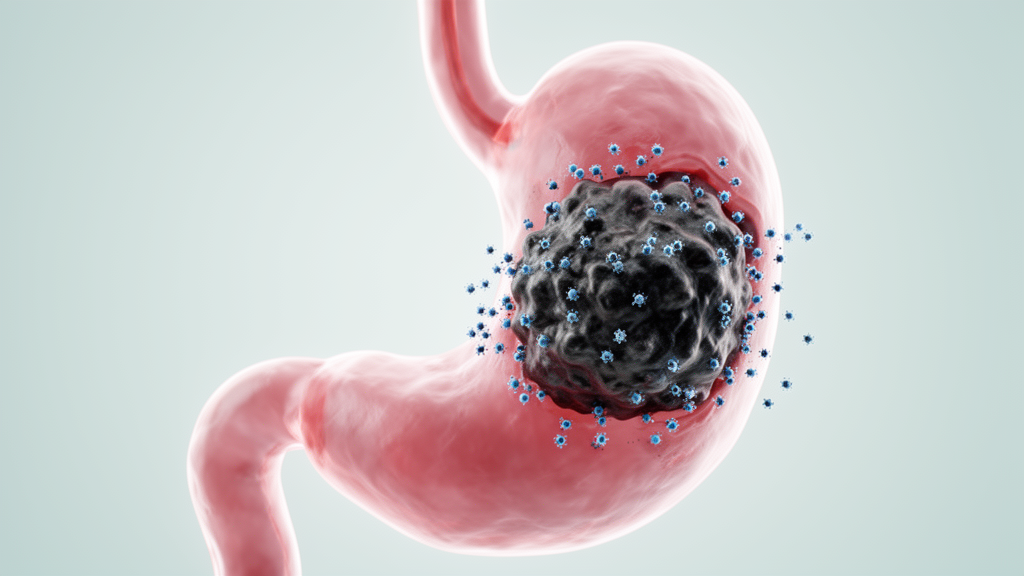
The abstract of a retrospective single-center study reports that early tumor shrinkage (ETS) during first-line immune checkpoint inhibitor–based chemotherapy was associated with longer subsequent progression-free survival in patients with measurable unresectable advanced gastric or gastroesophageal junction adenocarcinoma. The analysis included 162 previously untreated patients who received first-line therapy between November 2021 and July 2025; 90 patients with measurable disease formed the ETS cohort.
ETS was defined as a reduction of at least 20% in the sum of target-lesion diameters at the first radiological assessment, evaluated under RECIST version 1.1. Among the 90 patients in the ETS cohort, 70, or 77.8%, experienced ETS. Best overall response was complete response in 11 patients (12.2%), partial response in 75 (83.3%), stable disease in two (2.2%) and progressive disease in two (2.2%), producing an objective response rate of 95.6%.
Because ETS was assessed after baseline, survival analyses used a fixed Day-90 landmark. At that landmark, ETS-positive patients had longer overall survival than ETS-negative patients, with a hazard ratio of 0.369 (95% confidence interval 0.181–0.752; p=0.006). They also had longer progression-free survival, with a hazard ratio of 0.395 (95% confidence interval 0.206–0.755; p=0.005). In the primary multivariable progression-free survival model, which included 84 patients and 51 events, ETS remained associated with favorable progression-free survival (hazard ratio 0.382, 95% confidence interval 0.197–0.740; p=0.004). A separate continuous analysis found a consistent association between the magnitude of tumor reduction and progression-free survival: the hazard ratio was 0.876 per 10-percentage-point greater reduction (95% confidence interval 0.777–0.987; p=0.030).
The findings indicate that ETS may be an on-treatment marker associated with early treatment sensitivity in this population, but the study does not establish clinical utility. Its retrospective, single-center design limits the strength and generalizability of the results, and the investigators stated that external validation is required. The reported associations also do not demonstrate that ETS causes longer survival. The available published abstract does not provide the full protocol, detailed model specification or other analyses needed for a complete assessment of the study.
Subject of Research: Association between early tumor shrinkage and progression-free survival during first-line immune checkpoint inhibitor–based chemotherapy in measurable advanced gastric or gastroesophageal junction cancer
Article Title: Early tumor shrinkage during first-line immune checkpoint inhibitor–based chemotherapy is associated with progression-free survival in measurable unresectable gastric cancer
Article References: Ushimaru, Y., Yamamoto, K., Omori, T., Kudo, T., Sakai, D., Yanagimoto, Y., Kawabata, R., Masuike, Y., Yamamoto, K., Fujikawa, K., Adachi, K., Matsuura, N., Momose, K., Kanemura, T., Sakano, Y., Kobayashi, Y., Kitakaze, M., Yokota, Y., Kubo, M., … Miyata, H. (2026). Early tumor shrinkage during first-line immune checkpoint inhibitor–based chemotherapy is associated with progression-free survival in measurable unresectable gastric cancer. BMC Cancer. https://doi.org/10.1186/s12885-026-17003-0
Image Credits: AI Generated
DOI: 10.1186/s12885-026-17003-0
Keywords: early tumor shrinkage, advanced gastric cancer, gastroesophageal junction cancer, immune checkpoint inhibitors, first-line chemotherapy, progression-free survival, overall survival, retrospective cohort study, RECIST 1.1, survival analysis, Early, tumor
Cite Scienmag News
Nathaniel Bowman. (October 20, 2026). Early tumor shrinkage associated with longer progression-free survival in measurable advanced gastric or gastroesophageal junction cancer. Scienmag. https://scienmag.com/early-tumor-shrinkage-associated-with-longer-progression-free-survival-in-measurable-advanced-gastric-or-gastroesophageal-junction-cancer/
Nathaniel Bowman. "Early tumor shrinkage associated with longer progression-free survival in measurable advanced gastric or gastroesophageal junction cancer." Scienmag, 20 October 2026, https://scienmag.com/early-tumor-shrinkage-associated-with-longer-progression-free-survival-in-measurable-advanced-gastric-or-gastroesophageal-junction-cancer/. Accessed 20 October 2026.
Nathaniel Bowman. "Early tumor shrinkage associated with longer progression-free survival in measurable advanced gastric or gastroesophageal junction cancer." Scienmag. October 20, 2026. https://scienmag.com/early-tumor-shrinkage-associated-with-longer-progression-free-survival-in-measurable-advanced-gastric-or-gastroesophageal-junction-cancer/


