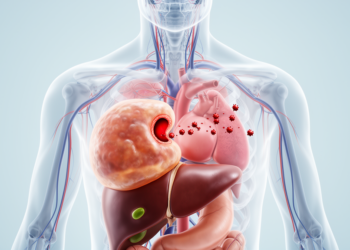
For patients with advanced renal cell carcinoma, the most common and lethal form of kidney cancer, treatment decisions have long been driven by scans and survival statistics. A new post hoc analysis of the landmark phase 3 CheckMate 9ER trial suggests that another source of information has been hiding in plain sight: the patients themselves. By linking patient-reported symptoms to clinical outcomes, researchers have shown that how patients feel in the first weeks of therapy may carry real prognostic weight, offering clinicians an early warning system that no imaging scan can replicate.
The underlying trial, CheckMate 9ER, compared first-line treatment with the combination of cabozantinib, an oral tyrosine kinase inhibitor that targets multiple pathways involved in tumor growth and blood vessel formation, against sunitinib, an older targeted therapy that had long been a standard of care. The combination of cabozantinib plus nivolumab, an immune checkpoint inhibitor that releases the brakes on T cells, had already demonstrated significant improvements in both progression-free survival and overall survival. What remained underexplored, however, was the relationship between those hard clinical endpoints and the day-to-day treatment experience of the patients receiving the drugs.
That gap is what the new modeling analysis, published in the journal Advances in Therapy, set out to close. Led by David Cella of the Robert H. Lurie Comprehensive Cancer Center at Northwestern University, together with an international team that included investigators from Memorial Sloan Kettering Cancer Center, Dana-Farber Cancer Institute, and institutions across Europe and South America, the researchers examined health-related quality-of-life data collected during the trial. Health-related quality of life, or HRQoL, encompasses the physical, emotional, and social dimensions of wellbeing that patients report through validated questionnaires, capturing dimensions of the disease experience that objective measures routinely miss.
The analytical approach was twofold. First, the team investigated whether early changes in patient-reported outcomes were statistically associated with subsequent clinical outcomes such as survival and disease progression. Second, they applied a statistical technique known as latent class analysis, or LCA, to the symptom data. Latent class analysis is a modeling method that sorts patients into unobserved subgroups based on patterns in their responses, rather than relying on pre-defined categories. In this case, the technique was used to identify symptom-based profiles at week 13 of treatment that might predict the later course of the disease.
The findings on individual symptoms were striking. Patients who experienced an early worsening of bone pain had a 45 percent higher risk of death compared with those who did not, corresponding to a hazard ratio of 1.45 with a p-value of 0.010, a result considered statistically significant. Early worsening of sleep quality carried an identical hazard ratio of 1.45, with an even stronger p-value of 0.007. Bone pain is a well-recognized burden in advanced renal cell carcinoma, where metastases frequently spread to the skeleton, but the finding that sleep disturbance independently tracks with mortality risk adds a new dimension to how clinicians might interpret what patients report in the clinic.
The latent class analysis identified three distinct patient profiles at week 13, differentiated by the burden and pattern of symptoms each group reported. Patients in the limited symptoms class, those reporting the mildest overall symptom burden, were more likely to have received the cabozantinib-nivolumab combination rather than sunitinib. They also had longer treatment durations and were generally less likely to experience disease progression than patients in the other symptom classes. In other words, the group that felt better was also the group whose disease was being controlled for longer, a convergence of subjective and objective outcomes that strengthens the case for monitoring patient-reported symptoms as part of routine care.
These results carry particular weight because they come from a randomized phase 3 trial rather than from observational cohorts, where symptom reporting can be confounded by differences in patient selection. CheckMate 9ER enrolled patients with previously untreated advanced renal cell carcinoma and randomized them between the two treatment strategies, allowing the analysis to compare symptom trajectories and outcomes within a controlled framework. The trial is registered as NCT03141177, and the original research article underpinning this summary was published in ESMO Open in November 2025.
The implications extend beyond prognosis. The authors argue that the analysis demonstrates a genuine link between early changes in patient-reported outcomes and treatment efficacy, underscoring the importance of balancing efficacy, tolerability, and quality of life when selecting first-line therapy. For clinicians, a patient who reports worsening bone pain or deteriorating sleep in the first months of treatment may warrant closer monitoring, earlier imaging, or a reconsideration of the therapeutic plan. For patients, the findings support shared decision-making, giving their own experiences a quantified role in conversations about which regimen to choose and when to adjust it.
There are also broader lessons for oncology drug development. Patient-reported outcomes have often been treated as secondary endpoints, useful for labeling claims but rarely integrated into models of clinical benefit. This analysis shows that symptom trajectories can be modeled formally, that subgroups defined by those trajectories differ in clinically meaningful ways, and that the choice of regimen shapes those trajectories from the outset. The finding that patients on the immune checkpoint inhibitor combination were more likely to land in the limited symptoms class suggests that tolerability differences between targeted therapy alone and combination immunotherapy may be larger and more consequential than traditional toxicity grading captures.
Caveats remain, as they do with any post hoc analysis. The symptom classes were identified from data collected for other purposes, and the associations between early symptoms and survival, while statistically robust, do not prove that symptoms directly influence disease course. It is possible that early symptom worsening is a marker of underlying biology, such as more aggressive or symptomatic metastatic disease, rather than a driver of outcomes in its own right. Prospective studies would be needed to test whether actively managing symptoms such as bone pain and sleep disturbance can change the trajectory of survival. Still, the work marks a step toward a more patient-centered oncology, one in which the voice of the patient is not an afterthought to the scan but a validated signal in its own right. For a disease that affects hundreds of thousands of people worldwide each year, that shift could reshape how first-line therapy is chosen, monitored, and discussed at the bedside.
Subject of Research: Health-related quality of life and clinical outcomes in first-line advanced renal cell carcinoma based on the CheckMate 9ER trial
Article Title: Summary of Research: Health-Related Quality-of-Life Profile and Clinical Outcomes in First-Line Advanced Renal Cell Carcinoma: A Modeling Analysis Based on the CheckMate 9ER Study
Article References: Cella, D., Derosa, M., Floden, L., Giles, R. H., Lothgren, M., Ogareva, A., Powles, T., Purnajo, I., Choueiri, T. K., Bergerot, C., Motzer, R. J., & Bedke, J. (2026). Summary of Research: Health-Related Quality-of-Life Profile and Clinical Outcomes in First-Line Advanced Renal Cell Carcinoma: A Modeling Analysis Based on the CheckMate 9ER Study. Advances in Therapy. https://doi.org/10.1007/s12325-026-03780-4
Image Credits: AI Generated
DOI: 10.1007/s12325-026-03780-4
Keywords: advanced renal cell carcinoma, CheckMate 9ER, cabozantinib, nivolumab, sunitinib, health-related quality of life, patient-reported outcomes, latent class analysis, progression-free survival, overall survival, bone pain, immunotherapy
Cite Scienmag News
Nathaniel Bowman. (October 8, 2026). Early Symptoms May Predict Survival in Advanced Kidney Cancer, CheckMate 9ER Analysis Shows. Scienmag. https://scienmag.com/early-symptoms-may-predict-survival-in-advanced-kidney-cancer-checkmate-9er-analysis-shows/
Nathaniel Bowman. "Early Symptoms May Predict Survival in Advanced Kidney Cancer, CheckMate 9ER Analysis Shows." Scienmag, 8 October 2026, https://scienmag.com/early-symptoms-may-predict-survival-in-advanced-kidney-cancer-checkmate-9er-analysis-shows/. Accessed 8 October 2026.
Nathaniel Bowman. "Early Symptoms May Predict Survival in Advanced Kidney Cancer, CheckMate 9ER Analysis Shows." Scienmag. October 8, 2026. https://scienmag.com/early-symptoms-may-predict-survival-in-advanced-kidney-cancer-checkmate-9er-analysis-shows/