


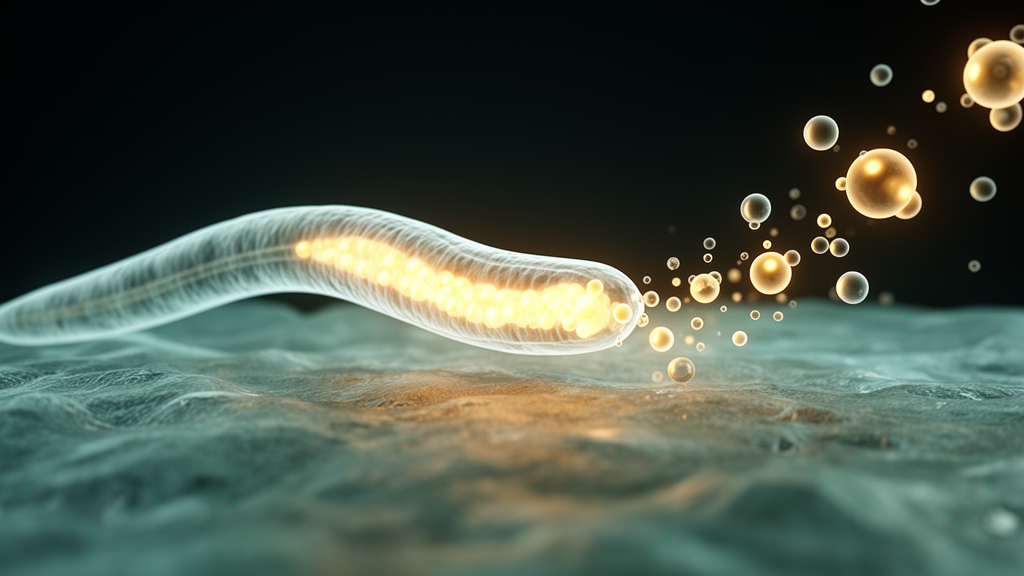
In the quiet corners of microbiology laboratories, a translucent roundworm barely a millimeter long has once again delivered a lesson that resonates far beyond its miniature nervous system. Researchers studying Caenorhabditis elegans have uncovered a molecular circuit that ties the fat metabolism of the gut directly to both the worm’s immune chemistry and its behavior, revealing how a single nuclear hormone receptor helps an animal decide, in effect, whether to fight a pathogen with its cells or simply walk away from it. The work, published in PLOS Biology by Jie Ren, Yu Sang, Young-Mo Kim, Ernesto S. Nakayasu, and Alejandro Aballay, describes a gut-to-brain signaling axis built on linoleic acid, an essential polyunsaturated fatty acid that animals cannot make from scratch and must carefully manage through diet and metabolism.
The central character in this story is NHR-68, a nuclear hormone receptor in the worm that belongs to a family of transcription factors with close evolutionary cousins throughout the animal kingdom, including humans. Nuclear hormone receptors are molecular sensors that bind small lipid-like molecules and then switch entire suites of genes on or off. Because they sit at the junction of metabolism and gene regulation, they are ideally positioned to answer one of the most fundamental questions in immunology: when an animal’s energy reserves are limited, how does the body decide how much to invest in defense? The new study shows that NHR-68 is one of the answers, acting in parallel with a related receptor called NHR-10 to control genes involved in polyunsaturated fatty acid metabolism inside the intestine.
What makes the finding striking is the dual output of this single regulatory node. When the researchers removed NHR-68 from the worms, the animals lost their ability to maintain proper levels of linoleic acid, and that metabolic disruption had a surprising consequence: the worms became impaired in their pathogen avoidance behavior. In laboratory assays, healthy C. elegans can sense dangerous bacteria and move away from them, a learned and innate behavioral defense that complements the molecular weapons deployed by their cells. Worms lacking NHR-68 were worse at this evasion, suggesting that the fat chemistry of the gut is somehow whispering instructions to the nervous system about which microbes to avoid.
The team then tested this idea from several directions, and the results converged on the same conclusion. When they supplemented the worms’ diet with linoleic acid, the avoidance behavior was restored, indicating that the fatty acid itself is a sufficient driver of the behavior. Even more telling were the genetic experiments targeting the worm’s fat synthesis machinery. Inhibiting fat-3, a gene required for desaturating fatty acids in a way that elevates linoleic acid levels, enhanced the worms’ pathogen avoidance. Conversely, blocking fat-2, which sits upstream in the pathway and is required to synthesize linoleic acid in the first place, diminished the behavior. In other words, the more linoleic acid available, the better the worm avoided danger; the less available, the worse it performed. This dose-like relationship between a dietary lipid and a survival behavior is exactly the kind of clean causal chain that experimental biologists dream of finding.
Localization experiments added another crucial layer. NHR-68, the researchers showed, acts specifically in the intestine, the organ that in C. elegans serves as both the primary metabolic hub and a major immune tissue. From this intestinal vantage point, changes in lipid metabolism influence a neural circuit that depends on AWC, a pair of olfactory sensory neurons well known to worm neurobiologists for their role in detecting volatile cues. The implication is that the gut and the brain are in constant metabolic conversation, and that the content of that conversation, carried at least in part by fatty acid signals, shapes how the animal perceives and responds to threats in its environment. This is a form of intestine-to-neuron communication that transforms a metabolic state into a behavioral decision.
But the story does not end with behavior. NHR-68 also turned out to be a brake on the worm’s classical molecular immune responses. The receptor suppresses the activation of two major defense pathways: PMK-1, a p38 MAPK signaling cascade that orchestrates transcriptional responses to infection, and DAF-16, the worm’s FOXO transcription factor that governs stress resistance and longevity. These pathways are the heavy artillery of invertebrate immunity, driving the expression of antimicrobial genes and other protective programs. By holding them in check, NHR-68 appears to enforce a balance, preventing the energetically expensive molecular defense machinery from running at full throttle when behavioral avoidance, a cheaper strategy, might suffice.
This trade-off logic is at the heart of what immunologists call defense allocation. Mounting a molecular immune response costs energy: it requires transcription, translation, and cellular remodeling, all of which draw on the same finite pools of nutrients and metabolic capacity that the animal needs for growth, reproduction, and maintenance. Fleeing a pathogen, by contrast, is comparatively cheap. The new findings suggest that the worm’s physiology has evolved a mechanism to weigh these options, using intestinal lipid status as the currency of the decision. When linoleic acid homeostasis is intact and NHR-68 is active, the animal invests in avoidance behavior while keeping molecular defenses moderated. When the system is perturbed, the balance shifts, and the consequences ripple through both the immune system and the nervous system simultaneously.
The evolutionary implications are considerable. Nuclear hormone receptors, p38 MAPK pathways, and FOXO transcription factors are all conserved across the animal tree, and linoleic acid is an essential fatty acid for humans as well as worms. While no one should assume that the exact circuit operates unchanged in mammals, the study provides a proof of principle that gut lipid metabolism can be wired directly into neural threat-detection circuits and immune regulation through a defined transcriptional mechanism. It adds momentum to a growing body of research on the gut-brain axis, a field that has largely focused on neural signals, hormones, and microbial metabolites but is now revealing that the lipid composition of the intestine itself may carry instructive information to the nervous system.
There are also practical horizons. If lipid metabolism influences pathogen avoidance and immune tuning in a genetically tractable animal, then similar metabolic levers might exist in other species, raising questions about how diet, fatty acid supplementation, and metabolic disease shape infection risk and behavioral responses to contaminated environments. The finding that elevating linoleic acid enhances avoidance, while blocking its synthesis diminishes it, points to specific enzymatic nodes, such as the fat-2 and fat-3 desaturases, whose activity levels could in principle tune an animal’s defensive posture. Whether pharmacological or dietary manipulation of these nodes could influence immunity in more complex organisms remains an open question, but the worm data provide a concrete molecular starting point for such investigations.
For now, the study stands as an elegant demonstration that immunity is not a single system but a coordinated portfolio of strategies, and that the coordination is written into the metabolism of the gut. A tiny worm, sensing a patch of dangerous bacteria, makes its escape decision with the help of a fatty acid whose levels are set by a nuclear receptor in its intestine, and that same receptor quietly arbitrates how aggressively the animal’s cells will fight if avoidance fails. It is a vivid reminder, delivered by one of biology’s most reliable model organisms, that the line between metabolism, behavior, and immunity is far thinner than textbooks once suggested, and that understanding host defense requires following the fat.
Subject of Research: Intestinal lipid metabolism and gut-brain signaling in the control of behavioral and molecular immunity in C. elegans
Article Title: Intestinal lipid metabolism controls molecular and behavioral immunity through NHR-68 and gut–brain signaling in Caenorhabditis elegans
Article References: Ren, J., Sang, Y., Kim, Y.-M., Nakayasu, E. S., & Aballay, A. (2026). Intestinal lipid metabolism controls molecular and behavioral immunity through NHR-68 and gut–brain signaling in Caenorhabditis elegans. PLOS Biology, 24(9), e3004026. https://doi.org/10.1371/journal.pbio.3004026
Image Credits: AI Generated
DOI: 10.1371/journal.pbio.3004026
Keywords: Caenorhabditis elegans, NHR-68, linoleic acid, gut-brain axis, pathogen avoidance, innate immunity, nuclear hormone receptor, PMK-1 p38 MAPK, DAF-16 FOXO, polyunsaturated fatty acids, intestinal metabolism, PLOS Biology
Cite Scienmag News
Kristina Jarvis. (October 8, 2026). Gut Fat Molecules Steer a Worm’s Immune Defenses and Its Urge to Flee Pathogens. Scienmag. https://scienmag.com/gut-fat-molecules-steer-a-worms-immune-defenses-and-its-urge-to-flee-pathogens/
Kristina Jarvis. "Gut Fat Molecules Steer a Worm’s Immune Defenses and Its Urge to Flee Pathogens." Scienmag, 8 October 2026, https://scienmag.com/gut-fat-molecules-steer-a-worms-immune-defenses-and-its-urge-to-flee-pathogens/. Accessed 8 October 2026.
Kristina Jarvis. "Gut Fat Molecules Steer a Worm’s Immune Defenses and Its Urge to Flee Pathogens." Scienmag. October 8, 2026. https://scienmag.com/gut-fat-molecules-steer-a-worms-immune-defenses-and-its-urge-to-flee-pathogens/


