Deep in the crowns of two coexisting Mediterranean oaks, a quiet annual race unfolds between making new organs and extending the shoots that carry them. A long-term study published in Web Ecology has now traced that race in unprecedented detail, combining four years of phenological observations with a painstaking, year-long dissection of apical buds in the evergreen Quercus ilex subsp. ballota and the deciduous Quercus faginea. The work, led by Gabriel Montserrat-Martí of the Instituto Pirenaico de Ecología (CSIC) together with Andreu Cera and John G. Hodgson, offers the first integrated analysis of phenology, pheno-morphology and organogenesis in oaks with contrasting leaf habits, and it delivers a mechanistic explanation for one of the most striking patterns in forest ecology: the boom-and-bust rhythm of growth and reproduction that follows mast years.
The research was conducted near Agüero in the province of Huesca, northeastern Spain, on a south-facing slope at 750 metres elevation under a continental Mediterranean climate. This is a world of two favourable seasons and two hostile ones: spring and autumn bring the moisture that fuels growth, while winter frost and summer drought impose hard limits on what a tree can do and when. The study plot, an 800 by 100 metre stretch of open scrub and scattered trees on a Calcisol formed over Miocene clays, held more than 60 adult trees of each oak species, evenly distributed and showing no sign of habitat segregation. That coexistence is precisely what makes the site scientifically valuable, because it allows the two species to be compared under identical conditions.
The team’s phenological work rested on a long-term research programme running from 1997 to 2010. For the new analysis, 15 individuals of each species were followed from 2006 to 2009, with monthly sampling that intensified to every two or three weeks in spring. Observers estimated the percentage of each crown displaying 14 carefully defined phenophases, from winter dormancy and bud burst through shoot growth, bud formation, flowering, fruit development and leaf senescence. Branch samples were preserved in a pheno-morphological herbarium, creating a verifiable historical record. The result was a detailed seasonal calendar for each species, showing when every visible stage of the annual cycle begins, peaks and ends.
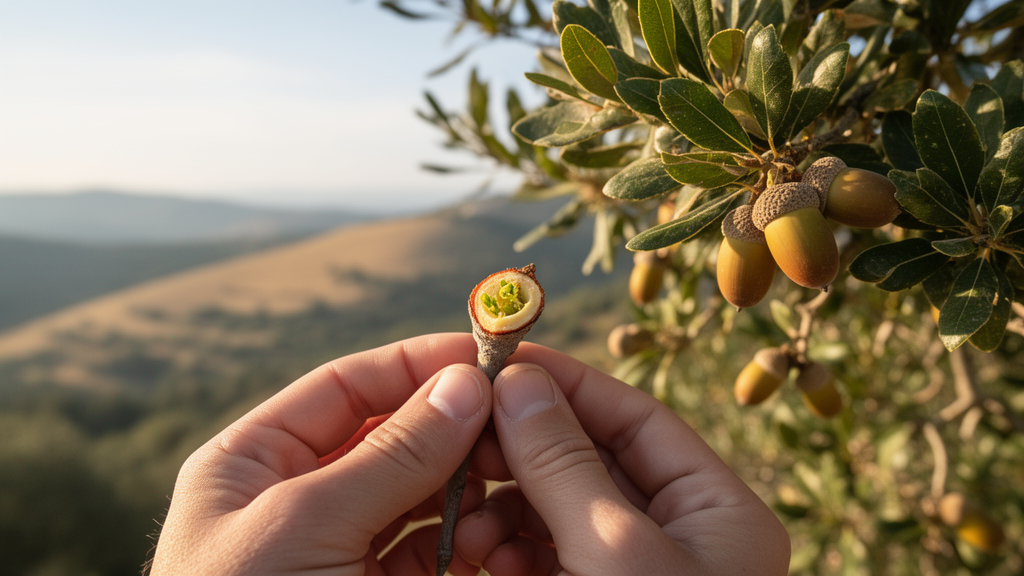
The organogenetic component demanded even greater patience. Because leaf units are packed densely inside tiny buds, complete dissection of even a single bud is extraordinarily laborious. The researchers therefore limited this part of the study to a single year, 2007, and two replicate trees per species, selecting fruit-bearing individuals so that reproductive structures would be represented. Across the year they fully dissected 123 buds of Q. faginea and 111 of Q. ilex down to the apical meristem, measuring every component under a stereomicroscope at 10 to 100 times magnification: scales, cataphylls, leaf primordia, stipules, axillary buds, hypsophylls and the primordia of male and female inflorescences.
What emerged from the dissections was a picture of remarkable preformation. Organogenesis in both species began in early spring, around the time of bud swelling in the deciduous oak and bud burst in the evergreen, and finished by mid-September, with bud development complete by November. By late summer, each winter bud contained the entire embryonic shoot for the following year, including axillary buds and fully preformed male inflorescences. Female inflorescence meristems, by contrast, were initiated surprisingly early but remained minimally developed, persisting as simple axillary meristems through winter and resuming growth only when the bud swelled in late winter, with flower initiation following in the bract axils and continuing until anthesis.
The two species ran strikingly similar programmes on slightly different clocks. Q. faginea burst its buds between mid-March and early April, roughly a month before Q. ilex, whose cycle began between mid-April and early May. In both species, most phenophases peaked in spring, and phenology and organogenesis proved tightly synchronised, advancing in parallel through the year. The deciduous oak produced larger buds with more nodes, while the evergreen packed in more leaf primordia despite smaller buds. A key anatomical difference emerged in the position of female flowers: Q. ilex placed them in the axils of mid to distal leaves, most often between the fourth and seventh leaves below the hypsophyll, whereas Q. faginea placed them more distally, typically in the three outermost leaves. That positional difference, the authors found, explains why the evergreen initiated its female inflorescences almost 15 days earlier than the deciduous species, despite starting organogenesis later.
This timing matters because the Mediterranean summer forces hard choices. Plant growth proceeds in two phases: slow, temperature-sensitive cell division, followed by potentially rapid cell expansion that can swell cell volumes ten- to twenty-fold. When shoot extension, fruit development and bud organogenesis all demand resources at once, something must give. The study’s first hypothesis, that organogenesis and shoot extension compete when they overlap, was supported. The evergreen oak, with its later bud burst and slower leaf maturation extending into September, finds its window for bud development compressed precisely when shoot growth is most vigorous. The deciduous oak, by finishing shoot extension early, enjoys a longer, less contested window. This, the authors argue, explains the alternating years of high and low shoot production observed in Q. ilex but not in Q. faginea: big shoot years leave less room for bud development, producing smaller buds and reduced growth the following year.
The second hypothesis fared less well, and the surprise it produced may be the study’s most consequential finding. The team had expected female inflorescence initiation to coincide with peak bud development and the onset of maximum fruit growth, providing a direct mechanism for the post-mast crash in flowering. Instead, initiation in both species preceded peak fruit development, and the evergreen started earliest of all. The authors propose a refined mechanism: in mast years, fruit development begins earlier than usual, with peduncles of pollinated flowers accelerating from May onwards, so that advanced fruit growth overlaps with the initiation of inflorescence meristems and the formation of new buds. In ordinary years this overlap never occurs, which is why normal fruit crops leave bud development largely unscathed, while mast years exact a heavy toll, yielding smaller buds and reduced flowering the following season. Supporting evidence comes from earlier work showing significantly reduced bud size in Q. ilex after an exceptionally abundant mast event, and from fruit-removal experiments in which mid-June defruiting shifted allocation toward leaves and female inflorescences.
The study also illuminates how these oaks survive the dry season at all. Summer-active meristems are shielded by bud scales, by scaly cupules around immature acorns, or by bark, while fine roots tap subsoil moisture. Unprotected organs, such as the lammas shoots that occasionally appear on 5 to 10 percent of branches, and occasionally far more in wet years, remain the exception. Buds, the authors note, behave as lower-priority sinks than shoots and developing fruits, succeeding only when water is ample or competition is low. Their completion also depends on early secondary growth that widens xylem vessels and sustains hydraulic conductivity before summer deficits bite.
For a biodiversity hotspot facing intensifying drought, the implications are sober. The deciduous oak’s early start extends its growing season and carbon assimilation, but a late frost or an excessively long, dry summer can wreck bud development and cascade into reduced shoot production, flowering and fruiting the next year. The evergreen, holding three cohorts of leaves and able to lengthen leaf longevity under drought, enjoys more flexibility. Ultimately, the authors conclude, the capacity of these oaks to persist and respond to climate change will hinge on their ability to synchronise phenological patterns with seasonal conditions and to maintain adequate summer growth, a balance now visible, node by node, inside the buds themselves.
Subject of Research: Bud organogenesis and phenology of coexisting evergreen and deciduous Mediterranean oak species
Article Title: An integrated study of bud development and phenology enhances our understanding of coexistence and reproduction in two Mediterranean Quercus species
Article References: Montserrat-Martí, G., Cera, A., & Hodgson, J. G. (2026). An integrated study of bud development and phenology enhances our understanding of coexistence and reproduction in two Mediterranean Quercus species. Web Ecology, 26(2), 203-221. https://doi.org/10.5194/we-26-203-2026
Image Credits: AI Generated
Keywords: Quercus ilex, Quercus faginea, phenology, organogenesis, bud development, masting, Mediterranean climate, oak reproduction, resource competition, drought, shoot growth, Web Ecology
Cite Scienmag News
Drew Townsend. (October 8, 2026). Inside the buds: how Mediterranean oaks time growth, flowers and mast years. Scienmag. https://scienmag.com/inside-the-buds-how-mediterranean-oaks-time-growth-flowers-and-mast-years/
Drew Townsend. "Inside the buds: how Mediterranean oaks time growth, flowers and mast years." Scienmag, 8 October 2026, https://scienmag.com/inside-the-buds-how-mediterranean-oaks-time-growth-flowers-and-mast-years/. Accessed 8 October 2026.
Drew Townsend. "Inside the buds: how Mediterranean oaks time growth, flowers and mast years." Scienmag. October 8, 2026. https://scienmag.com/inside-the-buds-how-mediterranean-oaks-time-growth-flowers-and-mast-years/