

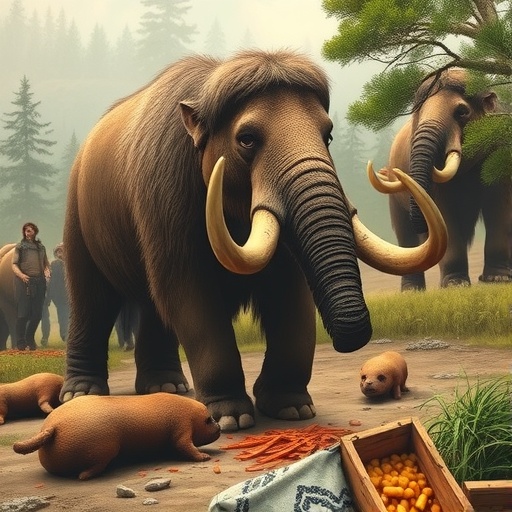
A new continent-scale analysis of ancient diets is challenging decades of assumptions about the first Americans. Far from being flexible foragers who lived off a broad mix of plants and small game, the earliest inhabitants of North and South America were, it seems, hyper-specialized hunters of mammoths, giant ground sloths, and other enormous herbivores. The research, published in Science Advances, weaves together archaeological evidence from Alaska to Patagonia to argue that for thousands of years, megafauna made up over 98 percent of these people’s caloric intake—a strategy that allowed them to sweep rapidly across two continents but may have ultimately driven their primary prey to extinction.
The work, led by Ben Potter of the University of Alaska-Fairbanks and involving University of Wyoming archaeologists Todd Surovell and Robert Kelly, is the latest salvo in a long-running debate over the behaviors of Early Paleoindians. The team synthesized zooarchaeological records from three distinct cultural groups: the Eastern Beringians who inhabited the land bridge region between 14,000 and 13,300 years ago, the famed Clovis people of North America (13,400–12,800 years ago), and the Fishtail projectile point makers of South America (12,900–11,600 years ago). Across all these sites—including the La Prele Mammoth site in Wyoming, where a Columbian mammoth was butchered nearly 13,000 years ago—the pattern was strikingly uniform. Human diets were dominated by large-bodied, fat-rich prey such as woolly mammoths, mastodons, gomphotheres, camelids, and mylodont ground sloths.
The logic behind this specialization was starkly caloric. In the steppe-tundra ecosystems that connected Siberia to the Great Plains via the Bering land bridge and the Ice-Free Corridor, plant resources were scarce and unpredictable. A single adult mammoth, however, could provide thousands of kilograms of meat and, critically, fat. The researchers note that high-protein, fat-supplemented diets—effectively a Paleolithic ketogenic regimen—would have been physiologically sustainable, contradicting earlier claims that humans cannot thrive on meat alone. By targeting megaherbivores, early Americans minimized the energy they spent on hunting and processing. Broken bones are conspicuously rare at many kill sites, suggesting that hunters often abandoned carcasses before fully stripping them, simply because it was more efficient to kill another animal than to laboriously extract every gram of marrow.
This “megafauna specialist” hypothesis contradicts interpretations that paint early Paleoindians as dietary generalists. Some scholars have pointed to isolated finds of small animal bones or plant remains as evidence of a broad-spectrum diet. The new paper pushes back forcefully, arguing that such items were at best occasional, opportunistic snacks. The overwhelming isotopic and faunal signature screams megafauna. Moreover, the technology these people carried was not designed for rabbits or fish. Clovis points and Fishtail points are large, robust, and often fluted—engineering optimizations for penetrating thick hide and muscle when hurled from an atlatl. Experimental archaeology has shown that such weapons, especially in the hands of coordinated groups, could absolutely bring down a juvenile or even adult mammoth.
The geographic sweep of the evidence is particularly compelling. The researchers trace a continuous corridor of mammoth habitat from western Beringia in Siberia through Alaska and down the ice-free corridor into the American Midwest. As the first humans moved south, they encountered the closely related Columbian mammoth and simply transferred their hunting toolkit and knowledge. Where mammoths were absent, such as in parts of Central and South America, the hunters switched their focus to gomphotheres and giant ground sloths—animals that offered similarly massive energy returns for a thrust or cast. This unbroken ecological thread explains how humans could expand from the Arctic to the tip of South America in a few hundred years without needing to master wildly different survival skills at each step.
The implications for the Pleistocene extinction debate are unavoidable. Between 13,000 and 11,000 years ago, dozens of genera of large mammals vanished from the Americas. The timing aligns eerily with human arrival, and the new data reinforce that early humans were not merely scavenging the occasional carcass but systematically harvesting these animals at rates that left minimal buffer against environmental stress. The researchers stop short of calling it a “blitzkrieg” but conclude that overhunting was the primary driver. Only after the megafauna collapsed did human diets radically diversify, with later groups turning to bison, waterfowl, fish, shellfish, and plants—the classic broad-spectrum adaptation visible in the archaeological record of the ensuing Archaic period.
But the paper also opens new questions. If the first Americans were such obligate megafauna specialists, what does that say about their social organization? Coordinated hunts of giant sloths or mammoths imply language, planning, and possibly large kin-groups. The team speculates that high residential mobility—constantly tracking the movements of herds—kept population densities low and cultural artifacts relatively uniform across vast distances, explaining the continent-wide similarities in spear points. As the megafauna waned, regionalization exploded, and the archaeological record became a mosaic of local innovations. The study, by tying together sites across the entire Western Hemisphere with a unified quantitative framework, offers a powerful new lens on one of the great human dramas: the peopling of the Americas and the staggering ecological transformation that followed in their footsteps.
Subject of Research: People (Early Paleoindian diet and megafauna specialization)
Article Title: Hemisphere-wide evidence of Early Paleoindian megaherbivore specialization
News Publication Date: 1-Jul-2026
Web References: https://www.science.org/doi/10.1126/sciadv.aef9628
References: Potter, B. et al. Hemisphere-wide evidence of Early Paleoindian megaherbivore specialization. Science Advances (2026).
Image Credits: Not provided
Keywords: Paleoindian, megafauna, Clovis, mammoth, ground sloth, Beringia, Pleistocene extinction, zooarchaeology, subsistence specialization, early Americans


