


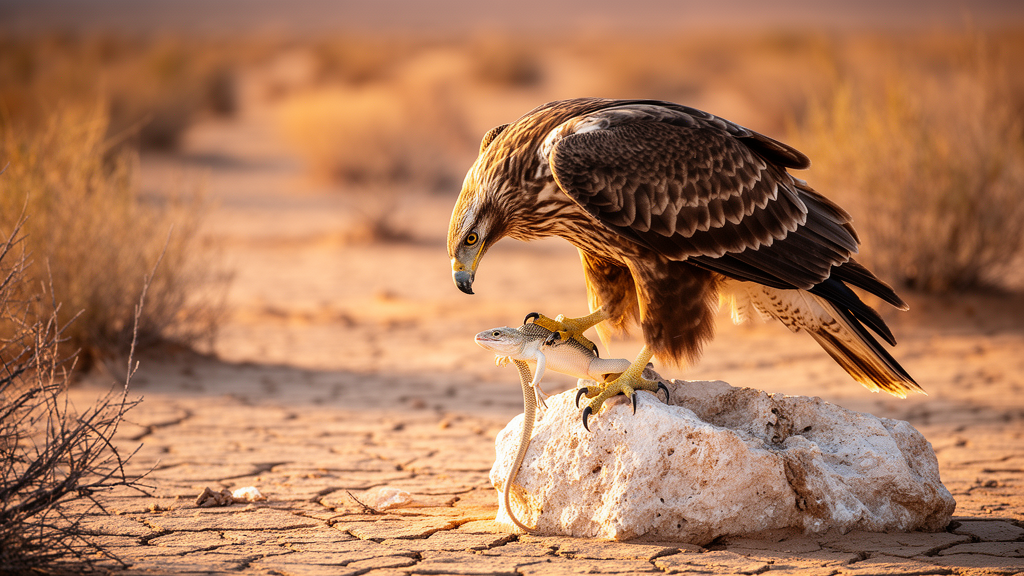
In the sun-scorched scrublands of the Thar Desert in western Rajasthan, India, a camouflaged camera perched beside an eagle’s nest has exposed a hidden truth about one of agriculture’s most valued allies. The short-toed snake eagle (Circaetus gallicus), a raptor celebrated for generations as a fearless destroyer of venomous serpents, turns out to be only half the specialist its reputation suggests. A new study, published in Frontiers in Bird Science, combined autonomous nest camera monitoring with a structured survey of 87 local residents to reveal a striking mismatch between what this raptor actually eats and what the people who live alongside it believe it eats. The findings carry urgent implications for the survival of the eagle in a landscape rapidly being transformed by industrial development.
The research team, led by conservationist Radheshyam Bishnoi of Pokhran alongside Govind Tiwari and Randeep Singh, focused their work on a 3,558-square-kilometer landscape centered on the Dholiya Oran region of Pokhran tehsil in Jaisalmer district. Orans are sacred community-conserved pastoral forests governed by ancestral spiritual mandates that strictly prohibit the cutting of green timber. These groves, dominated by deep-rooted legacy trees such as Khejri (Prosopis cineraria) and Kumath (Acacia senegal), form conspicuous arboreal islands within an otherwise tree-scarce desert. It is precisely within these protected canopies that the short-toed snake eagle builds its nesting platform, while its reptilian prey roams the contiguous open scrublands and agricultural fields. The result is a tightly integrated human-wildlife interface where breeding raptors and agropastoralists share the same limited space.
To establish an empirical dietary baseline, the researchers deployed high-resolution weather-proof camera traps equipped with passive infrared motion sensors and invisible infrared flash arrays at an active nest site on a legacy tree. Mounted on an adjacent branch roughly one to one-and-a-half meters from the nest platform, the camera operated continuously on a 24-hour cycle, capturing bursts of three still images followed by a 10-second video sequence whenever motion was detected. The intensive dietary analysis was deliberately constrained to a standardized three-month window corresponding to the peak chick-provisioning phase, spanning from egg-hatching to fledging, when parental food demand reaches its maximum and every delivery reveals the pair’s hunting priorities.
The camera data yielded 62 verified prey delivery events, and their taxonomic composition delivered the study’s most consequential surprise. The diet split exactly evenly between the two major reptile clades: 31 deliveries of snakes, order Ophidia, and 31 of large desert lizards, order Lacertilia. Among the snakes, the most remarkable find was the Saw-scaled Viper (Echis carinatus), a cryptically colored and highly venomous species of serious medical concern, which alone accounted for 16.1 percent of all recorded prey, or 32.3 percent of the total snake intake. The remaining ophidian prey comprised the mildly venomous Afro-Asian Sand Snake (Psammophis lineolatus), the non-venomous Glossy-bellied Racer (Platyceps ventromaculatus), and unidentified colubrid fragments.
The lizard half of the diet, however, tells a story of ecological dependency that no local tradition had recorded. Bengal monitor lizards (Varanus bengalensis) made up the single largest prey category at 22.6 percent of deliveries, followed by the Indian Fringe-toed Lizard (Acanthodactylus cantoris), a sand dune specialist, at 19.4 percent, and the Indian Spiny-tailed Lizard (Saara hardwickii) at 8.1 percent. These are not incidental snacks but large-bodied prey that define the energetic budget of chick rearing. Monitors and spiny-tailed lizards require open native scrublands to persist, and fringe-toed lizards are highly sensitive to the fencing that accompanies solar grid installations. Half of the eagle’s breeding fuel, in other words, comes from precisely the habitat type most vulnerable to elimination in the race for desert development.
While the cameras documented biological reality, the survey quantified what the community knows, and the contrast proved statistically dramatic. Baseline perceptions of the eagle were overwhelmingly positive. Respondents returned a median Likert score of 4.0 out of 5 for the cultural value of the eagle, agreeing strongly that its presence is an auspicious sign, and equally strong support for protecting the raptor regardless of tangible benefits. A composite ‘Snake Control Awareness’ index, aggregating statements about the eagle keeping agricultural fields safe, reducing fear of venomous snakes, and preventing pest population explosions, reached a median of 3.67, confirming that locals acutely recognize the bird as a guardian of the fields.
But when presented with the statement ‘I have observed the eagle hunting not only snakes, but also desert lizards and monitor lizards,’ responses collapsed to a median of 1.0 on the five-point awareness scale. Fully 52.9 percent of respondents, 46 of the 87 surveyed, scored at the absolute minimum, indicating complete unawareness. A paired Wilcoxon Signed-Rank Test comparing the snake-control composite against lizard awareness confirmed the difference as highly systematic rather than random, with p < 0.001 and an effect size of r = 0.57, indicating a very strong cognitive gap. The researchers call it the ‘lizard blindspot’: the community reveres the eagle for killing snakes but has no idea that lizards sustain half of the raptor’s reproductive energy budget.
Remarkably, the blindspot cuts across every demographic divide the team tested. Whether respondents were traditional pastoralists who trail livestock through the open scrub or agriculturalists managing static crop fields, lizard awareness sat flat at the minimum score, with no statistically significant difference between the livelihood groups. Nor did the gap follow generational lines: young adults aged 18 to 35, mid-career adults, and village elders all returned identical median lizard-awareness scores of 1.0, and a Kruskal-Wallis test found no significant variance. Even the Traditional Ecological Knowledge index, measuring deeper natural history literacy about nesting cycles, prey identification, and chick-feeding behavior, was structurally preserved across generations, showing that the community’s environmental lore is intact; it simply never incorporated the eagle’s lacertilian dependency.
This cognitive gap introduces a real conservation vulnerability. In state land records, the open uncultivated scrublands that sustain Bengal monitors, fringe-toed lizards, and spiny-tailed lizards are routinely misclassified as ‘wastelands,’ and western Rajasthan is undergoing rapid conversion of these areas into intensive irrigated agriculture, linear infrastructure, and massive renewable energy grids of overhead high-voltage transmission lines, wind farms, and solar installations. Because locals value the eagle for snake control and associate it with the sacred nesting groves, they offer little resistance when the surrounding hunting grounds are fenced and bulldozed, assuming that protecting the Oran canopy is sufficient. The authors warn the biological consequence bluntly: protecting nesting trees becomes obsolete if the surrounding landscape cannot provide the roughly 50 percent of caloric fuel required to rear chicks, and losing the lizards risks the regional collapse of the very avian snake-controllers the community culturally treasures.
The study’s remedy is as much cultural as ecological. The researchers propose an ‘agricultural ally’ conservation framework that integrates empirical nest camera evidence with the community’s existing spiritual ethos of Jeev-Daya, compassion for all living beings, which already anchors the Oran system. Their recommendation is tangible: bring high-definition nest camera footage of eagles delivering lizards to their chicks into village Gram Sabha council meetings, so that the abstract ecosystem service becomes a visible reality. When communities understand that the scrublands dismissed as disposable wastelands are the foraging engines sustaining their revered snake-controllers, the argument goes, they are far more likely to resist industrial fragmentation of these habitats. The authors note important limitations: the dietary data derive from 62 deliveries at a single nest during one provisioning window and cannot be confidently generalized to the regional population, and perception surveys carry inherent response-bias risks. Still, the study’s central message is clear: in the Thar Desert, saving an eagle means saving its lizard-rich, undervalued desert home, and the most powerful conservation tool may be a video shown on a village council’s screen.
Subject of Research: Dietary ecology and community perceptions of the short-toed snake eagle in the Thar Desert, India
Article Title: The eagle as an agricultural ally: quantifying the predation of medically significant snakes and public perception gaps in the Thar Desert
Article References: Bishnoi, R., Tiwari, G., & Singh, R. (2026). The eagle as an agricultural ally: quantifying the predation of medically significant snakes and public perception gaps in the Thar Desert. Frontiers in Bird Science, 5, Article 1897409. https://doi.org/10.3389/fbirs.2026.1897409
Image Credits: AI Generated
DOI: 10.3389/fbirs.2026.1897409
Keywords: short-toed snake eagle, Circaetus gallicus, Thar Desert, raptor conservation, herpetophagy, Saw-scaled Viper, desert lizards, traditional ecological knowledge, Oran sacred groves, ecosystem services, habitat fragmentation, human-wildlife coexistence
Cite Scienmag News
Margaret Porter. (October 15, 2026). Eagles That Hunt Venomous Snakes Secretly Rely on Desert Lizards, Study Finds. Scienmag. https://scienmag.com/eagles-that-hunt-venomous-snakes-secretly-rely-on-desert-lizards-study-finds/
Margaret Porter. "Eagles That Hunt Venomous Snakes Secretly Rely on Desert Lizards, Study Finds." Scienmag, 15 October 2026, https://scienmag.com/eagles-that-hunt-venomous-snakes-secretly-rely-on-desert-lizards-study-finds/. Accessed 15 October 2026.
Margaret Porter. "Eagles That Hunt Venomous Snakes Secretly Rely on Desert Lizards, Study Finds." Scienmag. October 15, 2026. https://scienmag.com/eagles-that-hunt-venomous-snakes-secretly-rely-on-desert-lizards-study-finds/


