


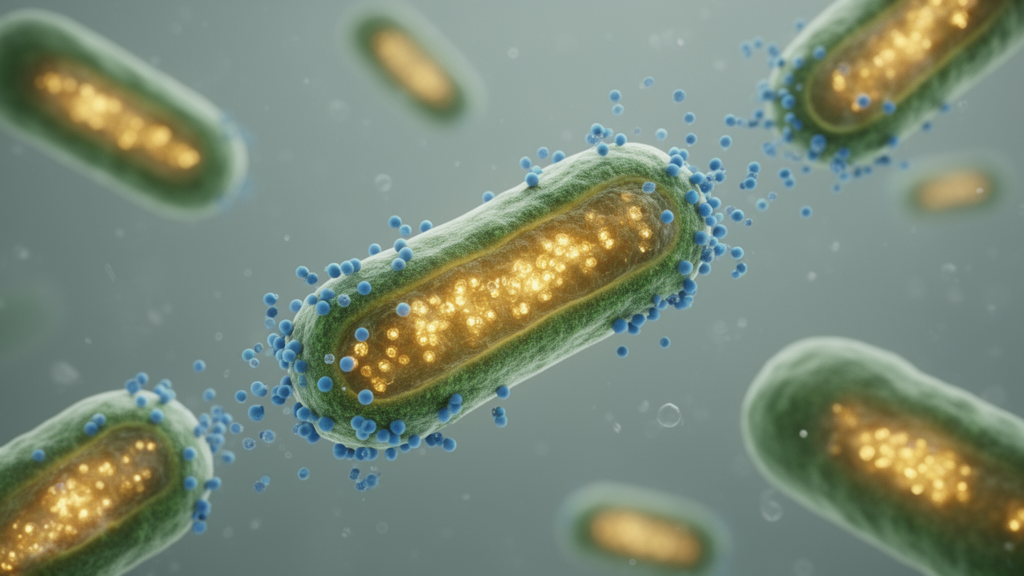
Octenidine, one of the most widely used antiseptics in hospitals and oral care products, has long been known to kill bacteria by wrecking their cell membranes. But a new study shows just how selective that destruction can be. Working with intact cells of purple photosynthetic bacteria, researcher Péter Maróti of the University of Szeged in Hungary has demonstrated that the compound leaves the bacteria’s most delicate light-driven machinery essentially untouched while devastating the membrane-level processes that keep the cellular energy economy running. The findings, published in Frontiers in Photobiology, offer an unusually clear dissection of where a clinically relevant biocide strikes inside a living, light-harvesting cell.
Purple non-sulfur bacteria are the classic model organisms for studying anoxygenic photosynthesis, the ancient form of light-energy conversion that does not split water or release oxygen. Their photosynthetic apparatus is housed in internal membranes packed with pigment-protein complexes. Light is captured by two antenna systems, the peripheral LH2 complex and the core LH1 complex that surrounds the reaction center, the pigment-protein engine where captured excitation energy is converted into a separated pair of electrical charges. That charge separation, moving an electron across the membrane in under a billionth of a second, initiates a cycle of electron and proton traffic that ultimately builds a proton motive force, the battery that powers the cell’s energy metabolism.
Octenidine dihydrochloride belongs to a family of dicationic amphiphiles, molecules carrying two positive charges and a long hydrophobic body. This architecture lets it do two things at once: anchor itself electrostatically to the negatively charged bacterial membrane surface and then wedge its hydrophobic portion into the lipid bilayer, disrupting lipid packing and membrane barrier function. Time-resolved small-angle X-ray scattering studies on model membranes have shown that octenidine strongly disrupts lipid hydrogen-bonding networks, effects that are particularly relevant in bacterial membranes where phosphatidylethanolamine and cardiolipin rely on such bonds for rigidity. Yet what happens to a photosynthetic membrane inside a whole, living bacterium had not been directly measured before.
Maróti combined two bacterial strains that differ in a crucial way: Rubrivivax gelatinosus, whose reaction centers carry a bound tetraheme cytochrome subunit and rely on periplasmic electron donors such as cytochrome c8 and HiPIP, and a cytochrome-less mutant of Rhodobacter sphaeroides, in which the donor side is effectively disabled. Using high-power blue and red laser diodes to trigger and monitor light-induced absorption changes, prompt fluorescence and millisecond delayed light, he followed every stage of the photosynthetic sequence, from the first charge separation to the accumulation of charge across the membrane, across octenidine concentrations spanning several orders of magnitude.
The headline result is a striking hierarchy of sensitivity. Isolated reaction centers in detergent solution showed no detectable effect on their pigments or photochemistry even at high octenidine concentrations, indicating negligible binding to the protein surface or its detergent belt. Reaction center photochemistry inside intact cells proved equally resistant: the charge-recombination kinetics that report on the lifetime of the first charge-separated state barely moved, and only concentrations above 100 micromolar produced a slight decline in primary photochemical efficiency. The explanation is architectural. The cofactors that perform charge separation sit roughly 15 to 20 angstroms inside the protein, where the dielectric shielding of the surrounding protein matrix and the enormous reorganization energy of the electron-transfer reaction swamp any electrostatic perturbation applied at the membrane surface.
The antenna system showed only moderate vulnerability. Fluorescence induction measurements revealed that the maximum fluorescence decreased progressively with octenidine, but critically, the emission at 860 nanometers, characteristic of LH2, did not increase relative to the 900-nanometer emission of the LH1–reaction center core. That spectral signature rules out a major blockade of the forward energy transfer route from LH2 to the core complex. Instead, the data point to increased non-radiative exciton losses within or near the LH1–RC domain: octenidine perturbs the local protein-lipid environment of the core, raising the ratio of energy dissipated as heat to energy successfully trapped by the reaction center, without severing the antenna’s basic wiring.
The true casualties were the processes that depend on intact membrane organization and repeated turnover. Millisecond delayed light, an emission that arises when separated charges recombine after excitation and whose amplitude reflects the energization of the membrane, was quenched strongly at concentrations below 10 micromolar, far below the levels needed to touch photochemistry. Cytochrome turnover told the same story. In intact cells of R. gelatinosus, oxidized cytochromes normally accumulate within milliseconds of illumination, but roughly 10 micromolar octenidine cut the saturating signal by half while leaving the rise time of the kinetics essentially unchanged. Because electron donation to the reaction center depends on the lateral mobility and spatial arrangement of membrane-embedded and periplasmic redox carriers, these results indicate that octenidine collapses the membrane potential and proton motive force and scrambles the traffic of redox components, the energetic backbone of cyclic photosynthesis.
Supporting the membrane-binding mechanism, the ionic strength of the medium shifted the octenidine response in telling ways. Adding sodium chloride pushed the half-maximal effect from about 20 to about 40 micromolar, consistent with simple electrostatic screening of the attraction between the dicationic antiseptic and the negatively charged membrane. Magnesium chloride, however, shifted the response in the opposite direction, to roughly 9 to 10 micromolar, indicating that divalent cations modify both the membrane surface and the speciation of octenidine itself in ways that a purely electrostatic model cannot capture. A Gouy–Chapman–Langmuir-type framework, in which electrostatic accumulation at the membrane interface is self-limiting as binding progressively neutralizes the surface charge, accounts for the extended concentration dependence of the inhibition.
The study also highlights a subtle experimental pitfall. At higher octenidine concentrations, the bacterial suspensions became strongly turbid, and the light-scattering signal roughly doubled at 50 micromolar and climbed steeply beyond it. Maróti’s analysis attributes most of this scattering to aggregates of octenidine itself in the aqueous phase, rather than to altered cells, because the total membrane-binding capacity of the cells saturates while the free antiseptide pool keeps growing. Distinguishing cellular from non-cellular scattering matters for anyone interpreting optical signals from antiseptic-treated suspensions, whether in photosynthesis research or in broader antimicrobial assays.
Beyond its biophysical elegance, the work has practical resonance. Purple non-sulfur bacteria are increasingly deployed in biotechnology, from wastewater treatment to bioplastics production and microbial electrosynthesis, so understanding the photophysical footprint of a common clinical antiseptic may inform both process stability and antimicrobial strategy. More fundamentally, the study provides the first direct link between a clinically used biocide and time-resolved photophysical signatures in intact photosynthetic cells, and it delivers a memorable lesson in membrane biology: the quantum-mechanical heart of photosynthesis is armored against chemical attack at the membrane surface, but the restless traffic of electrons and protons that it powers is exquisitely exposed. Kill the membrane’s organization, and the machine’s most sophisticated part keeps firing into a dead circuit.
Subject of Research: Selective disruption of membrane-coupled photosynthetic functions by the antiseptic octenidine in intact purple bacteria
Article Title: Octenidine selectively disrupts membrane-coupled photosynthetic functions in intact purple bacteria
Article References: Maróti, P. (2026). Octenidine selectively disrupts membrane-coupled photosynthetic functions in intact purple bacteria. Frontiers in Photobiology, 4, Article 1841679. https://doi.org/10.3389/fphbi.2026.1841679
Image Credits: AI Generated
DOI: 10.3389/fphbi.2026.1841679
Keywords: octenidine, purple bacteria, photosynthesis, reaction center, membrane biophysics, proton motive force, delayed light, fluorescence induction, cytochrome turnover, antiseptics, electron transfer, light harvesting
Cite Scienmag News
Drew Townsend. (October 15, 2026). Common Antiseptic Octenidine Paralyzes Bacterial Photosynthesis Without Touching Its Core Machinery. Scienmag. https://scienmag.com/common-antiseptic-octenidine-paralyzes-bacterial-photosynthesis-without-touching-its-core-machinery/
Drew Townsend. "Common Antiseptic Octenidine Paralyzes Bacterial Photosynthesis Without Touching Its Core Machinery." Scienmag, 15 October 2026, https://scienmag.com/common-antiseptic-octenidine-paralyzes-bacterial-photosynthesis-without-touching-its-core-machinery/. Accessed 15 October 2026.
Drew Townsend. "Common Antiseptic Octenidine Paralyzes Bacterial Photosynthesis Without Touching Its Core Machinery." Scienmag. October 15, 2026. https://scienmag.com/common-antiseptic-octenidine-paralyzes-bacterial-photosynthesis-without-touching-its-core-machinery/


