


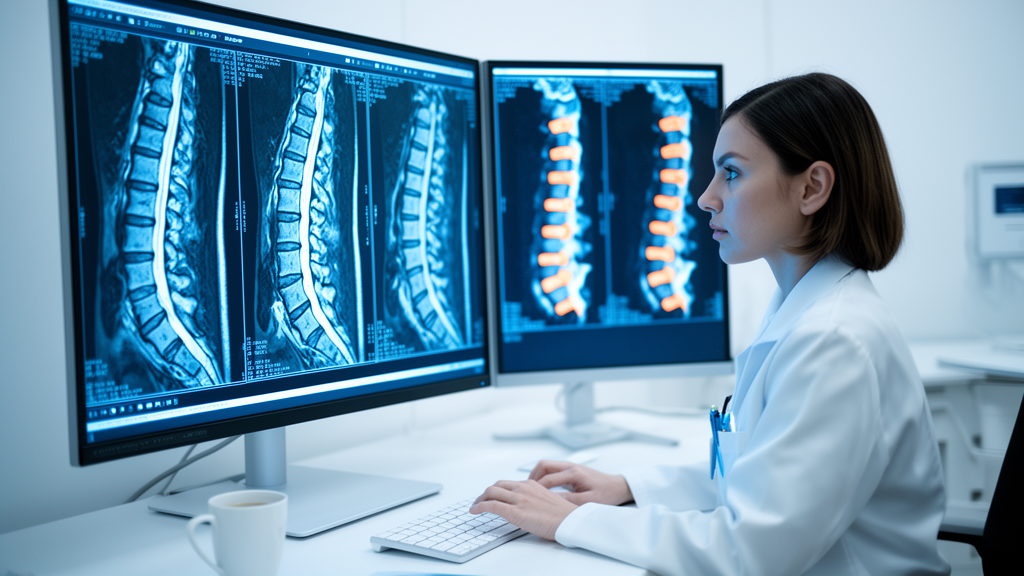
Deciding whether a patient with a worn-out, slipping vertebra needs spine surgery has long been one of the most subjective calls in orthopedics. Two surgeons examining the same magnetic resonance image can walk out of the reading room with opposite recommendations, and both may point to the literature to defend their position. A new retrospective study from China suggests that an algorithm might help narrow that uncertainty. By training a machine learning model on routine MRI measurements and basic clinical data, researchers have built a decision support tool that, in internal testing, correctly distinguished patients who benefited from surgery from those who did well with conservative care roughly four times out of five.
The condition at the center of the work is degenerative lumbar spondylolisthesis, or DLS, in which one lumbar vertebra slides forward over the one beneath it while the neural arch remains intact. It is a leading cause of chronic low back pain, neurogenic claudication, and radiating leg pain, and it becomes increasingly common as spines age. Physical therapy, pain management, and epidural steroid injections remain the first-line approach, and most patients improve without an operation. But an estimated 20 to 30 percent of patients develop persistent or worsening symptoms that ultimately push them toward decompression and fusion surgery. The trouble is that no standardized, quantitative criteria exist for identifying who belongs in that group.
Traditionally, surgeons rely on the failure of conservative treatment and the severity of a patient’s reported symptoms. MRI, the gold-standard imaging method for DLS, actually contains a wealth of relevant information: disc degeneration, facet joint arthritis, canal narrowing, and the health of the paraspinal muscles that stabilize the spine. In practice, however, clinicians tend to eyeball one or two isolated parameters, such as the degree of slippage, and underuse the multidimensional pattern that emerges when all of these degenerative features are considered together. Machine learning, which excels at detecting complex, nonlinear interactions in high-dimensional data, seemed to the researchers like the right instrument for the job.
The team behind the study, published in Frontiers in Musculoskeletal Disorders, screened 546 patients diagnosed with DLS between January 2018 and December 2022 and ultimately assembled a final cohort of 342 people with single-level disease at either the L4-L5 or L5-S1 segment. The mean age was 65.4 years, and nearly two-thirds were women. Crucially, the researchers defined their outcome groups by what actually happened to patients rather than by what a surgeon chose to do. The surgical candidate group consisted of 148 patients who underwent decompression or fusion and then achieved at least a 30 percent improvement on the Oswestry Disability Index at one year, a threshold anchored to the established minimal clinically important difference for that questionnaire. The nonoperative group comprised 194 patients who remained stable or improved during at least six months of conservative care without crossing over to surgery.
Twenty-three patients who had surgery but failed to improve sufficiently were excluded from the primary analysis, a deliberate choice meant to ensure the model learned the signature of genuinely appropriate surgical candidates rather than simply imitating past, potentially subjective, prescribing decisions. Each patient’s MRI was scored by two independent musculoskeletal radiologists blinded to outcomes, using established scales: Pfirrmann grades for disc degeneration, Pathria grades for facet arthritis, Goutallier grades for fatty infiltration of the multifidus and erector spinae muscles, and direct measurements of slippage percentage and facet joint angles. Agreement between readers was substantial to excellent, with intraclass correlation coefficients of 0.91 for slippage and 0.87 for facet angle.
After feature selection whittled 15 candidate variables down to ten, four algorithms were trained and tested using five-fold cross-validation: logistic regression, LASSO, random forest, and XGBoost, a gradient-boosted tree method that has become a favorite in clinical prediction work. XGBoost won decisively. It achieved an area under the receiver operating characteristic curve of 0.86, with a 95 percent confidence interval of 0.82 to 0.90, along with 81 percent sensitivity and 79 percent specificity. Its confidence interval did not overlap with that of logistic regression, which languished at an AUC of 0.75, suggesting the improvement was statistically meaningful rather than noise. Random forest landed in between at 0.83.
What sets the study apart from many machine learning papers in medicine is its effort to pry open the black box. Using the TreeSHAP algorithm, a game-theory-based method that quantifies each feature’s contribution to every individual prediction, the researchers found that the degree of slippage was the single most influential predictor, followed by fatty infiltration of the multifidus muscle and the Pfirrmann disc degeneration grade. The finding about the multifidus is particularly intriguing from a biomechanical standpoint. The multifidus acts as a dynamic stabilizer of the lumbar spine, and severe fatty replacement of that muscle may compromise the spine’s ability to hold itself together, potentially explaining why conservative therapies fail in those patients. Advanced disc degeneration, meanwhile, is associated with loss of disc height, foraminal narrowing, and nerve root compression that often resists nonoperative management.
The team also ran several robustness checks. When the 23 poor-outcome surgical patients were folded back into the surgical group, the AUC dipped only modestly, to 0.82, and the ranking of feature importance held steady, indicating the model captures real morphological differences rather than an artifact of patient selection. Dropping the SMOTE oversampling technique used to balance the classes barely changed performance, from an AUC of 0.86 to 0.84, a difference that was not statistically significant. Decision curve analysis, which weighs the net benefit of acting on a model’s predictions across a range of thresholds, showed that the XGBoost model outperformed the default strategies of treating everyone surgically or managing everyone conservatively across threshold probabilities of roughly 15 to 75 percent, including the clinically uncertain zone of 30 to 60 percent where most DLS decisions actually get made.
The authors are emphatic that this is a preliminary, hypothesis-generating result, not a tool ready for the clinic. The study was retrospective and single-center, which introduces selection bias and limits generalizability, and five-fold cross-validation provides only an internal estimate of performance. The model also relied exclusively on static, supine MRI images, which cannot capture the dynamic instability that flexion-extension radiographs and standing full-spine films reveal, and the outcome definition carries a risk of circular reasoning, since the model learns from past successful treatment trajectories rather than an absolute biological indication for surgery. Notably, patients who did poorly in either treatment arm were only partially represented in the analysis.
Still, the vision is compelling. If the model survives prospective, multi-center external validation, the researchers imagine deploying it as a web-based calculator or embedding it in electronic health record systems, where SHAP force plots would show each patient exactly which anatomical features, a 22 percent slippage here, a Grade 4 fatty-infiltrated multifidus there, drove the prediction. Such transparency could anchor more structured shared decision-making conversations between surgeons and patients, quantifying what has long been a matter of intuition. The authors stress that the tool should complement, never replace, clinical judgment and patient preference. Future iterations, they suggest, should fold in dynamic imaging and harness deep learning segmentation to extract muscle and disc measurements automatically, turning a laborious manual grading process into a real-time assessment at the point of care.
Subject of Research: Machine learning-based clinical decision support for surgical candidacy in degenerative lumbar spondylolisthesis using MRI features
Article Title: Development and internal validation of a machine learning-based clinical decision support tool for surgical intervention in degenerative lumbar spondylolisthesis: a retrospective MRI study
Article References: Ma, J., & Wang, H. (2026). Development and internal validation of a machine learning-based clinical decision support tool for surgical intervention in degenerative lumbar spondylolisthesis: a retrospective MRI study. Frontiers in Musculoskeletal Disorders, 4, Article 1919288. https://doi.org/10.3389/fmscd.2026.1919288
Image Credits: AI Generated
DOI: 10.3389/fmscd.2026.1919288
Keywords: degenerative lumbar spondylolisthesis, machine learning, XGBoost, MRI, SHAP, clinical decision support, spine surgery, multifidus fatty infiltration, Pfirrmann grade, cross-validation, surgical candidacy, conservative treatment
Cite Scienmag News
Ophelia Keating. (October 15, 2026). AI Reads Spine Scans to Decide Who Needs Back Surgery. Scienmag. https://scienmag.com/ai-reads-spine-scans-to-decide-who-needs-back-surgery/
Ophelia Keating. "AI Reads Spine Scans to Decide Who Needs Back Surgery." Scienmag, 15 October 2026, https://scienmag.com/ai-reads-spine-scans-to-decide-who-needs-back-surgery/. Accessed 15 October 2026.
Ophelia Keating. "AI Reads Spine Scans to Decide Who Needs Back Surgery." Scienmag. October 15, 2026. https://scienmag.com/ai-reads-spine-scans-to-decide-who-needs-back-surgery/


