


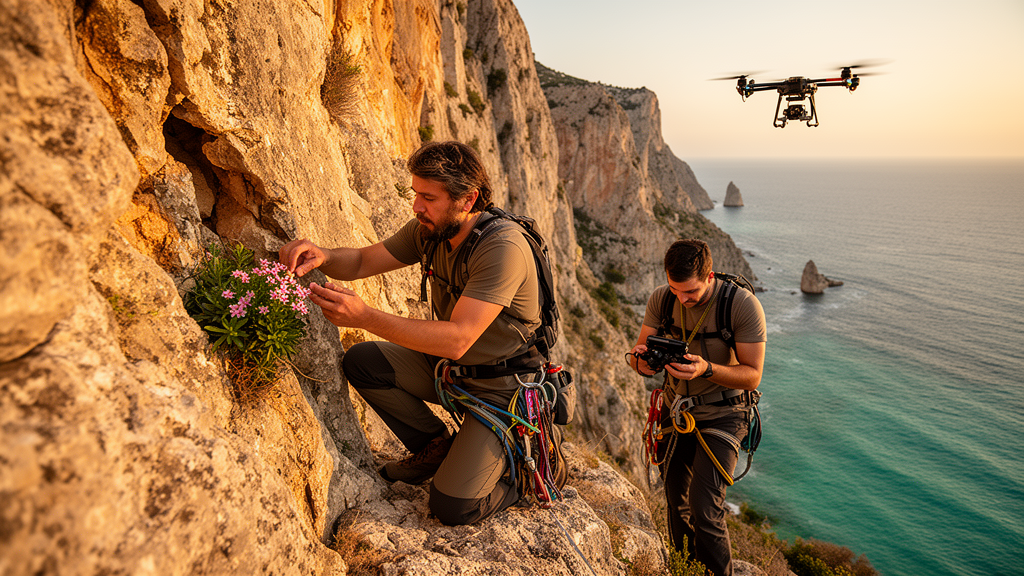
High on the truncated limestone cone that Sicilians call the Cervino di Sicilia, a small drone has done what generations of botanists could not: it has photographed a rock saxifrage that had vanished from scientific records for a hundred years. A new study published in Italian Botanist documents an intensive floristic investigation of the Rocca di Novara massif in northeastern Sicily, combining conventional field campaigns with aerial imagery to penetrate one of the most inaccessible botanical refuges on the island. The survey recorded 300 vascular plant taxa and confirmed the survival of a suite of rare cliff-dwelling endemics, including Saxifraga callosa subsp. australis, a species last seen on the mountain by botanist Nicotra in 1880.
Rocca di Novara, also known as Rocca Salvatesta, rises to 1,340 meters on the southern edge of the Peloritani Mountains, a range that stretches roughly 70 kilometers along the island’s northeastern shoulder. Unlike the neighboring Peloritani peaks, which are built of ancient crystalline and metamorphic rocks such as gneisses and schists, Rocca di Novara is a small carbonate massif, a Mesozoic limestone formation resting on a siliceous basement. Its steep slopes, scree fields and sheer cliffs form a natural fortress against human access, which is precisely why the botanists chose it. The harsh topography has shielded rare plants from most anthropogenic disturbance, but it has also made a complete inventory nearly impossible using traditional walking-and-collecting methods alone.
The study originated in a field activity organized by the Italian Botanical Society as part of an intensive course in the determination of vascular plants, held on May 21, 2022. That initial group excursion, designed as a training exercise, evolved into a multi-season research effort. The team returned in May, June and November 2023 to capture the full seasonal spectrum of the local flora, from spring-blooming geophytes to autumn-drying annuals. Collected specimens were pressed, dried and deposited at the Herbarium of the University of Catania and the Herbarium Mediterraneum Panormitanum in Palermo, with identifications based primarily on the recent standard flora of Italy and nomenclature following the 2024 Italian checklist.
The technological heart of the investigation, however, was aerial. In May and June 2022 the researchers flew a compact DJI Mavic Mini drone along the vertical cliff faces of the summit, letting it hover while taking intermittent high-resolution photographs that could later be examined for diagnostic floral and vegetative characters. This vertical-flight, stop-and-shoot technique has become increasingly popular in cliff ecology because it allows researchers to identify many vascular plants on otherwise unreachable rock walls and to quantify cliff-face diversity without mountaineering equipment. It was exactly this approach that yielded the study’s most dramatic result: the rediscovery of Saxifraga callosa subsp. australis on the summit cliffs, confirming a population that had gone unconfirmed since the nineteenth century.
The numbers from the survey are impressive for such a small massif. The 300 recorded taxa belong to 189 genera and 51 families, with ferns contributing 10 species and flowering plants dominating the rest. Monocots account for 53 taxa, or about 17.75 percent, while eudicots make up the remaining 247. The richest families are the classic Mediterranean lineups: daisies lead with 37 taxa at 12.3 percent of the flora, followed by legumes with 30, mints with 24, grasses with 21, pinks with 18, cabbages with 16, orchids with 14, carrots with 11 and plantains with 10. Trifolium, the clovers, is the most species-rich genus with 14 taxa. The comparatively low grass count, the authors note, reflects the scarcity of grass-favored habitats: much of the mountain is cloaked in bracken communities or sheer subvertical cliffs dominated by other families altogether.
The phytogeographic signal is what elevates the study from a routine checklist to a document of real conservation weight. Thirteen of the recorded taxa are endemic to Italy, and a further 12 are strictly endemic to Sicily, each representing about 4 percent of the flora. Among the Sicilian endemics are Anthyllis albiflora, Centaurea gussonei, Dianthus graminifolius, Odontites bocconei subsp. bocconei, Symphytum gussonei and Trifolium bivonae. Some display striking distribution patterns: while most Sicilian endemics range across the island’s northern mountains, Centaurea gussonei is confined to the northeastern corner, and Anthyllis albiflora and Dianthus graminifolius are centered in the west. The Rocca di Novara population of Dianthus graminifolius, normally a plant of warm lowland grasslands, here clings to mountain cliffs and shows transitional characters toward a related species, prompting calls for further taxonomic study.
Even more remarkable are the disjunct occurrences of orophilous, or mountain-loving, species that in Sicily were otherwise known only from the Madonie massif further west. Aubrieta columnae subsp. sicula, Daphne oleoides subsp. oleoides, Helianthemum oelandicum subsp. incanum and Minuartia recurva subsp. condensata all reappear on the limestone walls of Rocca di Novara, forming an isolated outpost of Madonie-type high-mountain flora. The cool, humid microclimate at the summit evidently sustains conditions that vanished from the surrounding lowlands long ago. Other rarities add to the picture: the finding of Crepis sancta confirms a Sicilian presence that had been considered doubtful for decades, and the parasitic broomrape Phelipanche gussoneana is recorded for the first time in eastern Sicily. Helianthemum oelandicum subsp. incanum, previously known only from western Sicilian massifs, is reported here for the first time from the eastern part of the island.
The life-form spectrum tells its own ecological story. Therophytes, short-lived annuals and biennials that survive unfavorable seasons as seed, make up 39.3 percent of the flora, a signature of shallow soils, intense solar exposure, seasonal drought and frequent fires. Among the perennials, hemicryptophytes lead at 32.7 percent, followed by geophytes at 13 percent and chamaephytes at 10.7 percent. The chamaephyte figure is notably high and tracks directly with the casmophilous vegetation, plants wedged into rock crevices, that colonizes the limestone cliffs of the upper massif. Woody phanerophytes are scarce at just 3.7 percent, reflecting the near-total loss of the original holm oak forest to grazing, fires and browsing; today only scattered nuclei of Quercus ilex with isolated hop-hornbeams persist, and nemoral species such as Stachys sylvatica and Fritillaria messanensis survive in the shade of bracken clumps and cliff bases.
The conservation implications are stark. Of the 300 taxa inventoried, 36, or 12 percent, fall within IUCN risk categories. Aubrieta columnae subsp. sicula, Fritillaria messanensis subsp. messanensis and Linaria multicaulis subsp. multicaulis are classified as Endangered, while Centaurea gussonei and Dianthus graminifolius are Vulnerable and five further species are Near Threatened. Encouragingly, not a single alien species was recorded, consistent with the pattern that non-native plants in Sicily concentrate in disturbed coastal zones rather than remote mountains. Yet the entire area is part of the Natura 2000 network only on paper; the authors highlight a troubling gap between the site’s formal protection as a Special Area of Conservation and the absence of active conservation measures on the ground.
Comparisons with the historical record sharpen the urgency. Nicotra’s 1880 list for the mountain included just 50 species, 13 of which the new survey failed to find. Some absences may reflect misidentifications or temporary sampling gaps among widespread annuals, but the disappearance of orophilous and shade-loving species may point to something more systemic: decades of climate change and human-driven deforestation eroding the ecological niches these plants occupy. One species, Silene calycina, reported by Nicotra on these very cliffs and known elsewhere only from the western Madonie, has never been found again and is probably extinct. The researchers also documented phenological shifts, with blooms arriving early or late as temperatures fluctuate. Against these pressures, the rediscovered saxifrage on the summit walls stands as both a warning and a demonstration: the drone-borne camera has opened a new window onto vertical botanical worlds just in time to show what still can be saved.
Subject of Research: Drone-based floristic survey of the vascular plants and endemic cliff flora of the Rocca di Novara massif in northeastern Sicily
Article Title: Using drone imagery and group field activities for an in-depth investigation of the vascular flora: a case study in the Rocca di Novara Massif (NE Sicily, Italy)
Article References: Porrovecchio, M., Cambria, S., Bacilliere, G., Barone, G., Crisafulli, A., Di Gristina, E., Di Pasquale, C., Di Mauro, M., Domina, G., Luchino, F., Marici, C., Miraglia, G., Tavilla, G., & Sciandrello, S. (2024). Using drone imagery and group field activities for an in-depth investigation of the vascular flora: a case study in the Rocca di Novara Massif (NE Sicily, Italy). Italian Botanist, 18, 13-28. https://doi.org/10.3897/italianbotanist.18.127209
Image Credits: AI Generated
DOI: 10.3897/italianbotanist.18.127209
Keywords: Rocca di Novara, Sicily, flora, endemic plants, drone survey, Saxifraga callosa, Peloritani Mountains, plant conservation, biodiversity, limestone cliffs, IUCN, Natura 2000
Cite Scienmag News
Margaret Porter. (October 18, 2026). Drones and Team Fieldwork Reveal Lost Plant Species After a Century on Sicily’s Rugged Cliffs. Scienmag. https://scienmag.com/drones-and-team-fieldwork-reveal-lost-plant-species-after-a-century-on-sicilys-rugged-cliffs/
Margaret Porter. "Drones and Team Fieldwork Reveal Lost Plant Species After a Century on Sicily’s Rugged Cliffs." Scienmag, 18 October 2026, https://scienmag.com/drones-and-team-fieldwork-reveal-lost-plant-species-after-a-century-on-sicilys-rugged-cliffs/. Accessed 18 October 2026.
Margaret Porter. "Drones and Team Fieldwork Reveal Lost Plant Species After a Century on Sicily’s Rugged Cliffs." Scienmag. October 18, 2026. https://scienmag.com/drones-and-team-fieldwork-reveal-lost-plant-species-after-a-century-on-sicilys-rugged-cliffs/


