


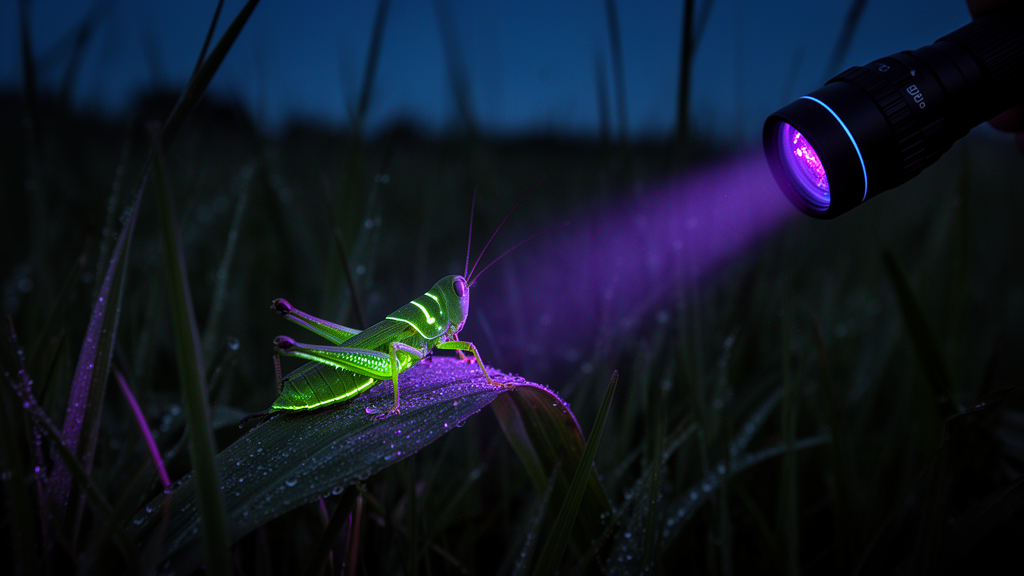
A quiet revolution is unfolding in the grasslands of Hungary, where a team of ecologists has shown that an ordinary fluorescent marker and an ultraviolet flashlight can transform the way scientists track one of Europe’s most cryptic insects. In a study published in the Journal of Orthoptera Research, researchers tested ultraviolet fluorescence marking on Isophya costata, a low-mobility bush-cricket species, by recapturing marked individuals every single night for sixteen days. The results offer the most detailed picture yet of how well this technique performs under real field conditions, and the findings could reshape how conservationists monitor insects living in dense, vertically structured vegetation.
Mark-release-recapture, often abbreviated as MRR, has long been considered the gold standard for estimating population sizes, tracking movement patterns, and measuring dispersal ability. The method is simple in principle: capture animals, mark them harmlessly, release them back into their habitat, and then recapture them over time to infer how many individuals live in an area and how far they travel. While butterflies dominate the MRR literature, orthopterans such as bush-crickets and grasshoppers have received far less attention, partly because traditional marking techniques struggle in habitats where tall grass hides everything from view.
Previous approaches relied on paint spots applied to the pronotum or small numbered labels glued to the femur. These work reasonably well in open, sparse habitats but become nearly useless when insects disappear into dense vegetation. Reflective tags illuminated by lamps at night offer an improvement, but dewdrops on leaves create false signals that confound observers. Ultraviolet fluorescence marking sidesteps this problem entirely: only the marked insect glows under UV light, producing a signature that cannot be mimicked by moisture or debris. Despite these theoretical advantages, no intensive daily study had ever been conducted to quantify how effective the method truly is, or how habitat structure and insect behavior influence detection success.
The research team focused on a population of Isophya costata living in approximately two hectares of mown grassland in Hungary’s Balaton Uplands. The site presented an ideal natural experiment because its vegetation was structurally heterogeneous. The northern third consisted of shorter, sparser grassland averaging twenty to thirty centimeters in height with roughly eighty to ninety percent vegetation cover, while the southern two-thirds featured taller grass reaching fifty to sixty centimeters with complete ground coverage. This contrast allowed the researchers to directly test whether vegetation structure affects how easily marked insects can be found.
On May 27, 2023, the team collected twenty males and twenty females and marked each with non-toxic, quick-drying permanent markers. Green ink identified insects released at the northern site, while yellow ink identified those released in the south. Because the pronotum offers limited surface area, individuals were numbered from zero to nine and given an additional line along the abdomen. Ten males and ten females were released at each of the two sites, and recaptures began the following evening. Using powerful UV flashlights emitting light at 385 to 395 nanometers, the researchers walked systematic transects spaced four meters apart, searching between 21:30 and 1:00 each night until mowing ended the study on June 12.
The numbers tell a compelling story. Across sixteen days, the forty marked individuals were recaptured 206 times, representing 32.2 percent of the theoretical maximum of 640 potential recaptures. Females proved significantly easier to find than males, with recapture rates of 38.1 percent versus 26.2 percent respectively. Individual variation was striking: one male was found only twice while another was located eleven times, and among females, one individual was never seen again after release while another from the same group was recaptured thirteen times. Females released in the shorter northern vegetation were recaptured significantly more often than any other group, confirming that vegetation structure exerts a powerful influence on detection success.
Mann-Kendall trend tests revealed a statistically significant decline in recaptures over time for nearly all groups, with one notable exception: females in the northern site showed no significant downward trend. This pattern, the researchers argue, reflects biology rather than methodological failure. As the study progressed, mortality and hiding behavior increased, but the marked insects had not dispersed beyond sixteen meters from their release points. Indirect mortality estimates suggested only about two percent of marked individuals died per day, indicating that the gradual decline in detections stemmed from insects concealing themselves deeper in the vegetation or falling prey to predators rather than from disappearing marks or emigration.
Perhaps the most striking finding concerns the geometry of detection. When the researchers analyzed photographs of recaptured insects, they found that 88 percent were located in the upper third of the vegetation, and most individuals held their body axis vertically rather than horizontally. Critically, the orientation of the insect relative to the UV beam dramatically affected visibility: when a bush-cricket’s body was parallel to the axis of illumination, the probability of detection dropped to roughly 50 percent, but when the body was perpendicular to the light, detection soared to nearly 100 percent. This directional bias means that marking all sides of the insect, rather than just the dorsal surface, substantially increases the odds of finding it regardless of posture.
The study also documented the devastating impact of mowing on the local population. When the grassland was cut, roughly half of the detected males bore injuries, and female detections plummeted because females had already descended into the lower vegetation layers to lay their eggs in the soil. Males, which remained in the safer upper vegetation, were still visible atop the cut windrows even when wounded. The researchers calculated that trampling mortality from their own fieldwork was negligible, at most five percent initially and declining below one percent as insects dispersed, confirming that daily MRR surveys can be conducted with minimal harm to fragile populations.
Compared with previous studies, these recapture rates are exceptional. A comparable investigation of the related bush-cricket Isophya beybienkoi achieved only thirteen to sixteen percent recapture success, likely because its transect lines were spaced twenty-five meters apart rather than four. The Hungarian team’s meticulous approach demonstrates that UV fluorescence marking, combined with tight transect spacing and nightly searches, can yield recapture data robust enough to estimate population sizes and monitor behaviors including mobility, feeding, reproduction, and egg-laying in species that would otherwise remain invisible. For conservationists racing to protect grassland insects from habitat loss and intensive mowing, this glowing technique offers a powerful new window into their hidden world.
Subject of Research: UV fluorescence mark-release-recapture testing on a low-mobility bush-cricket population
Article Title: Testing of UV fluorescence marking with daily recaptures of a low-mobile bush-cricket species
Article References: Varga, S., & Kenyeres, Z. (2024). Testing of UV fluorescence marking with daily recaptures of a low-mobile bush-cricket species. Journal of Orthoptera Research, 33(2), 281-288. https://doi.org/10.3897/jor.33.120070
Image Credits: AI Generated
Keywords: UV fluorescence, mark-release-recapture, bush-cricket, Isophya costata, Orthoptera, population monitoring, conservation biology, grassland ecology, insect marking, vegetation structure, Hungary, field ecology
Cite Scienmag News
Gavin Prescott. (October 18, 2026). Glowing in the Dark: UV Markers Reveal Hidden Lives of Bush-Crickets. Scienmag. https://scienmag.com/glowing-in-the-dark-uv-markers-reveal-hidden-lives-of-bush-crickets/
Gavin Prescott. "Glowing in the Dark: UV Markers Reveal Hidden Lives of Bush-Crickets." Scienmag, 18 October 2026, https://scienmag.com/glowing-in-the-dark-uv-markers-reveal-hidden-lives-of-bush-crickets/. Accessed 18 October 2026.
Gavin Prescott. "Glowing in the Dark: UV Markers Reveal Hidden Lives of Bush-Crickets." Scienmag. October 18, 2026. https://scienmag.com/glowing-in-the-dark-uv-markers-reveal-hidden-lives-of-bush-crickets/


