


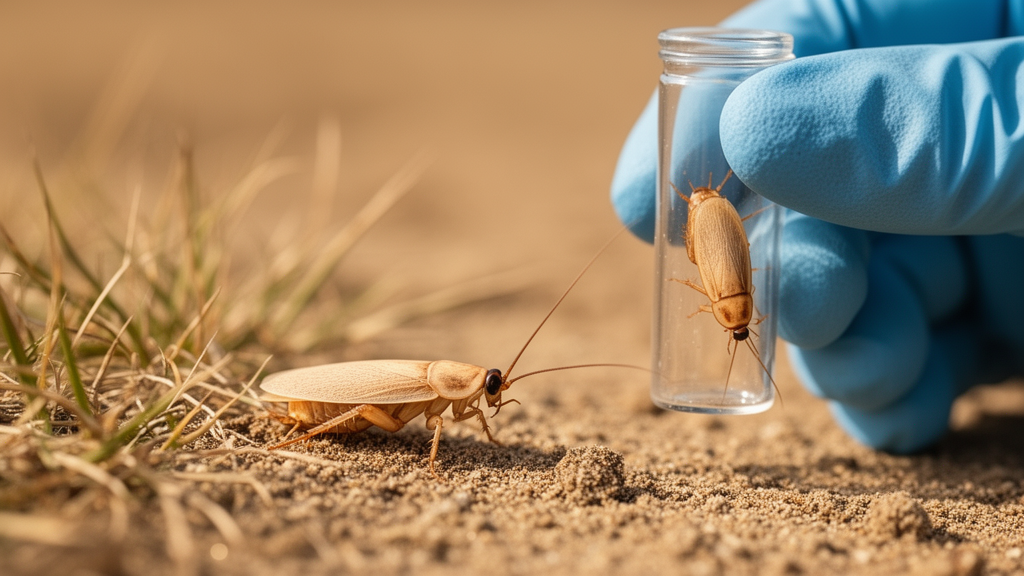
Dashlights, vinegar traps, and a midnight hunt on a dry hillside above Tbilisi have delivered a first for Georgia: the fossorial sand cockroach Hemelytroblatta livida, recorded in the country for the very first time. The discovery, published in the journal Caucasiana as part of the Caucasus Barcode of Life (CaBOL) project, extends the known range of this elusive desert-dweller by almost 680 kilometers to the north-east, a leap that rewrites what scientists thought they knew about where this species lives.
Sand cockroaches, the subfamily Corydiinae of the family Corydiidae, are among the strangest and least studied of their kind. Unlike the household pests most people picture, these insects are specialists of arid, sandy, and steppe environments, burrowing beneath rocks and into loose soil. They display one of the most dramatic sexual dimorphisms in the insect world: males are fully winged and take to the air at night, while females are generally wingless, fossorial creatures equipped with adaptations for life underground. In several other genera, such as Ergaula, Eucorydia, Therea, and Hypercompsa, females do retain wings, but in most sand cockroaches the females are Earth-bound excavators, rarely seen even by entomologists working in the same habitats.
That reclusive lifestyle, combined with what the authors describe as the unfortunate reputation of cockroaches in general, has long hampered the study and collection of Corydiinae. The most significant historical work on the group’s taxonomy dates to Chopard in 1929, who recognized 54 species in 10 genera across the Palaearctic Region, seven of those genera and 23 of the species being new to science. The most recent comprehensive treatment of the subfamily in the former USSR came from Bey-Bienko in 1950, who recognized five genera and ten species across the region, including Hemelytroblatta incerta, H. livida, H. minuta, H. roseni, the Egyptian cockroach Polyphaga aegyptiaca, and several relatives of Central Asian origin. Only two of those species, H. livida and the far more widespread P. aegyptiaca, were known to occur in the Caucasus, and until now neither had received any serious study in Georgia itself.
The new records stem from fieldwork conducted under CaBOL, a collaborative biodiversity cataloguing initiative led by the Institute of Ecology at Ilia State University. Males of H. livida were collected at night by hand using flashlights in xerothermic, sun-baked habitats, where the insects were found perched on vegetation such as Rhamnus pallasii and Pyrus salicifolia, or captured in pitfall traps filled with vinegar. Females, true to their subterranean habits, were gathered during the day by turning rocks in steppe and heathland sites. All specimens were preserved in 96% ethanol and deposited in the collections of Ilia State University in Tbilisi.
The six collection sites tell a story of a species quietly occupying dry corners of the Georgian landscape. Three males came from Dighomi village about eight kilometers east of Tbilisi at roughly 734 meters above sea level, one from Didgori on a slope of loose soil in deciduous forest, one more male from a xerothermic slope in Tbilisi itself, and two females from Kumisi in steppe habitat and the Kvernaki ridge near Gori, both found under rocks. The sites cluster between roughly 650 and 800 meters elevation, precisely the kind of warm, dry terrain that fossorial sand cockroaches favor.
What elevates the find from a simple distributional note to a landmark record is the genetic work. The team extracted DNA using a Quick-DNA Magbead Plus Kit and amplified a 658-base-pair fragment of the cytochrome oxidase subunit I gene, the standard DNA barcode used to identify animal species. Of six specimens processed, four high-quality, BOLD-compliant barcodes representing two species were generated. For H. livida, a single barcode from a female collected on the Kvernaki ridge was deposited in the Barcode of Life Data System under Barcode Index Number AEP4515, and it is quite literally the first COI sequence ever published for the species or any of its close relatives. The same is true for the Egyptian cockroach: two identical barcodes from Dighomi specimens gave scientists their first COI sequences for P. aegyptiaca as well.
Until these sequences existed, neither species appeared in the BOLD reference database, meaning anyone attempting to identify a mystery specimen of either cockroach using DNA would have hit a dead end. The new barcodes close that gap and provide a molecular reference point for future surveys across the Caucasus, the Middle East, and Central Asia. The researchers compared sequences using the Kimura two-parameter distance model as implemented in BOLD, and verified the morphological identifications against the classic descriptions and drawings of Brunner von Wattenwyl from 1882, Chopard from 1929, and Bey-Bienko from 1950, finding that the Georgian specimens correspond well to those historical accounts.
The historical biogeography is equally striking. Originally described from Cyprus in 1865, H. livida was previously known from Greece, Iran, Iraq, Syria, Turkey, and, within the Caucasus, only from Julfa and Ordubad in Azerbaijan, on the basis of Bey-Bienko’s 1950 work. The Georgian records push the species’ confirmed range roughly 680 kilometers to the north-east, suggesting that suitable xerothermic corridors across the South Caucasus may harbor more populations than anyone realized. Bey-Bienko also noted subtle coloration differences between specimens from Greece and Azerbaijan, which tend to be brighter with fewer dark spots on the elytra, and their counterparts from Asia Minor and Central Asia, a hint that regional variation in this species may repay closer study.
The paper also consolidates what is known about the Egyptian cockroach in Georgia, a species whose range spans the entire Mediterranean region, southern Europe, and southwestern Asia as far east as Iran. Despite its broad distribution, location-specific data from Georgia were almost nonexistent. By combining fresh CaBOL material, museum specimens from Ilia State University, and photographic records from the Georgian Biodiversity Database, iNaturalist, and the citizen science Facebook group Wildlife in Georgia, the authors assembled a national picture spanning Batumi, Chachuna Managed Reserve, Gori, Kumisi, Tbilisi, Rustavi, Poladauri, Kutaisi, Mtskheta, and Uplistsikhe. A juvenile even turned up under artificial garbage near Dighomi, proof that these ancient insects persist at the edges of the capital.
There is still far more unknown than known. Virtually nothing has been documented about the phenology or reproductive biology of H. livida, which are likely similar to those of its close relatives, and the juveniles, which closely resemble adult females but carry more prominent ornamentation, have barely been described at all. The authors point out that while corydiid taxonomy has advanced considerably in the last decade, with growing evidence of greater species diversity within the family, DNA-based phylogenetic studies have lagged behind largely because obtaining specimens is so difficult. Their hope is that targeted surveys of these neglected burrowers will reveal the true diversity of sand cockroaches in Georgia and across the Caucasus, and clarify how the region’s lineages fit into the global cockroach tree of life.
Subject of Research: First DNA-barcoded record of the sand cockroach Hemelytroblatta livida in Georgia and notes on Corydiinae in the Caucasus
Article Title: The first DNA-assisted record of Hemelytroblatta livida ( Blattodea : Corydiidae ) from Georgia with notes on Corydiinae species composition in the Caucasus
Article References: Seropian, A., Arsenashvili, E., Bulbulashvili, N., Japaridze, L.-G., Zukakishvili, A., Japarashvili, S., Memishishi, A., & Mumladze, L. (2023). The first DNA-assisted record of Hemelytroblatta livida (Blattodea: Corydiidae) from Georgia with notes on Corydiinae species composition in the Caucasus. Caucasiana, 2, 71-75. https://doi.org/10.3897/caucasiana.2.e103189
Image Credits: AI Generated
DOI: 10.3897/caucasiana.2.e103189
Keywords: Hemelytroblatta livida, sand cockroaches, Corydiidae, Georgia, Caucasus, DNA barcoding, COI, BOLD, biogeography, CaBOL, Polyphaga aegyptiaca, entomology
Cite Scienmag News
Gavin Prescott. (October 18, 2026). Sand Cockroach Surfaces in Georgia for the First Time, Confirmed by DNA Barcode. Scienmag. https://scienmag.com/sand-cockroach-surfaces-in-georgia-for-the-first-time-confirmed-by-dna-barcode/
Gavin Prescott. "Sand Cockroach Surfaces in Georgia for the First Time, Confirmed by DNA Barcode." Scienmag, 18 October 2026, https://scienmag.com/sand-cockroach-surfaces-in-georgia-for-the-first-time-confirmed-by-dna-barcode/. Accessed 18 October 2026.
Gavin Prescott. "Sand Cockroach Surfaces in Georgia for the First Time, Confirmed by DNA Barcode." Scienmag. October 18, 2026. https://scienmag.com/sand-cockroach-surfaces-in-georgia-for-the-first-time-confirmed-by-dna-barcode/


