


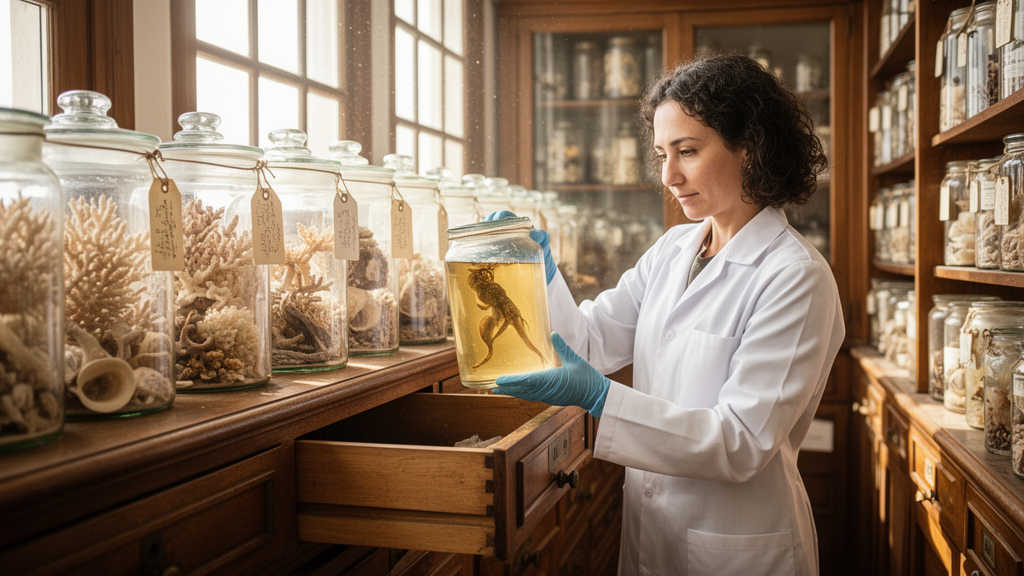
In the vaults of Lisbon’s Museu Nacional de História Natural e da Ciência sits a treasure trove that most marine biologists never knew existed: more than 30,000 specimens of fish, molluscs and crustaceans hauled from the tropical waters of Africa and Asia during Portuguese oceanographic campaigns of the 1950s and 1960s. A new study published in Natural History Collections and Museomics provides the first comprehensive account of this collection, documenting 7,305 occurrences that together represent 1,372 species across 447 families and 21 classes. After decades of understaffing and neglect that rendered the material virtually inaccessible, the entire dataset has now been revised, digitised and published through the Global Biodiversity Information Facility, opening a unique window onto mid-twentieth-century marine life in Angola, Cabo Verde and Mozambique.
The story begins in the late 1940s, when post-war technological advances pushed European powers with African territories to invest in oceanographic research, exemplified by expeditions such as the Danish Atlantide of 1945 to 1946 and the Belgian Noordende III of 1948 to 1949. Portugal followed suit within its broader colonial agenda of scientific occupation. In 1948 the government created the Missão de Estudos de Pesca, a Fisheries Research Mission intended to provide scientific guidance for fishing activities and improve the exploitation of colonial resources. When planned work stalled, the mission was restructured in 1951 into the Missão de Estudos de Pesca de Angola, limited to that territory, and then transformed again in 1953 into the Missão de Biologia Marítima, whose remit expanded across the Portuguese colonies. Its objectives were threefold: fundamental research on the biology of economically important marine species, support for the development of fisheries and related industry, and the assembly of botanical and zoological inventories of marine life.
Fieldwork was carried out aboard the NO Baldaque da Silva, a roughly 50-metre steamer acquired from the Australian Navy in 1948 as HMS Rusckholm, modified for fisheries and oceanographic research and added to the Portuguese fleet in 1949. The vessel was equipped with Hensen and Apstein nets for plankton, Van Veen, Knudsen and Petersen dredges for substrate sampling, and Nansen bottles for water samples. The main fishing method was bottom trawling with Vigneron-Dhal nets some 52 metres long with 60-millimetre mesh, typically towed at eight knots for 40 to 120 minutes. French-type lobster traps, Heligoland nets at shallow depths, beach seines known as chinchorros, fixed Valencian gear and hand collecting at low tide rounded out the toolkit. When the Baldaque da Silva needed a new boiler in 1960, the government swapped boilers with the hydrographic vessel Salvador Correia and exchanged the ships’ names, so campaigns logged under both names were in fact conducted by the same hull. A trawler named Sardinella, fitted with a mechanical hauler for encircling nets, operated mainly off Benguela Province in Angola.
The scientific staffing of the missions reads like a small drama of scarcity. Recruitment difficulties meant the first campaign’s staff amounted to just two researchers: the German Wilhelm Nümann as supervisor and the Portuguese Herculano Zacarias Vilela. Nümann’s contract ended with the first campaign in 1952, and Vilela took over, assisted by Pedro Emílio Guerreiro da Franca and Rui Horácio dos Santos Monteiro. Vilela led the Missão de Biologia Marítima until 1958, when Franca replaced him and went on to direct the successor centres until his death in 1971. By 1973 the research group had grown to ten researchers and eight assistants. Specimens were examined aboard ship or in shore laboratories, then shipped to Lisbon, where specialists in Portugal, Belgium, France and Senegal, including William Adam, Eugène Leloup, Jacques Forest, Danièle Guinot and Jean Cadenat, worked up the material for publication.
The resulting publications spanned systematic catalogues, ecological and biogeographical notes, experimental fishing trials and industrial optimisation studies, with particular attention to tuna, sardines, hakes, lobster and shrimp. In Angola, the campaigns ran from the first MEPA expedition between May 1951 and February 1952 through further cruises in 1957, 1960, 1963 and 1964, accumulating more than 500 bottom trawls between Cabinda Province and Namibia’s Kunene Region. Angola dominates the collection with 5,076 records, followed by Cabo Verde with 1,444 and Mozambique with 656. Cabo Verde was surveyed across all its main islands between 1957 and 1959, with later Portuguese-German cruises aboard the RV Walther Herwig in 1964 and 1970. In Mozambique, a single 1957 campaign based at the marine biology station on Inhaca Island, led by José Gonçalves Sanches, produced the bulk of that country’s material.
Taxonomically, the collection’s crown jewels are its type specimens, the physical standards by which species names are defined. The study located and flagged 19 types representing nine nominal taxa. Among the fishes are paratypes of the driftfish Cubiceps niger, the needlefish Tylosurus acus rafale and the damselfish Chromis lubbocki. Among the molluscs are the holotypes of the cone snails Conus angolensis and Conus lucirensis, the ark clam Arca geissei angolensis, and the squids Moroteuthis robsoni and Todarodes sagittatus angolensis, the latter two described by William Adam in 1962. The snapping shrimp Alpheus holthuisi, described by Ribeiro in 1964 from Cabo Verde, completes the list. Only five of these nine taxa remain valid today, yet most of the types have never been critically re-examined since their original descriptions, making their rediscovery scientifically significant.
Reconstructing the collection’s data was an exercise in forensic curation. Each specimen originally carried a structured record number encoding the campaign, year, vessel or brigade, taxonomic group and serial number, such as MBM.1960.NO.P.89, but the remaining information lived on collection datasheets rather than on the specimens themselves. The original field worksheets could not be found in any archive, and labels added during later transfers frequently contained transcription errors. Where sources conflicted, the researchers prioritised the original datasheets while documenting their reasoning case by case. Locality descriptions were georeferenced using the GeoLocate application together with campaign reports and published maps, and because only the starting positions of trawls were recorded, the team supplied additional sampling data such as trawl duration and heading rather than assigning arbitrary uncertainty values. All records were formatted to DarwinCore standards for GBIF.
The physical conservation work was equally demanding. Dry-preserved shells, corals and echinoderms stored in open cardboard boxes were rehoused in closed, foam-cushioned containers, while fluid-preserved specimens in cracked jars with melted gaskets were transferred to new glass. Fish and cnidarians originally fixed in four per cent formalin were progressively moved into seventy per cent ethanol, and every jar received a new standardised label on archival paper alongside a barcode, with all historical labels retained. The effort also revealed gaps: 525 records remain unaccounted for, and it is unclear whether that material was ever transferred to the museum, was lost, or was donated elsewhere. Roughly twenty per cent of the collection is still unidentified beyond family level, and some studied material was never published, including Cabo Verde molluscs and echinoderms from all three countries, among which are specimens labelled as types of Cherbonnier species that were never formally described.
The study’s authors argue that the collection’s long inaccessibility had measurable costs for science. When researchers revised the cone snails of Angola and Cabo Verde over recent decades, none could consult the nearly 1,000 cone snail specimens held in Lisbon, and some authors explicitly noted the unknown whereabouts of Angolan type material. Hidden distribution records likewise surfaced: the fishes Holacanthus africanus and Scarus hoefleri were present in the Angolan collection long before being officially reported for the country in 2021. Gathered in a colonial context, the collection now offers a foundation for scientific cooperation and knowledge transfer between Portugal and the independent nations whose waters it samples. The authors close with a cautionary lesson in collections management: institutional restructurings scattered documentation, severed specimens from their data and erased the history of lost material, underscoring the critical need for Portuguese natural history museums to invest in permanent, trained curatorial staff before more collections slip into silence.
Subject of Research: Digitisation and taxonomic review of zoological collections from Portuguese oceanographic campaigns in former colonial territories
Article Title: The zoological collections of Portuguese oceanographic campaigns in former colonial territories
Article References: Parrinha, D., Brites Soares, L., Cartaxana, A., & Alves, M. J. (2024). The zoological collections of Portuguese oceanographic campaigns in former colonial territories. Natural History Collections and Museomics, 1, 1-34. https://doi.org/10.3897/nhcm.1.136860
Image Credits: AI Generated
Keywords: natural history collections, oceanographic campaigns, Portugal, Angola, Cabo Verde, Mozambique, marine biodiversity, type specimens, digitisation, GBIF, museomics, colonial science
Cite Scienmag News
Margaret Porter. (October 18, 2026). Lost for Decades, a Vast Colonial-Era Marine Collection Resurfaces in Lisbon. Scienmag. https://scienmag.com/lost-for-decades-a-vast-colonial-era-marine-collection-resurfaces-in-lisbon/
Margaret Porter. "Lost for Decades, a Vast Colonial-Era Marine Collection Resurfaces in Lisbon." Scienmag, 18 October 2026, https://scienmag.com/lost-for-decades-a-vast-colonial-era-marine-collection-resurfaces-in-lisbon/. Accessed 18 October 2026.
Margaret Porter. "Lost for Decades, a Vast Colonial-Era Marine Collection Resurfaces in Lisbon." Scienmag. October 18, 2026. https://scienmag.com/lost-for-decades-a-vast-colonial-era-marine-collection-resurfaces-in-lisbon/


