


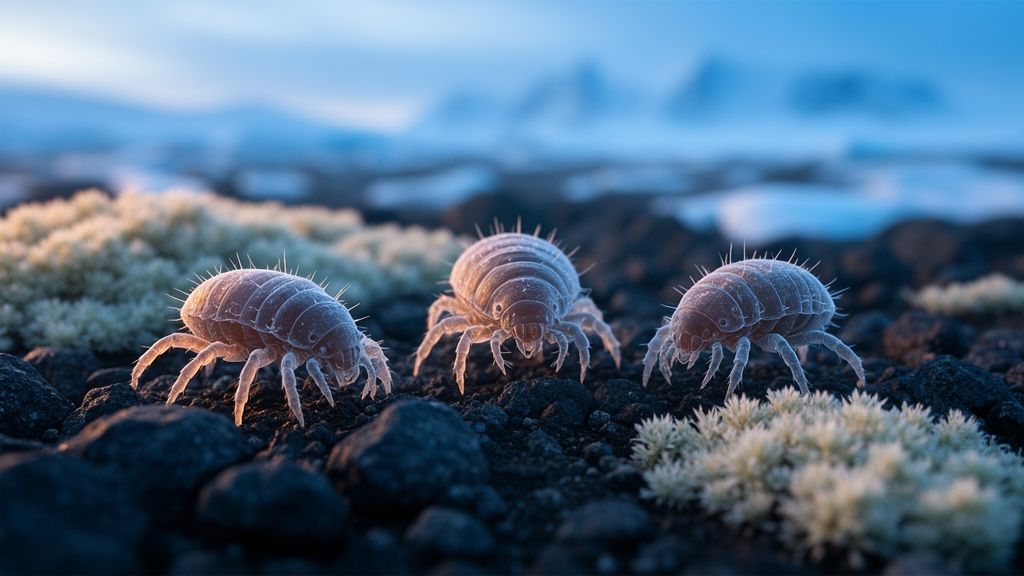
Deep in the moss carpets of the western Antarctic Peninsula, researchers have uncovered evidence that tiny, armored soil mites are arriving in one of the planet’s most isolated ecosystems — and some of them may have hitched a ride with humans. A new survey of oribatid mites, published in Frontiers of Biogeography, reports records from the South Shetland Islands, the Graham Coast and the Argentine Islands, gathered during the XXVI to XXVIII Ukrainian Antarctic expeditions between 2022 and 2024. Among the finds are three species never before documented anywhere in the Antarctic region, a discovery that is prompting scientists to question how these minute arthropods are reaching a continent better known for its strict biosecurity than for invasive invertebrates.
Oribatid mites, a suborder of the order Sarcoptiformes, are among the most successful animals on Earth in terms of described diversity. More than 11,600 species, distributed across 1,328 genera and 166 families, are known globally. Yet Antarctica remains strikingly depauperate: roughly 148 taxa are recorded from the continent and the sub-Antarctic islands, including about 100 Antarctic species and around 54 from sub-Antarctic islands. The maritime Antarctic — the Antarctic Peninsula region and the South Shetland Islands — currently lists just 14 species and three subspecies. Against that backdrop, any new record carries unusual biogeographic weight, because each addition must be weighed against the possibilities of long-range natural dispersal, contamination of samples, or human-mediated introduction.
The fieldwork behind the new records was meticulously distributed across four areas of the maritime Antarctic. On the Argentine Islands and Hovgaard Island in the Wilhelm Archipelago, and on Lahille Island roughly 32 kilometers south of Ukraine’s Akademik Vernadsky Station, researchers sampled a wide range of substrates: bryophyte mats and carpets dominated by mosses such as Sanionia, Warnstorfia and Andreaea, moss turfs of Bryum and Polytrichum strictum, algal communities of the green alga Prasiola crispa, and even nesting material from south polar skuas and kelp gulls. Further samples came from Nelson Island in the South Shetland Islands and an unnamed islet in the Pitt Islands. Soil and vegetation were placed into Berlese–Tullgren funnels, which use heat and desiccation gradients to coax living arthropods out of the substrate, directly into 96 percent ethanol for preservation.
In total, 123 individual oribatid mites were recovered. Back at the Center Pedobiology of the National Academy of Sciences of Ukraine, specimens were sorted under an Olympus SZX10 stereomicroscope and identified in detail with an Olympus BX51 light microscope using standard taxonomic keys. Five species, including two subspecies, representing five families emerged from the material: Nanhermannia elegantissima, Hermanniella dolosa, Suctobelbella sinuata, Membranoppia loxolineata, and two subspecies of Alaskozetes antarcticus, the giant of Antarctic microarthropods. Three of these — the single specimens of N. elegantissima, H. dolosa and S. sinuata — constitute the first records of their species anywhere in the Antarctic region.
Each of the three newcomers tells a different biogeographic story. Nanhermannia elegantissima was previously known from the Neotropical and peri-Antarctic regions, but within the peri-Antarctic zone only from the Falkland Islands. The specimens came from Lahille Island and Eight Island in the Argentine Islands, and the authors point to a suggestive historical thread: the long operational and logistical connection between the Falklands and the Argentine Islands dating back to Operation Tabarin in the mid-1940s, continuing through the Falkland Islands Dependencies Survey, the British Antarctic Survey and today’s Ukrainian Antarctic Programme. Decades of station traffic have moved people and cargo between these locations, though the researchers caution that natural dispersal cannot be ruled out.
Hermanniella dolosa presents an even starker puzzle. This species is native to the Palaearctic region — the temperate belt of Eurasia — and its single adult, found in a Bryum moss turf on Eight Island in March 2024, is entirely out of place on the Antarctic Peninsula. The team considers it most likely to be a contaminant, an accidental import rather than a colonizer. Suctobelbella sinuata, recovered from a moss turf on Irizar Island, is known from tropical and subtropical localities including Bali and Hawaii, with a peri-Antarctic record on Amsterdam Island in the Indian Ocean. That island, however, sits at a subtropical latitude with a warm temperate climate, and none of the species’ known haunts have a plausible link to the western Antarctic Peninsula. An anthropogenic origin seems the most parsimonious explanation here too.
The remaining two taxa are familiar faces recorded in new places. Membranoppia loxolineata, a small oppiid mite known from the South Orkney and South Shetland Islands, the northwestern Antarctic Peninsula and as far south as Marguerite Bay, was found on Lahille Island, Skua Island, an islet in the Barchans, and twice on Galindez Island — the first formal records for the Argentine Islands and Lahille Island. Alaskozetes antarcticus, the largest microarthropod in Antarctica and a conspicuous, abundant inhabitant of the maritime Antarctic, turned up in numerous samples across Nelson, Hovgaard, Eight, Uruguay, Skua, Galindez and the Three Little Pigs Islands, as well as the Pitt Islands. Notably, the subspecies A. a. antarcticus and A. a. intermedius were recorded in exactly the same substrates and locations, prompting the authors to question the biological validity of the subspecies distinction, which has yet to be tested with molecular phylogenetics. The record of A. a. intermedius is the first from the Argentine Islands.
Why does this matter beyond taxonomy? In an era of rapid climate change in the Antarctic Peninsula — one of the fastest-warming regions of the Southern Hemisphere — robust baseline biodiversity data are fundamental for detecting change. The Antarctic is considered particularly vulnerable to biological invasion, yet relatively few non-native species have so far become established there, and no non-native oribatid mite is currently known to be established in the maritime or continental Antarctic. Still, oribatids are formidable survivors: many tolerate extreme cold, desiccation and salinity, some littoral species endure long-term submersion in seawater, and birds can act as dispersal vectors. A single surviving specimen is not proof of a population, but it is a flag that demands follow-up.
The authors stress that targeted resurveying of the exact collection sites is now essential to determine whether any of the three new species has actually established. Confirmation would require documenting local population size and distribution, verifying completion of the life cycle, and assessing the species’ ecophysiological potential — work that would demand substantial numbers of living individuals. If established populations exist, the next question is whether they could affect native microarthropod communities, which in the maritime Antarctic are sparse, highly adapted and evolutionarily isolated. The context is a region experiencing considerable growth in both national operator activity and tourism, and human presence carries an inherent risk of moving species, whether non-native or translocating Antarctic natives between locales.
For now, the three single specimens stand as tantalizing signals rather than confirmed invasions — most plausibly contaminants or inadvertent introductions tied to human logistics, with natural dispersal a residual possibility that cannot be dismissed. What the study delivers with certainty is a sharper picture of the mite fauna of the Argentine Islands and surrounding archipelagos, and a case study in how even the best-protected continent on Earth is not sealed off from global traffic. Detailed biosecurity guidelines already exist under the COMNAP and SCAR framework, and the researchers argue they must be applied rigorously and consistently by every operator and visitor. Meanwhile, the moss banks of the Peninsula will keep being sifted funnel by funnel, because in Antarctica, the difference between a stowaway and a settler can only be resolved by going back to look again.
Subject of Research: New oribatid mite records and their biogeographic implications in the Antarctic Peninsula region
Article Title: New oribatid mite ( Acari , Oribatida ) records in the Antarctic Peninsula region
Article References: Hushtan, H., Hushtan, K., Kovalenko, P., Puhovkin, A., Convey, P., & Kozeretska, I. (2025). New oribatid mite (Acari, Oribatida) records in the Antarctic Peninsula region. Frontiers of Biogeography, 18, Article e146943. https://doi.org/10.21425/fob.18.146943
Image Credits: AI Generated
Keywords: oribatid mites, Antarctic Peninsula, maritime Antarctic, biogeography, biosecurity, invasive species, Ukrainian Antarctic expeditions, Argentine Islands, South Shetland Islands, Alaskozetes antarcticus, moss habitats, climate change
Cite Scienmag News
Violet Maxwell. (October 18, 2026). Tiny stowaways: Three mite species recorded in Antarctica for the first time. Scienmag. https://scienmag.com/tiny-stowaways-three-mite-species-recorded-in-antarctica-for-the-first-time/
Violet Maxwell. "Tiny stowaways: Three mite species recorded in Antarctica for the first time." Scienmag, 18 October 2026, https://scienmag.com/tiny-stowaways-three-mite-species-recorded-in-antarctica-for-the-first-time/. Accessed 18 October 2026.
Violet Maxwell. "Tiny stowaways: Three mite species recorded in Antarctica for the first time." Scienmag. October 18, 2026. https://scienmag.com/tiny-stowaways-three-mite-species-recorded-in-antarctica-for-the-first-time/


