


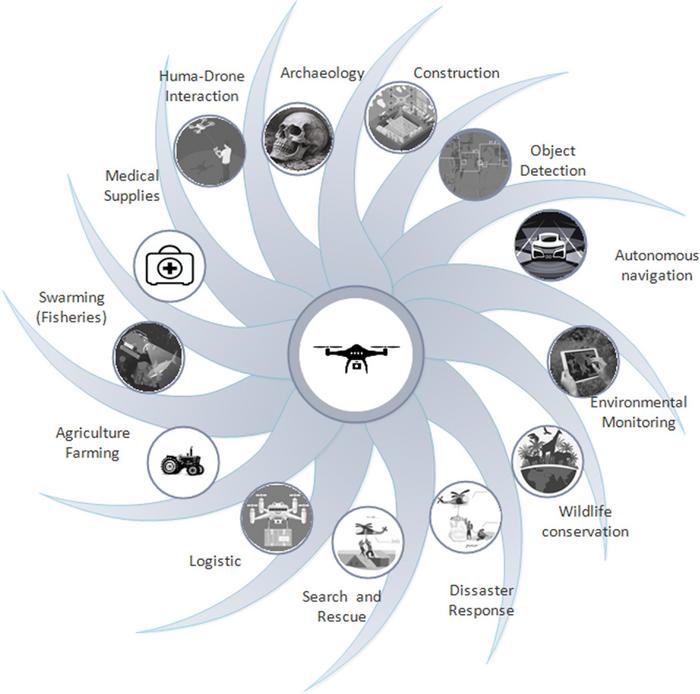
In recent years, the landscape of drone technology and unmanned aerial systems (UAS) has undergone a profound transformation, evolving from rudimentary experimental machinery to indispensable components embedded across a multitude of sectors critical to human progress. These intelligent aerial platforms are now pivotal in domains ranging from disaster response and healthcare logistics to precision agriculture, archaeological exploration, and environmental surveillance. Scientific investigations reveal that next-generation drones, empowered by sophisticated artificial intelligence and machine learning algorithms, are poised to redefine operational capabilities and societal impacts on a global scale.
At the forefront of this technological revolution is the integration of AI-driven autonomy in drones, enabling these machines to execute complex tasks with minimal human intervention. This evolution encompasses enhanced object detection, sophisticated path planning, and dynamic obstacle avoidance, facilitated by advances in sensor technologies. State-of-the-art drones now utilize LiDAR systems, multispectral imaging, and inertial measurement units (IMUs) to build detailed environmental maps and conduct nuanced analyses essential for applications in surveying and ecological monitoring.
Underpinning these advancements is a robust theoretical framework focused on mathematical modeling of autonomous navigation within UAVs. Researchers have developed optimization-based path loss models that incorporate terrain and environmental constraints, offering a more accurate representation of signal degradation and communication efficacy over various landscapes. This modeling approach surpasses traditional methods by factoring in real-world complexities that influence drone flight stability and connectivity, providing a strategic blueprint for enhancing operational efficiency.
Complementing the theoretical foundation is a comprehensive evaluation of diverse optimization algorithms. Genetic algorithms, particle swarm optimization, ant colony optimization, and reinforcement learning each contribute uniquely to calculating optimal flight trajectories. These methods aim to minimize energy consumption while maximizing flight duration and reliability. By dynamically adapting to environmental conditions and mission parameters, drones can achieve impressive endurance, opening new possibilities in long-haul medical deliveries and expansive surveillance assignments across urban and forest terrains.
The applications of such autonomous systems resonate through an array of critical fields. In disaster management scenarios, drones’ real-time data assimilation capabilities enable rapid situational awareness and resource allocation. Similarly, in precision agriculture, multispectral imaging assists in crop health assessment and optimized irrigation, enhancing yield and sustainability. Environmental scientists employ drone technology for wildlife monitoring, though cognizance is maintained on the potential disturbances such flights may impart on animal behavior and habitats, underscoring the need for eco-conscious operational protocols.
Despite the remarkable promise, the proliferation of intelligent drone systems summons a vital discourse on regulatory and ethical dimensions. The swift evolution necessitates updated legal frameworks that rigorously address issues of privacy, airspace governance, and operational accountability. The authors highlight a global imperative for harmonized policies that safeguard public interests while nurturing innovation. Moreover, the increasing complexity and deployment frequency of drones escalate concerns about security and necessitate advanced counter-drone technologies to counteract unlawful or malevolent activities.
Environmental impact remains an equally pressing challenge, as the manufacture and operation of drones involve ecological trade-offs. Specifically, the mass production of lithium-ion batteries contributes to electronic waste, while drone noise profiles and emissions may disrupt sensitive ecosystems. Advocates call for a balanced trajectory that integrates technological advancements with environmental stewardship to ensure biodiversity preservation and minimize carbon footprint, an equilibrium essential for sustainable drone industry growth.
Futuristic visions situate drones as integral nodes within the burgeoning Internet of Things (IoT) ecosystem, leveraging high-speed 5G and emergent 6G networks to facilitate instantaneous data exchange and seamless connectivity. This integration promises to accelerate advancements in urban air mobility (UAM), potentially revolutionizing passenger transport through safe, efficient aerial vehicles. Drones, therefore, stand at the cusp of transforming urban landscapes and transportation paradigms, contingent upon continued breakthroughs in safety protocols and infrastructural readiness.
Research contributions from institutions across the UAE, Algeria, and Malaysia coalesce in this comprehensive meta-analysis, bridging the nexus between theoretical constructs and pragmatic drone deployments. By aligning mathematical precision with operational challenges, the study articulates a clear pathway to real-world application scenarios, encompassing wildlife conservation, disaster relief, and agricultural monitoring. The emphasis on energy efficiency and secure operation underscores the multifaceted priorities integral to advancing drone technology responsibly.
Looking ahead, specialized drones tailored to specific industrial requirements are anticipated to emerge, harnessing technological refinement to meet nuanced operational demands unattainable by current generic models. This customization heralds a new epoch in drone design, wherein adaptability, endurance, and intelligent autonomy converge to enable unprecedented versatility across commercial and industrial sectors. Prolonged flight durations and minimized recharge intervals, driven by battery innovations, will further empower drones to undertake extended missions with heightened efficiency.
The societal impact of these emerging drone capabilities is profound. Automation and AI-driven intelligence will catalyze unprecedented transformations across industries, enhancing safety, productivity, and environmental monitoring. However, the trajectory also mandates a conscientious approach to ethical concerns, particularly around data privacy and responsible use of surveillance technologies. Transparency, accountability, and community engagement will be critical to fostering public trust and ensuring societal acceptance of pervasive drone integration.
In conclusion, the future of drone technology embodies a synthesis of automation, adaptability, and environmental consciousness. As these aerial systems become ingrained within the fabric of daily life and industrial processes, their evolution will remain intrinsically linked to ongoing advances in AI, sensor technologies, and communication networks. This intricate interplay signifies a new horizon where drones not only augment human capabilities but also catalyze a paradigm shift in how societies operate, conserve, and innovate.
News Publication Date: 1-Dec-2026
Web References:
https://doi.org/10.1016/j.ijcce.2025.10.004
https://www.sciencedirect.com/science/article/pii/S2666307425000440
References:
International Journal of Cognitive Computing in Engineering (2026). DOI: 10.1016/j.ijcce.2025.10.004
Cite Scienmag News
Alan Morgan. (February 1, 2026). Drone Technology Poised to Revolutionize Disaster Response, Healthcare, Environmental Management, Agriculture, and Cybersecurity. Scienmag. https://scienmag.com/drone-technology-poised-to-revolutionize-disaster-response-healthcare-environmental-management-agriculture-and-cybersecurity/
Alan Morgan. "Drone Technology Poised to Revolutionize Disaster Response, Healthcare, Environmental Management, Agriculture, and Cybersecurity." Scienmag, 1 February 2026, https://scienmag.com/drone-technology-poised-to-revolutionize-disaster-response-healthcare-environmental-management-agriculture-and-cybersecurity/. Accessed 4 September 2026.
Alan Morgan. "Drone Technology Poised to Revolutionize Disaster Response, Healthcare, Environmental Management, Agriculture, and Cybersecurity." Scienmag. February 1, 2026. https://scienmag.com/drone-technology-poised-to-revolutionize-disaster-response-healthcare-environmental-management-agriculture-and-cybersecurity/


