


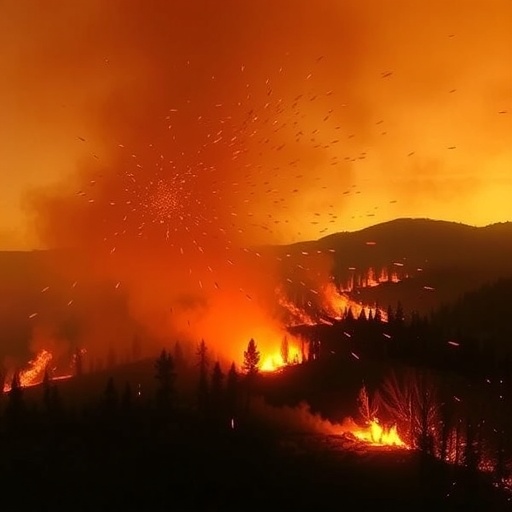
In recent years, wildfires have escalated in frequency and intensity, leaving profound impacts on ecosystems, air quality, and public health across the globe. However, one aspect of wildfire effects that has received comparatively little attention—yet holds enormous significance—is the behavior of pyrogenic particles as they travel downwind from fire zones. A groundbreaking study published in Communications Earth & Environment sheds new light on the deposition patterns of these wildfire-emitted particles, revealing how far and wide they can spread, and the profound implications of their dispersal.
The research, led by Scordo, Bavandpour, Or, and colleagues, presents a comprehensive analysis of downwind deposition of pyrogenic particles. These particles, primarily consisting of charred organic matter and soot, are lofted high into the atmosphere during wildfire events. Once airborne, their fate is dictated by complex interactions with atmospheric currents, chemical transformations, and physical settling processes. Understanding the mechanisms and extent of deposition is vital for unraveling how wildfires influence air pollution, ecosystem nutrient cycling, and climate forcing on regional and even global scales.
Central to the study is the integration of field measurements, atmospheric modeling, and particle characterization techniques to trace the distribution pathways of wildfire plumes. By leveraging advanced remote sensing data and in situ sampling from wildfire-affected regions, the authors quantify how pyrogenic particle concentrations evolve as plumes travel hundreds of kilometers downwind. This spatial perspective unveils patterns unseen when focusing solely on the fire source vicinity. The research reveals that pyrogenic particles can deposit far beyond initial fire perimeters, exerting influence over distant landscapes and populations previously assumed to be unaffected.
One remarkable finding of the investigation is the pronounced heterogeneity in deposition rates dependent on topography, meteorological conditions, and plume characteristics. Mountainous terrain, for instance, facilitates complex airflow patterns that can enhance particle scavenging and deposition in certain valleys. Conversely, stable atmospheric conditions tend to favor the extended transport of fine particles by suppressing vertical mixing. Therefore, wildfire-derived aerosols do not simply dilute uniformly with distance; instead, they interact dynamically with the environment, creating patchy deposition landscapes that challenge existing air quality models.
The pyrogenic particles themselves exhibit a range of sizes and morphologies, influencing their atmospheric residence times and deposition velocities. The study identifies that fine particulate matter, particularly those less than 2.5 micrometers in diameter, remains suspended longer and can penetrate deeper into human respiratory systems, amplifying health risks in communities downwind. Larger particles settle more rapidly but contribute significantly to local soil and water contamination upon deposition. The authors emphasize that assessing this size-dependent behavior is crucial for anticipating both immediate health impacts and longer-term ecological consequences from wildfire smoke.
Another significant contribution of the research lies in elucidating the chemical nature of the particles. Pyrogenic particles are rich in black carbon and complex organic compounds, some of which are toxic and capable of altering biogeochemical cycles when deposited in soil and water bodies. This chemical fingerprinting helps trace particle sources and transformations during atmospheric transport. The study highlights potential feedback loops where deposited particles can influence wildfire recurrence by altering soil properties and vegetation health, indicating that wildfire effects are interwoven with ecosystem resilience in ways not fully recognized until now.
By combining empirical data with sophisticated atmospheric transport models, Scordo and colleagues provide a predictive framework that links wildfire characteristics to downwind particle deposition patterns. This framework has the potential to improve air quality forecasting during wildfire seasons by enabling authorities to better anticipate pollutant burdens in urban and rural areas removed from the fire front. Furthermore, it assists policymakers in developing targeted mitigation strategies to protect vulnerable populations from harmful smoke exposure, especially as wildfire seasons lengthen with global climate change.
The implications of these findings extend beyond immediate environmental and health concerns. Pyrogenic particles deposited into ocean and freshwater systems can modify light penetration and nutrient dynamics, influencing aquatic biological productivity and carbon cycling. Additionally, black carbon deposited on snow and ice surfaces accelerates melting, contributing to feedback mechanisms in polar and alpine environments. The study underscores the interconnectedness of wildfire emissions and earth system processes, advocating for integrated monitoring efforts that bridge atmospheric science with ecology and hydrology.
This research also calls into question some prevailing assumptions about wildfire smoke impacts being localized phenomena. The evidence presented reveals that wildfire plumes behave as dynamic vectors transporting pollutants across continents in some cases. These experiences warrant a rethink of international air quality standards and collaborative wildfire management policies, as smoke from one region may have detrimental effects thousands of kilometers away. The transboundary nature of wildfire smoke thus emerges as a critical consideration for global environmental governance.
A key strength of the study is its multidisciplinary approach, combining expertise in atmospheric chemistry, fluid dynamics, ecology, and environmental health. This integrated perspective was essential to grasp the full complexity of pyrogenic particle lifecycle, from emission through transport to deposition and ecosystem interaction. The meticulous spatial and temporal resolution of their data sets sets a new benchmark for wildfire smoke research, enabling a deeper understanding of smoke’s hidden footprint that often eludes less detailed analyses.
Looking ahead, the authors suggest several avenues for future research, including more targeted investigations during extreme fire events, which are increasing under climate change scenarios. There is also a need to explore how changing vegetation types and fire intensities influence particle composition and behavior. Technological advancements in sensor networks and satellite remote sensing promise to improve real-time monitoring capabilities, essential for rapid health advisories and mitigation efforts.
The study’s broader message carries weight in a planet increasingly defined by megafires and smoke-laden skies. It urges greater investment in wildfire science infrastructure and sustained international data sharing. Only through collaborative, cutting-edge research can we hope to fully decipher and manage the far-reaching consequences of wildfire smoke, thereby protecting both human and environmental health from this insidious byproduct of a warming, drying world.
In conclusion, the revelation of intricate downwind deposition dynamics by Scordo and colleagues marks a pivotal advancement in wildfire research. Their work transforms our understanding of pyrogenic particle transport from simplistic dispersal models into an appreciation of smoke as a multifaceted atmospheric agent linking fire behavior with global environmental change. As wildfires become an ever more frequent reality, this study serves as a crucial reminder of the unseen yet potent journeys these particles undertake, shaping air quality, ecosystems, and climate far beyond the burning frontier.
Cite Scienmag News
Russell Cooper. (June 9, 2026). Downwind Deposition of Wildfire Pyrogenic Particles. Scienmag. https://scienmag.com/downwind-deposition-of-wildfire-pyrogenic-particles/
Russell Cooper. "Downwind Deposition of Wildfire Pyrogenic Particles." Scienmag, 9 June 2026, https://scienmag.com/downwind-deposition-of-wildfire-pyrogenic-particles/. Accessed 3 September 2026.
Russell Cooper. "Downwind Deposition of Wildfire Pyrogenic Particles." Scienmag. June 9, 2026. https://scienmag.com/downwind-deposition-of-wildfire-pyrogenic-particles/


