


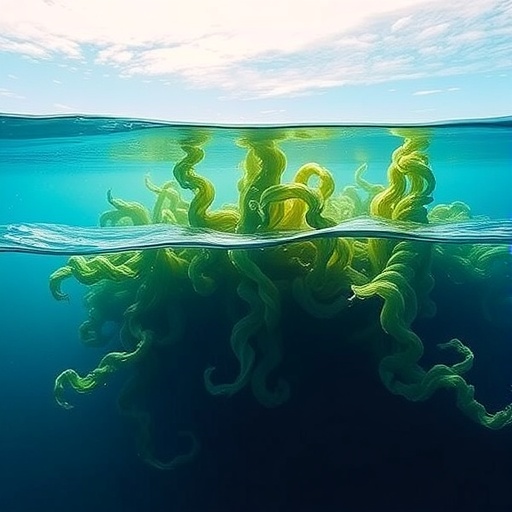
In a groundbreaking long-term study, marine scientists at the University of California, Santa Barbara, have revealed that the productivity of giant kelp forests is more profoundly influenced by disturbance events than by resource availability. By analyzing 20 years of meticulous monthly data from the Santa Barbara Coastal Long Term Ecological Research site, the researchers uncovered how storms and physical disruptions dictate the net primary productivity (NPP) of these vital coastal ecosystems.
Giant kelp, known for its exceptional growth rates and ecological importance as a foundational species, experiences frequent biomass removal due to natural disturbances such as winter storms and wave action. Unlike terrestrial ecosystems, where factors like temperature, water, and nutrient availability primarily regulate productivity, these marine forests contend with rapid turnover driven largely by physical disturbance.
Senior researcher Daniel Reed highlights that previous studies, including one from 2008, initiated a conceptual model describing kelp productivity fluctuations. However, the current dataset—collected over nearly two decades—provides a more nuanced understanding, especially after significant recent challenges to kelp forests such as marine heatwaves, purple sea urchin outbreaks, and substrate burial from shifting sands.
Lead author Billie Beckley explains that kelp productivity largely hinges on survival through disturbances rather than just growth rates. “Winter storms strongly shape how productive kelp forests are by removing biomass and changing the forest’s ability to recover,” she stated. The findings emphasize that the combined effects of storm-induced mortality and the successful recruitment of new kelp plants dictate annual variations in NPP.
Interestingly, the study also highlights indirect effects where disturbances, while initially destructive, can enhance productivity by creating open spaces and improving light penetration, which benefits kelp recruits. This dynamic balance between disturbance and regrowth underscores the complexity of these ecosystems.
The implications of this research extend beyond kelp forests themselves, as the productivity generated significantly nourishes nearshore food webs, both through biomass dispersal into deeper waters and as organic matter delivered to beaches. This connectivity underscores the broader ecological importance of understanding how disturbance regimes shape ecosystem health.
With climate change intensifying the frequency and severity of storms and marine heatwaves, such insights become critical for designing conservation and restoration strategies. The researchers caution that increasing environmental stressors could disrupt the delicate equilibrium between disturbance and kelp forest resilience.
By shedding light on how mechanical disturbances dominate productivity patterns in giant kelp forests, this study challenges traditional ecological paradigms and offers a vital perspective on managing coastal marine ecosystems in an era of rapid environmental change.
Cite Scienmag News
Violet Maxwell. (July 13, 2026). Disturbance Impacts Giant Kelp Growth More Than Resource Levels. Scienmag. https://scienmag.com/disturbance-impacts-giant-kelp-growth-more-than-resource-levels/
Violet Maxwell. "Disturbance Impacts Giant Kelp Growth More Than Resource Levels." Scienmag, 13 July 2026, https://scienmag.com/disturbance-impacts-giant-kelp-growth-more-than-resource-levels/. Accessed 4 September 2026.
Violet Maxwell. "Disturbance Impacts Giant Kelp Growth More Than Resource Levels." Scienmag. July 13, 2026. https://scienmag.com/disturbance-impacts-giant-kelp-growth-more-than-resource-levels/


