


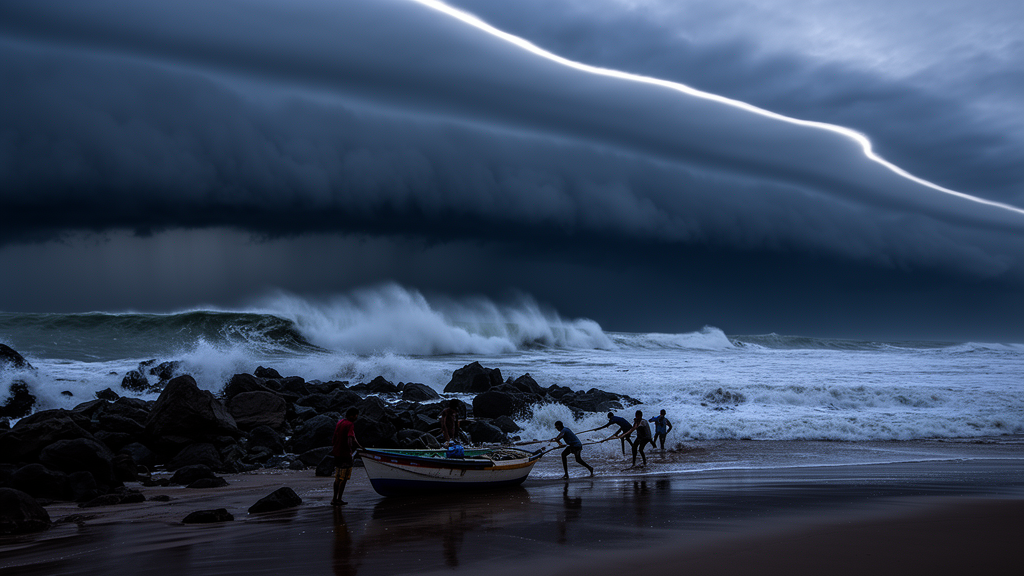
When the waves strike Peru’s coast, the storm that created them may be thousands of kilometers away and, in some cases, on the other side of the Equator. A new study published in Weather and Climate Dynamics has dissected the atmospheric machinery behind the most extreme swell events to hit the Peruvian shoreline over the past two decades, revealing a remarkably consistent fingerprint: a deep, vertically coherent Pacific cyclone working in tandem with a strengthened jet stream to whip up winds over vast stretches of open ocean, precisely aimed at the coast of South America. The research, led by Gonzalo Agurto Barragán of the Peruvian Navy’s Directorate of Hydrography and Navigation together with Soledad Collazo and Ricardo García-Herrera of the Universidad Complutense de Madrid, offers coastal planners and forecasters a new way to anticipate these remote hazards days before the first wave arrives.
The team assembled its benchmark sample from an unusual and valuable archive: special warnings issued by the Peruvian Navy between 2008 and 2025. These operational records classify swell episodes by their expected coastal impact, with a very strong swell defined as waves exceeding three times their normal height and a strong swell between two and three times normal. From this record, the researchers identified five very strong events, all arriving during the austral winter months of May through September with pronounced south-westerly directions from the South Pacific, and six strong events originating in the North Pacific, mostly during boreal winter. Because the Navy archive is the only homogeneous operational classification available for the Peruvian coast, the authors treat these eleven cases as a benchmark sample rather than an exhaustive climatology.
A central challenge in studying remote swells is timing. The waves that batter a Peruvian beach were generated days earlier, sometimes on the far side of an entire ocean basin, so the atmospheric conditions that matter occurred long before the coastal impact. The researchers solved this by applying deep-water wave theory, calculating the group velocity of a swell packet from its wave period and the great-circle distance between the storm’s wind region and the coast. Using representative swell periods of 16 to 20 seconds, consistent with long-period swells previously reported for Peru, they estimated travel times of roughly three to four days for Southern Hemisphere events and eight to eleven days for Northern Hemisphere events. These windows then defined the periods over which they examined atmospheric fields from the ERA5 reanalysis.
The composite analysis of the Southern Hemisphere events revealed a strikingly organized pattern. Days before the swell peak, sea-level pressure anomalies form a tripolar structure over the southeast Pacific: a deep extratropical cyclone south of 40 degrees south, flanked by broad anticyclonic anomalies to its southwest and southeast. This arrangement dramatically tightens the meridional pressure gradient along the storm’s equatorward flank, driving a wide corridor of intensified westerly and south-westerly winds between roughly 35 and 55 degrees south. Crucially, the disturbance is barotropic, meaning the pressure anomalies at the surface, at 500 hectopascals, and at 250 hectopascals are nearly vertically aligned, allowing the storm to persist and sustain its winds over the same stretch of ocean. The result is a swath of enhanced significant wave height exceeding one meter across the high-latitude source region, with wave energy radiating directly toward Peru and Chile.
The jet stream diagnostics added a decisive layer to the picture. Applying a multiparametric method that measures not just jet intensity but also sharpness, tilt, and meridional coherence, the team found that Southern Hemisphere events coincide with a polar-front jet that is significantly stronger and sharper than the austral-winter climatology, with its core confined to a narrow latitude band and a modest southwest-to-northeast tilt. This compact, energized jet reinforces the storm-jet coupling that keeps the surface wind corridor locked in place over the swell-generation region. In the Northern Hemisphere, the configuration is different but equally coherent: the subtropical jet intensifies, sharpens, and extends longitudinally across the North Pacific, while the polar-front jet weakens and becomes less continuous. This redistribution of upper-level momentum supports deep, slow-moving cyclones over the central and western North Pacific, whose westerly to north-westerly winds can still fling wave energy across the Equator toward northern Peru.
The hemispheric contrast also explains why Southern Hemisphere events hit harder. Swell from the South Pacific travels a shorter path, arriving in three to four days with limited dispersion, and the tripolar pressure pattern sustains winds over an exceptionally long fetch. Northern Hemisphere swells must cross the entire Pacific and the Equator, a journey of eight to eleven days during which the wave energy spreads and attenuates. That is why, in the Navy’s classification, Southern Hemisphere events reached the very strong category while their Northern counterparts topped out at strong. Recent episodes illustrate the stakes: a May 2023 anomalous southwest swell caused coastal flooding and closed dozens of Peruvian ports, while a late-December 2024 swell from a North Pacific winter storm surprised tourist beaches and small ports on Peru’s northern coast under otherwise fair local weather.
Perhaps the most consequential finding concerns climate change. Because extreme swell records span only a few years, the team turned to a flow-analogue framework, searching the ERA5 record from 1950 to 2025 for days with atmospheric circulations dynamically similar to each event and comparing the surface winds associated with those analogues in past and present climate periods. Because circulation is held fixed across analogues, any difference in wind speed cannot be attributed to changes in the circulation pattern itself. For the Southern Hemisphere events, the result was unambiguous: analogous circulation patterns are now associated with significantly stronger surface winds than in the past, and the corresponding significant wave heights have increased as well. The one exception was event E3, which showed no significant influence of the dominant climate mode but may instead respond to the regional forcing of the Amundsen Sea Low.
The likely culprit behind this Southern Hemisphere intensification is the Southern Annular Mode, the leading mode of extratropical Southern Hemisphere variability. Analogue days in the recent period occurred predominantly under positive SAM phases, which strengthen and shift the westerly wind belt poleward, boosting windiness over the high-latitude South Pacific exactly where the swell-generating storms live. The trend toward more positive SAM conditions has been linked in the scientific literature to stratospheric ozone depletion and rising greenhouse gas concentrations, providing a plausible physical pathway from anthropogenic forcing to stronger swell-producing winds. The authors are careful to note that differences between past and present analogues may also reflect internal climate variability or other external factors, but the coherence of the signal across nearly all Southern Hemisphere events, supported by statistically significant wave-height increases, makes it physically compelling.
The Northern Hemisphere story is far messier. Analogue reconstructions revealed no consistent climate-change signal: the three most recent events showed stronger present-day winds, while the three earlier ones showed weaker winds, and no single mode of Pacific variability, whether the Pacific Decadal Oscillation, ENSO, the Pacific-North American pattern, the Arctic Oscillation, the Western Pacific pattern, or the Interdecadal Pacific Oscillation, could account for the split. The two groups of events appear governed by opposing configurations of large-scale climate modes, and regression analysis found these modes explain only a modest fraction of the wind variability, implying that local synoptic processes and factors such as aerosol changes, Arctic sea-ice variations, and subtropical tropospheric warming may also be at play. The high interannual and decadal variability of the North Pacific, the authors note, is precisely why the IPCC expresses low confidence in attributing observed changes in extratropical cyclones there to human influence.
The practical payoff of this work lies in early warning. Because the precursor patterns, a deep barotropic cyclone aligned with an energized jet, emerge days before coastal impact, monitoring these large-scale configurations could give Peruvian authorities substantially longer lead times than current approaches, allowing ports to close, fishing fleets to stay ashore, and coastal communities to prepare before the waves arrive. The authors caution that their sample is concentrated after 2010 and that extending the analysis further back will require reconstructing pre-2008 events. They also propose applying the flow-analogue framework to large ensembles of climate model simulations under historical and future forcing scenarios, which would allow a formal attribution of the circulation changes and a more robust assessment of how anthropogenic climate change will shape the swell hazards of Peru’s coastline in the decades ahead.
Subject of Research: Meteorological and jet-stream drivers of extreme remote swell events affecting the Peruvian coast
Article Title: Meteorological drivers of extreme swells on the Peruvian coast
Article References: Meteorological drivers of extreme swells on the Peruvian coast. (n.d.). https://doi.org/10.5194/wcd-7-1779-2026
Image Credits: AI Generated
Keywords: extreme swells, Peru, jet stream, extratropical cyclones, ERA5 reanalysis, Southern Annular Mode, Pacific Decadal Oscillation, coastal flooding, wave climate, flow analogues, climate change attribution, early warning systems
Cite Scienmag News
Russell Cooper. (October 9, 2026). Distant Pacific Storms and Jet Stream Power Behind Peru’s Most Dangerous Swells. Scienmag. https://scienmag.com/distant-pacific-storms-and-jet-stream-power-behind-perus-most-dangerous-swells/
Russell Cooper. "Distant Pacific Storms and Jet Stream Power Behind Peru’s Most Dangerous Swells." Scienmag, 9 October 2026, https://scienmag.com/distant-pacific-storms-and-jet-stream-power-behind-perus-most-dangerous-swells/. Accessed 9 October 2026.
Russell Cooper. "Distant Pacific Storms and Jet Stream Power Behind Peru’s Most Dangerous Swells." Scienmag. October 9, 2026. https://scienmag.com/distant-pacific-storms-and-jet-stream-power-behind-perus-most-dangerous-swells/


