


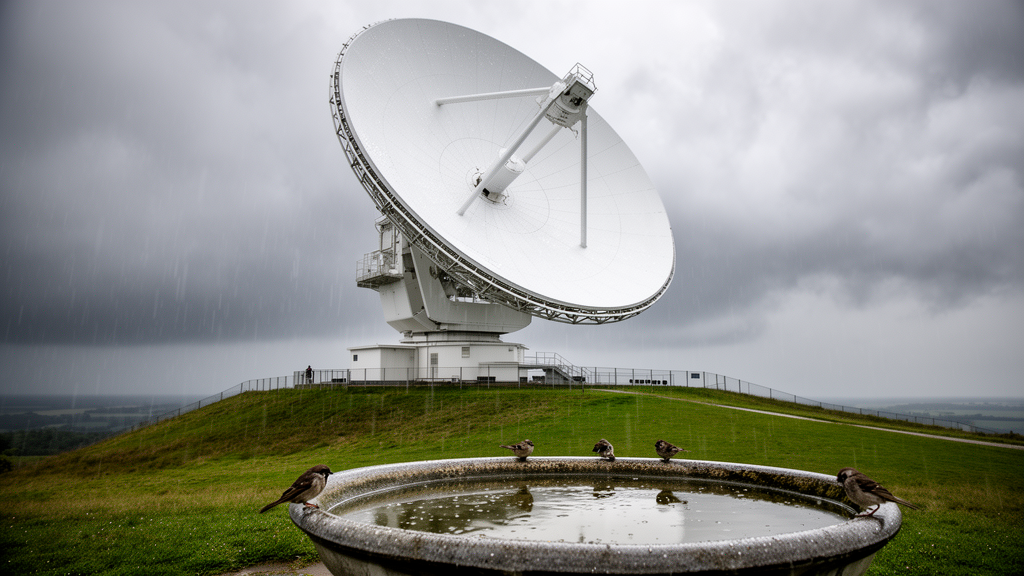
Every weather forecast, flood warning, and climate model ultimately depends on a deceptively simple question: can the radar be trusted? A decade-long study from the University of Bonn has now delivered an uncomfortable answer for one of radar meteorology’s most beloved calibration tricks, and in doing so has introduced a new technique that may outperform the standard methods used to keep weather radars honest. The research, published in Atmospheric Measurement Techniques, forms the calibration foundation for an ambitious ten-year climatology of cloud and precipitation microphysics built from X-band radar observations over western Germany.
The radar at the heart of the study, known as BoXPol, has been scanning the skies above Bonn since 2009 from its perch on the roof of the Institute of Geosciences. Operating at X-band wavelengths of about 3.2 centimeters, the instrument measures how horizontally and vertically polarized radar pulses interact with raindrops, snowflakes, and melting ice. Two quantities matter most: the reflectivity factor ZH, which gauges how much energy is scattered back, and the differential reflectivity ZDR, which captures how much raindrops are flattened by air resistance. For quantitative rainfall estimation, hydrometeor classification, and microphysical retrievals, both must be calibrated with extraordinary care, with ZDR in particular requiring accuracy on the order of 0.1 to 0.2 decibels.
The trouble began with the birdbath method, long considered the gold standard for ZDR calibration. The idea is elegant: point the antenna straight up at 90 degrees elevation and watch rain fall through the beam. Viewed from below, falling raindrops appear nearly spherical, so the horizontally and vertically polarized returns should be identical, and any measured difference reveals the instrument’s bias. But when the Bonn team, led by Tobias Scharbach together with Velibor Pejcic and Silke Trömel, scrutinized birdbath-derived offsets across their 2013 to 2023 record, they found the method only worked reliably between April 2014 and April 2017. Outside that window, errors exceeding 0.2 decibels crept in, with the 2013 values proving especially unrealistic.
The culprit appears to be an elevation dependence nobody expected. Hardware changes documented in the radar’s logbook, including magnetron replacements, a software upgrade from the Enigma 3 to Enigma 4 signal processor, and system restarts, seem to have caused the ratio of radar constants for the vertical and horizontal channels to differ between the vertical birdbath scan and the 18-degree elevation scans used for the science. In other words, an offset measured pointing straight up does not necessarily apply to the oblique scans that actually produce the data. The researchers suspect the mechanical elevation control or the rotary joints connecting transmitter and receiver to the antenna, and they caution that other radars may harbor the same hidden flaw. Their message to the community is blunt: do not blindly transfer a birdbath offset to the rest of the volume scan without verification.
As a replacement, the team adapted a technique based on quasi-vertical profiles, or QVPs, a clever way of squeezing vertical information out of ordinary conical scans. By azimuthally averaging a full 360-degree sweep at a fixed 18-degree elevation, the radar effectively synthesizes a vertical cross-section of the atmosphere, with statistical averaging that dramatically reduces noise. In light rain, defined by reflectivity below 20 dBZ and high correlation between the polarization channels, the mean ZDR of such a profile should match a theoretically expected value. The team derived that expectation from T-matrix electromagnetic scattering simulations, fed by a large dataset of drop size distributions measured with disdrometers across Germany, mostly in Bonn, between 2011 and 2019.
A satisfying robustness emerged from the simulations: whether the temperature was 5 or 30 degrees Celsius, and whether the width of the raindrop canting angle distribution ranged from 5 to 12 degrees, the intrinsic ZDR in light rain barely budged, settling at about 0.1 decibels. That insensitivity means the calibration does not hinge on uncertain environmental assumptions. Daily offsets were computed only when at least 100 valid measurements existed and the spread stayed below 0.2 decibels, with gaps filled by a centered 30-day rolling mean. During the stable 2014 to 2017 period, the QVP-based offsets and the birdbath offsets agreed closely, with a root-mean-square difference of just 0.1 decibels, confirming that both methods capture the same underlying reality when the hardware cooperates.
With ZDR secured, the researchers flipped a classic calibration technique on its head to tackle ZH. The well-known relationship between reflectivity and differential reflectivity in light rain has traditionally been used to calibrate ZDR; here, the team inverted it, using measured ZDR as a predictor for the ZH that should ideally be observed. A polynomial fit to the T-matrix simulations at 10 degrees Celsius, roughly Germany’s average annual temperature, provides the expected reflectivity for each measured ZDR, and the difference between measurement and expectation yields the daily ZH offset. Strict filtering, including a minimum Spearman correlation of 0.4 between the two variables on each scan and the exclusion of mixed-phase hydrometeors well below the melting level, keeps the technique anchored in genuine light rain.
Validation came from two independent directions. First, the team compared their calibrated reflectivity against measurements from the Dual-frequency Precipitation Radar on the Global Precipitation Mission core satellite, treating the spaceborne instrument as a reference in the sky. Across 92 satellite overflights between 2014 and mid-2019, the new method’s offsets tracked the satellite values with a root-mean-square error of 0.70 decibels, a mean absolute error of 0.60 decibels, and a mean bias of just minus 0.50 decibels when averaged over statistically stable periods. Second, they tested the conventional alternative, self-consistency relations that exploit the interplay between reflectivity, differential reflectivity, and the specific differential phase KDP. That approach produced larger discrepancies, with errors several times greater and a systematic overestimation of expected reflectivity, partly reflecting uncertainties in KDP processing and in the assumed raindrop shape models.
The payoff extends well beyond calibration bookkeeping. Accurately calibrated polarimetric variables are the raw material for the second paper in the series, which assembles a ten-year climatology of quasi-vertical profiles capturing the melting layer and the dendritic growth layer where snowflakes blossom into intricate crystals. Such climatologies of ice water content, particle number concentration, and mean particle size offer numerical weather prediction modelers a statistically robust benchmark against which to test and improve their microphysics schemes, which are known to overproduce graupel and underestimate ice particle concentrations. Polarimetric fingerprints of aggregation, size sorting, and dendritic growth, once the radar is trustworthy, become a powerful lens on processes models struggle to represent.
There are lessons here for every weather service operating a polarimetric radar. The study demonstrates that a calibration method can be locally valid yet globally misleading, and that elevation-dependent biases may lurk in instruments that appear perfectly healthy when pointed skyward. It also shows that the atmosphere itself, properly filtered for homogeneous stratiform rain using a combination of melting layer detection and Shannon information entropy, can serve as a calibration reference when dedicated targets or satellite overpasses are unavailable. The researchers suggest future work could combine their inverted ZH-ZDR technique with attenuation-based and solar calibration approaches, extend validation to other climates and wavelengths, and push toward higher-resolution offset estimates. For now, the Bonn team has shown that sometimes the best way to calibrate a radar is to stop looking straight up and start reading what the rain itself is trying to say.
Subject of Research: Calibration of polarimetric X-band weather radar variables for a long-term microphysical climatology
Article Title: Long-term climatology of vertical profiles of polarimetric variables and ice-microphysical retrievals at X-band – Part 1: Radar calibration
Article References: Scharbach, T., Pejcic, V., & Trömel, S. (2026). Long-term climatology of vertical profiles of polarimetric variables and ice-microphysical retrievals at X-band – Part 1: Radar calibration. Atmospheric Measurement Techniques, 19(19), 6209-6228. https://doi.org/10.5194/amt-19-6209-2026
Image Credits: AI Generated
Keywords: weather radar, radar calibration, polarimetric variables, differential reflectivity, reflectivity factor, X-band radar, quasi-vertical profiles, birdbath scan, GPM satellite, microphysics, melting layer, quantitative precipitation estimation
Cite Scienmag News
Russell Cooper. (October 9, 2026). Weather Radar Calibration Gets a Rethink as Birdbath Method Falls Short. Scienmag. https://scienmag.com/weather-radar-calibration-gets-a-rethink-as-birdbath-method-falls-short/
Russell Cooper. "Weather Radar Calibration Gets a Rethink as Birdbath Method Falls Short." Scienmag, 9 October 2026, https://scienmag.com/weather-radar-calibration-gets-a-rethink-as-birdbath-method-falls-short/. Accessed 9 October 2026.
Russell Cooper. "Weather Radar Calibration Gets a Rethink as Birdbath Method Falls Short." Scienmag. October 9, 2026. https://scienmag.com/weather-radar-calibration-gets-a-rethink-as-birdbath-method-falls-short/


