


For decades, clinicians have relied on a deceptively simple maneuver to gauge how well older bodies are holding up: ask a patient to stand up from a chair, sit back down, and repeat. Now, new research suggests that this humble movement test carries a powerful warning signal much earlier in life than previously appreciated. A longitudinal study tracking nearly 3,000 middle-aged adults for up to 18 years has found that people in their thirties, forties, and fifties who cannot complete five chair stands face more than double the mortality risk of those who can perform the task quickly and easily. The findings, published in PLOS Aging and Health, position the five-repetition chair stand test as a potentially life-saving screening tool for a population that doctors rarely think to test at all.
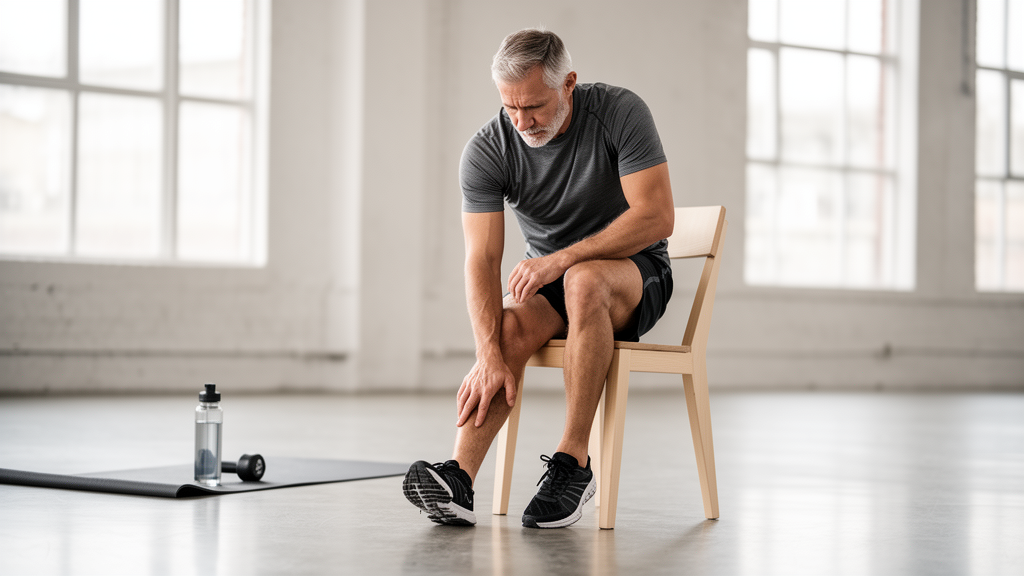
The five chair stand test, abbreviated CST-5, is a 60-second assessment of leg strength, endurance, and balance. Participants begin seated in a chair with their arms folded across their chest, then rise to a full standing position and sit back down five times as quickly as they safely can. The clock captures everything that matters about lower-body function: the explosive power of the quadriceps and gluteal muscles, the cardiovascular capacity to sustain repeated effort, the proprioceptive control needed to keep the body stable through each transition, and the joint mobility that allows a full range of motion at the hips, knees, and ankles. Because standing up from a chair is an activity most people perform dozens of times a day without thinking, failure to do it five times in a row represents a meaningful departure from normal physiological function rather than an abstract laboratory measurement.
Geriatricians have used the CST-5 for years to evaluate elderly patients, and a robust body of work has linked poor performance to elevated risks of falls, frailty, disability, and death in people over 65. What has been missing is evidence about the test’s relevance for middle-aged adults, a group that generally falls outside the scope of physical performance screening. The new study, led by Nicolle A. Mode, Alan B. Zonderman, and Michele K. Evans, set out to fill that gap by following a socioeconomically diverse cohort of 2,943 adults aged 30 to 64 enrolled in Baltimore, Maryland. The researchers measured chair stand performance at four separate study visits and tracked mortality over an 18-year follow-up period spanning 2004 to 2022.
The study’s longitudinal design is what gives its conclusions real weight. Rather than taking a single snapshot of physical ability, the investigators recorded CST-5 results at repeated visits, with participants averaging 2.5 assessments each. At enrollment, the participants had a mean age of 48.7 years, and by the fourth visit their mean age had risen to 59.7 years. Using Cox regression models with time-varying covariates, a statistical approach that allows the analysis to incorporate updated test results as participants aged, the team could ask whether changes in chair stand ability over time tracked with changes in mortality risk. This design helps distinguish between people who were always physically limited and those whose function declined during the study window, offering a more nuanced picture than a single baseline measurement ever could.
The headline finding is stark. People who were unable to complete the five chair stands had a hazard ratio of 2.19 for mortality, with a 95 percent confidence interval of 1.65 to 2.92, compared with participants who finished the test in less than 13.7 seconds. In practical terms, failing the test more than doubled the risk of dying during the follow-up period, and the confidence interval sits comfortably above 1.0, indicating the result is statistically robust. Just as striking is how common test failure was in this relatively young cohort: the proportion of participants unable to complete the CST-5 rose from 19 percent at the first visit to 31 percent at the fourth visit. Nearly one in five adults in their thirties through fifties, an age range when most people assume their bodies are still resilient, could not perform a movement that healthy adults typically manage without effort.
Perhaps the most clinically provocative detail concerns the disconnect between test failure and self-reported function. Among participants who could not complete the CST-5 at the first visit, half reported no difficulties getting out of a chair in their daily lives. This gap between subjective experience and objective performance suggests that many middle-aged adults are unaware of the physiological decline their bodies are quietly undergoing. Daily chair transfers are typically performed at a self-selected, comfortable pace with plenty of recovery time between efforts, which can mask deficits in the strength and endurance that a timed, repeated test exposes. A patient who feels fine standing up from the sofa after dinner may nonetheless lack the lower-body power reserve that predicts long-term survival, and without a standardized test, neither the patient nor the physician would ever know.
Intriguingly, the data suggest that the critical threshold is not speed but the binary ability to finish at all. Among participants who did complete the test, there was no statistically significant difference in mortality risk between slower and faster performers; the hazard ratio comparing the two groups was 1.24, with a 95 percent confidence interval of 0.95 to 1.62, a range that includes the null value of 1.0. In other words, once a person can complete five stands, finishing in 15 seconds rather than 10 does not appear to carry a measurable survival penalty in this cohort. The message for clinicians is therefore refreshingly simple: the first question to ask is not how fast a patient can stand, but whether the patient can stand five times at all. Inability to complete the test is the red flag that demands attention.
The researchers also tested whether the association held up when other known mortality risk factors were taken into account. Adding additional covariates to the statistical models did not change the main findings, indicating that the CST-5 captures physiological information that standard risk factors miss. This independence matters because it implies the test is not merely a proxy for age, body weight, or self-reported health status. Instead, it appears to integrate the function of multiple body systems, including muscle mass and quality, neuromuscular coordination, cardiovascular reserve, and joint integrity, into a single number that reflects overall biological resilience. No questionnaire or blood panel currently provides that kind of integrated functional snapshot so cheaply and quickly.
The practical appeal of the CST-5 lies in its extraordinary simplicity. The test requires nothing more than a sturdy chair, a stopwatch, and about a minute of a clinician’s or patient’s time. There are no laboratory fees, no calibration, no specialized training beyond basic instruction, and no exposure to radiation or contrast agents. In an era when health screening increasingly depends on expensive imaging and biomarker panels, a test that costs essentially nothing yet doubles as a mortality predictor for middle-aged adults is a rare and valuable commodity. The authors argue that the CST-5 may provide important clinical information for middle-aged adults in an easy-to-administer format, and the new evidence gives that argument considerable force.
For the public, the takeaway is both sobering and actionable. Middle age is when the physiological foundations of late-life health are quietly laid, and the ability to rise from a chair five times in succession turns out to be a surprisingly sensitive barometer of those foundations. Failing the test does not seal anyone’s fate, but it should prompt a conversation with a healthcare provider about strength training, physical activity, and the underlying conditions that may be eroding muscle and balance. Half of the people who failed the test in this study felt perfectly capable of getting out of a chair, which means self-assessment is not enough. A one-minute test administered at a routine checkup could reveal a risk that neither patient nor doctor suspected, and the earlier that risk is identified, the more years remain to do something about it.
Subject of Research: The five chair stand test as a predictor of mortality risk in middle-aged adults
Article Title: Middle-aged chair stands predict mortality risk
Article References: Mode, N. A., Zonderman, A. B., & Evans, M. K. (2026). Middle-aged chair stands predict mortality risk. PLOS Aging and Health, 1(2), e0000026. https://doi.org/10.1371/journal.page.0000026
Image Credits: AI Generated
DOI: 10.1371/journal.page.0000026
Keywords: chair stand test, mortality risk, middle-aged adults, physical performance, leg strength, longitudinal study, Cox regression, aging, functional assessment, screening, PLOS Aging and Health, balance
Cite Scienmag News
Beatrice Stafford. (October 9, 2026). A Simple Chair Test in Middle Age May Reveal Hidden Mortality Risk. Scienmag. https://scienmag.com/a-simple-chair-test-in-middle-age-may-reveal-hidden-mortality-risk/
Beatrice Stafford. "A Simple Chair Test in Middle Age May Reveal Hidden Mortality Risk." Scienmag, 9 October 2026, https://scienmag.com/a-simple-chair-test-in-middle-age-may-reveal-hidden-mortality-risk/. Accessed 9 October 2026.
Beatrice Stafford. "A Simple Chair Test in Middle Age May Reveal Hidden Mortality Risk." Scienmag. October 9, 2026. https://scienmag.com/a-simple-chair-test-in-middle-age-may-reveal-hidden-mortality-risk/


