


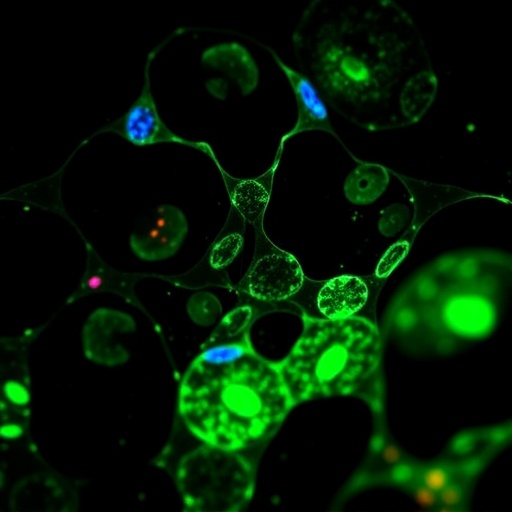
A drug that millions of people with breast cancer already take every day may be hiding a second, unexpected talent: the ability to silence the inflammatory uproar of aged and damaged cells that accumulate in our tissues and quietly poison them from within. In a new study published in Nature Aging, researchers report that short-term treatment with abemaciclib, a widely prescribed inhibitor of the cell-cycle enzymes CDK4 and CDK6, suppresses the inflammatory program that senescent cells unleash as they build up during aging and after chemotherapy. In mice, the drug blunted the tumor-promoting activity of senescent cells left behind by cancer treatment and produced measurable gains in physical function in animals weakened by chemotherapy. Behind the effect, the team identified a specific molecular circuit — a three-way axis linking CDK4/6, the retinoic acid receptor RARα, and the master inflammatory transcription factor NF-κB — and showed that severing that circuit with drugs can calm inflamed tissue without killing the cells responsible for the damage.
The cells at the heart of the study are senescent cells — cells that have permanently exited the cell cycle yet refuse to die. Senescence is not simply wear and tear; it is an actively programmed state that can be triggered by telomere erosion, DNA damage, oncogene activation, or the genotoxic stress of chemotherapy itself. Many front-line cancer drugs work by inflicting precisely the kind of damage that forces cells into this arrested condition. In the short term, the arrangement serves the body well, acting as a brake that keeps damaged cells from turning cancerous. But senescent cells do not retire quietly. They secrete a dense mixture of inflammatory cytokines, growth factors, and tissue-remodeling enzymes known as the senescence-associated secretory phenotype, or SASP. The pro-inflammatory arm of this program, driven by NF-κB and termed the NF-κB-associated SASP, or NASP, by the study’s authors, is considered its most destructive component. It fuels the chronic, low-grade inflammation that accumulates with age, erodes the function of multiple tissues, and — in a cruel twist — can nurture the survival and regrowth of tumors that survive treatment.
For much of the past decade, the field’s answer to these cells has been to eliminate them outright with drugs called senolytics. That strategy has produced striking results in animal models and early clinical studies, but it carries inherent hazards. Clearing senescent cells can strip tissues of cells that still perform useful structural and repair functions, some senolytic compounds produce significant side effects, and it remains unclear which senescent cells in a given tissue should be removed. A quieter strategy has therefore gained ground: senomorphic drugs, which leave senescent cells in place but turn down their harmful secretions. The persistent difficulty has been finding a molecular switch that is specific to the inflammatory SASP, accessible to existing drugs, and capable of acting in cells whose senescent state is already fully established — since most screens test only whether a compound prevents senescence from arising in the first place. The new study identifies a single, clinically validated target, the CDK4/6 kinase pair, that appears to satisfy all three criteria.
CDK4 and CDK6 are best known as gatekeepers of cell division. Paired with their cyclin partners, they phosphorylate the retinoblastoma protein, releasing cells from the G1 checkpoint and sending them into DNA replication. Abemaciclib, an oral drug approved for the treatment of hormone receptor-positive breast cancer, exploits precisely this role to halt tumor proliferation. The researchers asked a different question: beyond controlling the cell cycle, do these kinases help operate the inflammatory program of senescence itself? To find out, they administered short courses of abemaciclib to senescent cells in culture and to mice carrying pre-existing senescent cells, then measured the activity of NASP genes. Crucially, the cells were already senescent before the drug arrived, meaning the experiments tested whether an established inflammatory state could be reversed — the therapeutically relevant scenario — rather than merely prevented. It could. Short-term CDK4/6 inhibition reliably suppressed the NASP signature in both cultured cells and living animals. The senescent cells remained in place, but their inflammatory output dropped sharply, as though the cell’s inflammatory alarm had been switched off without dismantling the rest of the machinery.
The practical consequences emerged most clearly in mice recovering from chemotherapy. Chemotherapy attacks tumors with DNA-damaging agents, but it also seeds tissues throughout the body with newly created senescent cells, and the SASP these cells secrete has a documented darker side: it can promote the proliferation, invasion, and survival of tumor cells that slip through treatment. In the study, short-term abemaciclib treatment reduced the pro-tumorigenic activity of chemotherapy-induced senescent cells, weakening their capacity to support residual cancer. Just as importantly, the drug changed how the animals moved. Mice that received brief CDK4/6 inhibition after chemotherapy showed improved physical function compared with untreated animals, indicating that quieting the senescent-cell secretome can translate into tangible gains in strength and mobility rather than changes confined to molecular readouts. For cancer survivors — a population in which chemotherapy-induced senescence has been increasingly implicated in long-term fatigue, weakness, and organ dysfunction — the result suggests a conceivable path toward a brief drug course that cleans up the inflammatory debris a treatment regimen leaves in its wake.
To exclude the possibility that abemaciclib was acting through some unrelated target, the researchers turned off CDK4 and CDK6 genetically instead of pharmacologically. The genetic knockdown reproduced the drug’s effects, dampening the established inflammatory program and confirming that the mechanism runs through CDK4/6 itself. The distinction matters more than it might appear. Repurposed drugs are notorious for off-target activity, and a senomorphic effect that evaporated under genetic scrutiny would have pointed toward some unknown and potentially undruggable pathway. Instead, the phenocopy pins the biology squarely on the kinases, and it carries a practical corollary: any molecule capable of engaging CDK4/6, not just abemaciclib, might in principle deliver a similar anti-inflammatory benefit, giving drug developers more than one route into the same circuit.
The mechanistic heart of the paper lies downstream of the kinases. When the team traced what happened after CDK4/6 inhibition, the first thing that dimmed was retinoic acid signaling — the gene-regulatory system governed by vitamin A derivatives and their nuclear receptors. Retinoic acid enters the cell, binds receptors such as RARα, and the activated complex then controls the expression of large sets of genes; the new data place this pathway upstream of the senescent cell’s inflammatory output. Supporting that positioning, the RARα antagonist agn194310 reproduced the effect of abemaciclib, suppressing NASP expression on its own. Protein-interaction experiments then exposed the physical wiring of the circuit: CDK4 and CDK6 were found to associate with NF-κB, the transcription factor that orchestrates inflammatory gene expression, while CDK4 additionally bound RARα — and abemaciclib disrupted these interactions. The picture that emerges is of CDK4/6 acting not merely as a cell-cycle engine but as a signaling scaffold, a platform on which retinoic acid receptor signaling and NF-κB-driven inflammatory transcription are coordinated within the senescent cell. Break the scaffold with a drug, and the inflammatory program loses its structural support and falls quiet. It is an unorthodox role for kinases famed for pushing cells through division, and it explains how a cancer drug acquires an anti-inflammatory second life.
The axis also proved consequential in ordinary aging, not only in the burst of senescence that follows chemotherapy. In naturally aged mice, both abemaciclib and agn194310 reduced NASP expression systemically, lowering the inflammatory tone that circulates through the aging body rather than acting in a single tissue, and both treatments improved the animals’ physical performance. The convergence is telling. A clinically approved CDK4/6 inhibitor and an experimental retinoic acid receptor antagonist — two chemically unrelated molecules acting at different nodes of the same circuit — produced matching outcomes, and both mirrored the consequences of removing CDK4/6 genetically. That pattern of evidence is hard to explain unless the CDK4/6–RARα–NF-κB axis is a genuine control point for senescence-associated inflammation during physiological aging. Equally notable is the treatment schedule: benefits appeared after short-term dosing, hinting that intermittent senomorphic therapy — brief pulsed courses rather than continuous treatment — might one day deliver the gains of targeting senescent cells while limiting prolonged drug exposure.
The findings arrive as the senescence field moves toward its first serious clinical tests, and they carry obvious translational appeal. Abemaciclib is already manufactured at scale, prescribed to large numbers of patients, and understood at the level of clinical pharmacology; its known risks in oncology, including diarrhea and reduced white blood cell counts, are well documented, even though appropriate doses and schedules for aging-related indications remain unexplored. The demonstration that brief treatment windows sufficed in mice hints at one way around the hazards of chronically suppressing CDK4/6, which would otherwise interfere with cell proliferation in tissues that renew themselves constantly. The RARα arm of the axis offers a second, independent drug target for the same biological goal, broadening the pharmacological options. None of this yet constitutes a therapy for aging. Mice are not people, doses tolerated in cancer care may not suit older adults, and frail patients or cancer survivors could face particular risks from a drug built to stop cells from dividing. Years of clinical testing would separate these results from any approved senomorphic regimen.
Even so, the study reframes a familiar drug target in an unfamiliar light. CDK4 and CDK6 entered medicine as accelerators of cell division that tumors learn to hijack; they now appear to double as structural supports for the inflammatory machinery of the senescent cell. If that second role holds true in humans, a molecule already validated in hundreds of thousands of patients could eventually be redeployed, at carefully chosen doses and schedules, to defuse the chronic inflammation that shadows both chemotherapy recovery and growing older. The senescent cells themselves would remain in place. Deprived of their inflammatory voice through the CDK4/6–RARα–NF-κB axis, they might finally become the quiet, harmless neighbors that aging biology always intended them to be.
Cite Scienmag News
Beatrice Stafford. (August 30, 2026). Disrupting CDK4/6–RARα–NF-κB axis eases senescence inflammation, improving aging and chemotherapy recovery. Scienmag. https://scienmag.com/disrupting-cdk4-6-rar%ce%b1-nf-%ce%bab-axis-eases-senescence-inflammation-improving-aging-and-chemotherapy-recovery/
Beatrice Stafford. "Disrupting CDK4/6–RARα–NF-κB axis eases senescence inflammation, improving aging and chemotherapy recovery." Scienmag, 30 August 2026, https://scienmag.com/disrupting-cdk4-6-rar%ce%b1-nf-%ce%bab-axis-eases-senescence-inflammation-improving-aging-and-chemotherapy-recovery/. Accessed 3 September 2026.
Beatrice Stafford. "Disrupting CDK4/6–RARα–NF-κB axis eases senescence inflammation, improving aging and chemotherapy recovery." Scienmag. August 30, 2026. https://scienmag.com/disrupting-cdk4-6-rar%ce%b1-nf-%ce%bab-axis-eases-senescence-inflammation-improving-aging-and-chemotherapy-recovery/


