


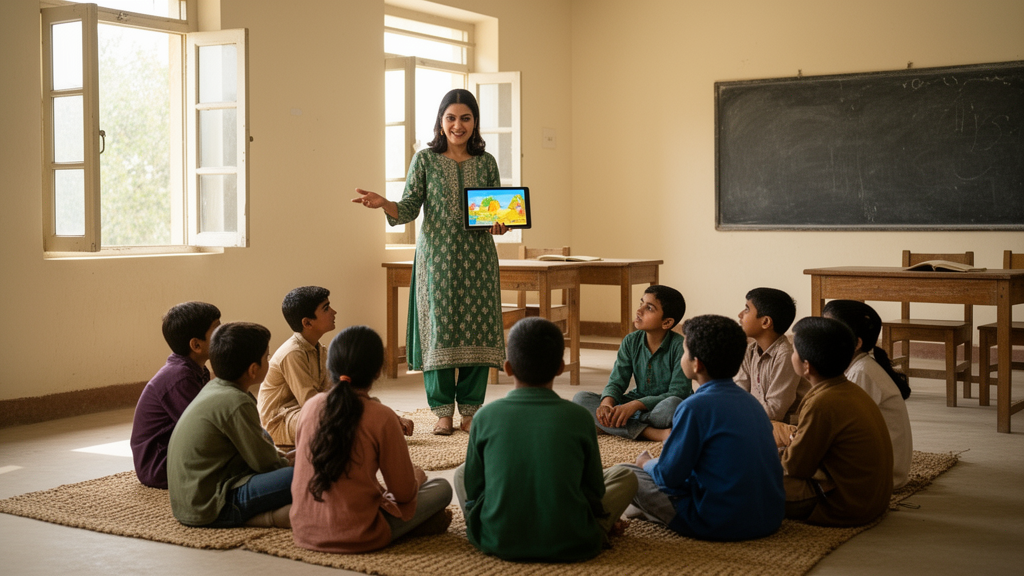
A four-week experiment with fifty practicing teachers in Pakistan has found that swapping lectures for digital storytelling nearly doubled measured levels of social awareness and empathy, offering some of the strongest controlled evidence yet that multimedia narratives can reshape the emotional skills of educators. The study, published in Discover Education, compared two groups of in-service private school teachers who received identical training content over the same schedule, with the only difference being the instructional method. Teachers who built and shared digital stories about empathy, classroom experiences, and social issues scored dramatically higher on post-tests than colleagues taught through traditional lectures, and their qualitative accounts suggest the effect reached deep into how they think about their students.
The rationale behind the research rests on a well-documented chain of influence in educational psychology. Teachers who can read the social and emotional needs of their students are better equipped to create supportive, inclusive classrooms, and decades of work on social-emotional learning have linked teacher competence in these areas to stronger student engagement, greater academic resilience, and healthier classroom climates. Students take more intellectual risks and develop sharper problem-solving skills when they perceive their environment as emotionally safe, and teachers model that safety through active listening, emotional regulation, and visible empathy. In Pakistan, where a single school chain can bring together children from Punjab, Sindh, Khyber Pakhtunkhwa, Baluchistan, Gilgit-Baltistan, and Azad Kashmir, classrooms routinely mix languages, cultures, socio-economic circumstances, and religious affiliations. Teachers lacking the tools to navigate that diversity may struggle to keep every learner feeling valued and heard.
Despite this established importance, most teacher training in the region still relies on textbooks and lectures, and prior evaluations of Pakistani teaching materials have flagged serious gaps in social-emotional content. The research team, led by Nuzhat Saadia Qureshi of Allama Iqbal Open University and Amjad Islam Amjad of The University of Lahore, identified a specific blind spot: while digital storytelling had been shown elsewhere to improve digital writing, communication, and emotional engagement, almost no controlled evidence existed on whether it could strengthen social awareness and empathy in teachers who were already working in classrooms. Their study was designed to close that gap with a quasi-experimental nonequivalent control group design, the practical choice given that the participating school system had already formed its professional development batches before the study began.
Digital storytelling itself is a deceptively simple technology. Emerging in the 1990s as a way to democratize the ancient practice of oral narrative, it asks creators to weave personal storylines together with images, music, narration, and video using everyday software. In the training program, teachers first brainstormed ideas and drafted storyboards and scripts, then produced digital content with multimedia tools, and finally presented their finished stories to the group for guided reflection and discussion. The method’s multimodal character, combining visual, auditory, and textual channels, aligns neatly with twenty-first-century skills such as creativity, digital literacy, and collaboration, and its emphasis on personal narrative forces the storyteller to articulate experiences from a first-person perspective, which is precisely where empathy researchers believe perspective-taking begins.
The theoretical engine behind the intervention is Social Learning Theory, which holds that people acquire competencies through observation, reflection, and social interaction rather than through passive reception of information. Digital storytelling operationalizes each of those mechanisms: participants observe authentic accounts of other people’s lives, reflect on the emotions embedded in those accounts, and negotiate meaning with peers during group discussion. The theory also predicts that collaborative learning amplifies individual gains, because shared experiences and peer feedback create multiple vantage points on the same material. If the theory holds, the storytelling group should outperform the lecture group not merely on knowledge recall but on the deeper dispositional qualities the study targeted.
The experimental setup was deliberately conservative. Fifty full-time teachers from a private school chain operating twenty-six institutions across the country volunteered for the study, with twenty-five assigned to each arm after a pre-test confirmed the groups were statistically indistinguishable at baseline. The researchers balanced the groups on teaching level, subject specialization, experience, age, and gender. Both groups received the same instructional modules, the same training schedule of five days per week over four weeks, and the same assessment procedures, delivered by the same instructor in separate sessions to prevent contamination. The first two weeks covered instructional content and the final two weeks focused on micro-teaching and lesson evaluation, with identical practical activities for both groups. Measurement instruments were adapted from the Toronto Empathy Questionnaire and the Social Emotional Competence Questionnaire, then validated through expert review, pilot testing with thirty teachers, and a full psychometric workup including exploratory and confirmatory factor analysis, with Cronbach’s alpha values between 0.74 and 0.84 and acceptable model fit indices.
The quantitative results were striking. On social awareness, the storytelling group averaged 6.24 compared with 3.19 for the lecture group, a difference the authors report as highly significant with t(48) = 30.95 and p < .001. On empathy, the experimental group averaged 6.34 against 3.62 for controls, with t(48) = 30.97 and p < .001. Effect sizes of this magnitude are rare in educational interventions, and while the quasi-experimental design and modest sample size warrant caution, the baseline equivalence of the groups strengthens the case that the storytelling method itself drove the change. The researchers used an independent-samples t-test at a stringent alpha of 0.001, arguing that the confirmed baseline comparability made covariate adjustment unnecessary.
The focus group data add texture to the numbers. Ninety-two percent of participants in the storytelling group reported that the method enhanced their social awareness, and the same proportion said the digital stories helped them feel others’ emotions more acutely. One teacher described the experience as eye-opening, saying she could now think more clearly about connecting to her students and solving their issues. Another admitted she had never been good at understanding other perspectives before the intervention, but found herself imagining her colleagues’ hardships as her own while watching their stories. Collaboration emerged as an unexpected dividend: teachers who had barely interacted at the start of the course reported negotiating, brainstorming, and sharing decisions on joint storytelling projects, with one participant calling the training a friend-finding experience that sharpened her listening and leadership skills. Not everything was seamless, as some participants struggled with unreliable internet connectivity at home, a reminder that digital interventions in developing contexts carry infrastructure burdens that lecture-based training does not.
The findings arrive at a moment when education systems worldwide are rethinking how emotional competencies are taught to the adults who run classrooms. Prior research has shown that teacher stress and unmet emotional needs degrade student outcomes, and that empathetic instructional practices help students navigate cultural diversity. This study suggests a concrete, low-cost vehicle for building those capacities in serving teachers rather than waiting for pre-service pipelines to change. The authors argue that structured storytelling activities, requiring teachers to create, share, and discuss personal and classroom experiences, should be embedded in professional development programs, and that school leaders must supply the time, digital resources, and technical support without which adoption stalls. Policymakers, they suggest, could write social-emotional learning and digital storytelling directly into training standards.
Limitations temper the enthusiasm. The sample came from a single private school system, and generalization to government schools, rural settings, or other countries remains untested. The study also lacked extended baseline analyses beyond the pre-test comparison, and no long-term follow-up was conducted to determine whether the empathy and awareness gains persist once teachers return to their routines. The authors call for multi-year longitudinal studies tracking cohorts of educators, replication across Pakistan’s diverse cultural regions, and trials applying the storytelling method to subject teaching in English, mathematics, and science. Still, the core message is difficult to dismiss: when teachers were given the tools to tell their own stories and witness those of their peers, they came back with measurably sharper ears for the children in front of them, and a training format older than writing itself proved it can still evolve for the digital age.
Subject of Research: Effects of digital storytelling on social awareness and empathy among in-service teachers in Pakistan
Article Title: Effects of digital storytelling on social awareness and empathy among in-service teachers in private schools of Pakistan
Article References: Qureshi, N. S., & Amjad, A. I. (2026). Effects of digital storytelling on social awareness and empathy among in-service teachers in private schools of Pakistan. Discover Education, 5(1), Article 1012. https://doi.org/10.1007/s44217-026-02230-1
Image Credits: AI Generated
DOI: 10.1007/s44217-026-02230-1
Keywords: digital storytelling, social awareness, empathy, in-service teachers, teacher professional development, social-emotional learning, Pakistan, quasi-experimental study, teacher training, classroom inclusivity, multimedia education, Social Learning Theory
Cite Scienmag News
Courtney Benton. (October 9, 2026). Digital Storytelling Boosts Empathy and Social Awareness in Pakistani Teachers. Scienmag. https://scienmag.com/digital-storytelling-boosts-empathy-and-social-awareness-in-pakistani-teachers/
Courtney Benton. "Digital Storytelling Boosts Empathy and Social Awareness in Pakistani Teachers." Scienmag, 9 October 2026, https://scienmag.com/digital-storytelling-boosts-empathy-and-social-awareness-in-pakistani-teachers/. Accessed 9 October 2026.
Courtney Benton. "Digital Storytelling Boosts Empathy and Social Awareness in Pakistani Teachers." Scienmag. October 9, 2026. https://scienmag.com/digital-storytelling-boosts-empathy-and-social-awareness-in-pakistani-teachers/


