


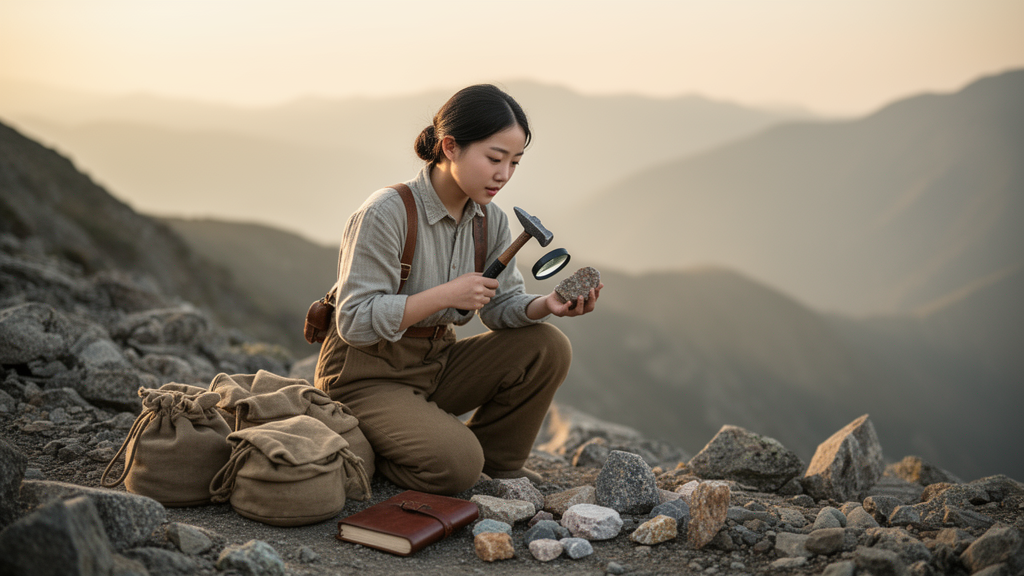
In April 1944, deep in the mountains of Guizhou Province in wartime China, three young geologists of the Geological Survey of China were killed by bandits while carrying out fieldwork. Among them was Y.S. Ma, who at the age of 25 was the only female geologist in China at the time. Beside her died T.Y. Hsu, aged 36, and K. Chen, aged 28, both described as budding and accomplished scientists in their own right. Eighty-two years after that day, a new historical study has brought their story back into the light, reconstructing the lives and deaths of three scholars who were killed before they could achieve their goals.
The study, authored by Jian Zhao Yin of the College of Earth Sciences at Jilin University in Changchun, was published as a preprint in March 2026 and is currently under review for the History of Geo- and Space Sciences, a journal of the European Geosciences Union. Its central contribution, as reviewers have noted, is the consolidation of dispersed Chinese-language primary and secondary sources into a coherent English-language account, a service that opens a largely unknown chapter of Chinese geoscience history to the international community of historians of science.
The evidentiary base of the reconstruction is unusually solid for an event of this kind. Yin draws on a contemporaneous obituary published in Geological Review, unpublished documents of the Geological Survey of China, and an interrogation record mediated through a 1944 account by Hou. Together, these sources allow the paper to piece together not only the circumstances of the killings but also the professional lives of the three victims, all of whom were working for the Geological Survey of China during the War of Resistance against Japan, when scientific fieldwork in the interior provinces carried risks far beyond the usual hardships of geological mapping.
Ma’s story stands out within that account. Fluent in five foreign languages despite never having travelled abroad, she had risen to a notable academic ranking in her field at an age when most scientists today are only beginning their doctoral studies. That she was the sole female geologist in China at the time underscores how narrow the doorway into the geosciences remained for women in early twentieth-century China, and how much individual determination was required to pass through it. Her death at 25, alongside two male colleagues aged 36 and 28, deprived Chinese geology of three careers that had barely begun.
The killings were not an isolated anomaly in the history of Chinese field science. The preprint also references the 1929 murder of the geologist Y.T. Chao, a case that reviewers have asked the author to consolidate into a single background passage. Taken together, these episodes illustrate a broader and often overlooked dimension of the history of geology: the physical dangers of fieldwork in politically unstable periods. Geological mapping requires scientists to travel into remote terrain, and in wartime China, with banditry rife in provinces like Guizhou, that necessity could prove fatal. The manuscript is, in part, a document of what one referee described as the risks of scientific fieldwork in wartime China.
The peer-review process surrounding the paper has itself become part of the story, revealing how historians of science negotiate the boundary between commemoration and analysis. The first referee report judged the manuscript to be of significant historical importance and emotional resonance, supported by valuable archival materials, but argued that in its current form it reads more like a commemorative narrative than a rigorous academic study. The reviewer recommended that the author clarify the research objectives in the introduction, explicitly framing the work as an exploration of themes such as the risks of scientific fieldwork in wartime China, the institutional role of the Geological Survey of China, or the gender dimensions of the early Chinese scientific community.
That same referee also urged the author to place Ma within an academic network rather than writing about her solely as an individual, an approach that would situate the case within broader questions of science and the state, scientific practice during wartime, and the status of women in early modern science in China. Emotional and rhetorical expressions, the reviewer argued, should be transformed into neutral, evidence-based statements, and a dedicated discussion section should interpret the historical materials rather than merely describe them. The journal’s editor subsequently rated these remarks as very important, asking the author to address all three points in detail and to concentrate on the facts.
A second referee, recommending only minor revision, offered a more detailed technical assessment of the evidence. This reviewer confirmed that the combination of the Geological Review obituary, the unpublished Geological Survey of China documents, and the interrogation record forms a reasonably solid evidentiary base, while asking the author to indicate which claims rest on primary documents and which on post-reform retrospective scholarship published in 2015 and 2020. The distinction matters for historians: details preserved in documents written close to the event carry different evidential weight than those reconstructed decades later, and a brief note in the introduction would help readers calibrate the reliability of specific details of the tragedy.
Perhaps the most striking element to emerge from the review discussion concerns what happened after the three scientists died. In 1945, three memorial prizes were established in their honour, and their influence on Chinese geoscience proved remarkably durable. Seven recipients of the Y.S. Ma Award were later elected to the Chinese Academy of Sciences, a fact mentioned almost in passing in the manuscript but one that the second referee argued deserves greater emphasis, precisely because it illustrates the lasting influence of the three murdered scholars on Chinese geoscience. A prize named for a scientist killed at 25 thus became, over the following decades, a marker of the highest scientific achievement in China.
The paper remains under review, with the author, who publishes under the name Jet Yin in the discussion, having thanked both referees and committed to revising the manuscript in light of their comments. Whatever form the final version takes, the underlying story it preserves is unlikely to change: in April 1944, during a war that had already consumed much of China, three young geologists went into the field for the Geological Survey of China and never returned. Y.S. Ma, the only female geologist in her country at the time, was 25 years old. Eight decades later, her name survives not only in an obituary and an interrogation record, but in a scientific prize whose winners went on to lead Chinese earth science, a quiet testament to how briefly lived lives can still shape a discipline for generations.
Subject of Research: The 1944 killing of Y.S. Ma, China's first female geologist, and its place in the history of Chinese geoscience
Article Title: The Fate of Y.S. Ma, China's First Female Geologist
Article References: Yin, J. Z. (2026). The Fate of Y.S. Ma, China's First Female Geologist. https://doi.org/10.5194/hgss-2026-6
Image Credits: AI Generated
DOI: 10.5194/hgss-2026-6
Keywords: Y.S. Ma, history of geology, Geological Survey of China, women in science, wartime China, Guizhou Province, fieldwork risks, History of Geo- and Space Sciences, memorial prizes, Chinese Academy of Sciences, science history, peer review
Cite Scienmag News
Violet Maxwell. (October 9, 2026). Murdered at 25: The Short Life and Lasting Legacy of China’s First Female Geologist. Scienmag. https://scienmag.com/murdered-at-25-the-short-life-and-lasting-legacy-of-chinas-first-female-geologist/
Violet Maxwell. "Murdered at 25: The Short Life and Lasting Legacy of China’s First Female Geologist." Scienmag, 9 October 2026, https://scienmag.com/murdered-at-25-the-short-life-and-lasting-legacy-of-chinas-first-female-geologist/. Accessed 9 October 2026.
Violet Maxwell. "Murdered at 25: The Short Life and Lasting Legacy of China’s First Female Geologist." Scienmag. October 9, 2026. https://scienmag.com/murdered-at-25-the-short-life-and-lasting-legacy-of-chinas-first-female-geologist/


