


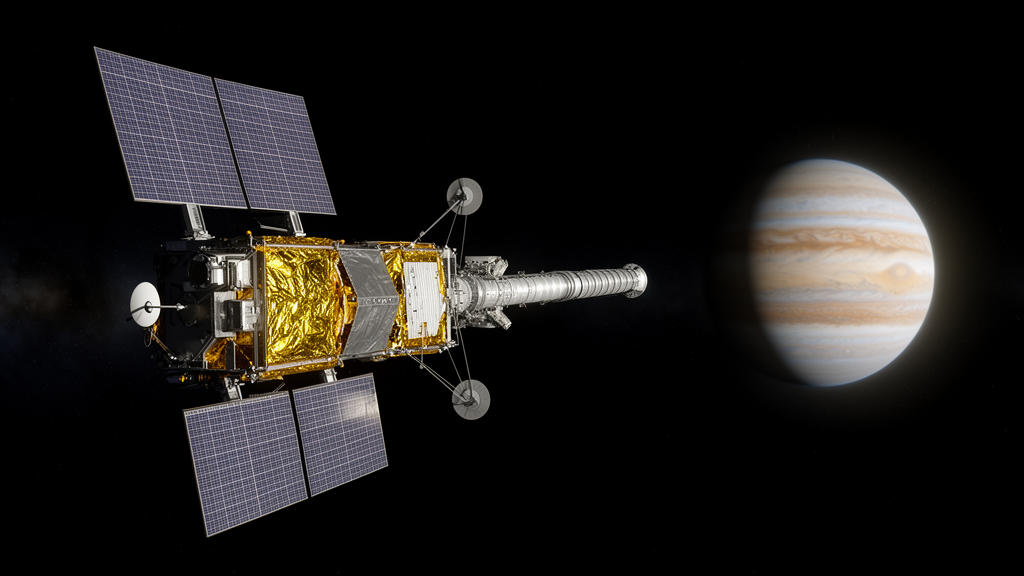
When the European Space Agency’s Jupiter Icy Moons Explorer, JUICE, swept past Earth and the Moon in August 2024 on its way to the outer solar system, it carried with it one of the most ambitious imaging spectrometers ever flown to a giant planet. Now, a team led by Yves Langevin of the CNRS and Université Paris-Saclay has published a comprehensive assessment of how that instrument, the Moons and Jupiter Imaging Spectrometer, or MAJIS, performed during its first real trial in space. The verdict, published in Annales Geophysicae, is emphatic: after a journey of more than a year and the violent shaking of launch, MAJIS is observing almost exactly as designed, and its early data offer a tantalizing preview of the science to come at Jupiter.
MAJIS is the visible and near-infrared imaging spectrometer at the heart of JUICE’s payload, designed to map the surfaces of Ganymede, Callisto and Europa and to probe the atmosphere of Jupiter across a spectral range from 0.5 to 5.56 micrometers. The instrument splits light into two channels, a VISNIR channel covering 0.495 to 2.35 micrometers and an infrared channel spanning 2.28 to 5.56 micrometers, each recording up to 640 spectral samples. During a planned 3.3-year tour of the Jupiter system followed by nearly a year in orbit around Ganymede, MAJIS will search for water ice, minerals, organic signatures and transient atmospheric phenomena. But before any of that could happen, the team needed to know whether the instrument’s delicate calibration had survived launch.
The answer came from an extraordinary opportunity: the Lunar-Earth Gravitational Assist, or LEGA, a double flyby executed on 19 and 20 August 2024 that brought JUICE within 750 kilometers of the Moon and 6,100 kilometers of Earth. Earth’s atmosphere turned out to be a gift for calibration. It is laced with narrow absorption bands from oxygen, water vapor, carbon dioxide, methane, nitrous oxide and carbon monoxide distributed across nearly the entire wavelength range of both MAJIS channels. By comparing MAJIS spectra of Earth with high-precision radiative transfer simulations from the 4A/OP model, the team could measure the exact position of each spectral channel, its width and its distortions across the field of view with nanometer precision.
The results revealed that launch had shifted the instrument’s spectral registration slightly, by about 3.8 nanometers in the VISNIR channel and 5.4 nanometers in the infrared channel, a finding first spotted using the instrument’s internal calibration unit, which carries a tungsten halogen lamp and a black body source. Crucially, the Earth observations confirmed that these small shifts apply uniformly across each channel’s full wavelength range, validating the updated calibration to within a single nanometer. For wavelengths beyond 3.5 micrometers, where the ground calibration setup had been limited, the flyby data provided the first reliable measurements, revealing residuals of only about 1.5 nanometers on average against a nominal spectral sampling of 6.5 nanometers. Independent checks against the PRISMA hyperspectral Earth-observation satellite and the IASI infrared sounder on the MetOp satellites produced residuals never exceeding 1.5 nanometers, a striking agreement between instruments calibrated entirely independently.
The radiometric story, meaning how accurately MAJIS measures the brightness of light, proved more intricate. Observations with the internal calibration unit before and after launch showed that the spatial distribution of the calibration signal had changed, with more light falling on the right side of the field of view and less on the left. The most likely explanation is that the geometric relationship between the internal light sources and the scattering screen shifted during launch, rather than any deformation of the main optics, since observations of the Moon and Earth otherwise matched expectations. More surprisingly, the team discovered a contamination of the left portion of the infrared detector by aliphatic compounds, identifiable by their characteristic carbon-hydrogen absorption signature near 3.4 micrometers, which reduced the response there by up to 37 percent. Because the contamination has remained stable since the commissioning phase in mid-2023, the team was able to compensate for it fully in the updated calibration, verified by the consistency of lunar spectra across the entire field of view.
To validate the absolute radiometric calibration, the team turned to the Moon, a target whose reflectance does not change over time. MAJIS lunar reflectance spectra fell comfortably within the wide range of measurements from previous missions, including the multiband imager and spectral profiler on Selene, the Moon Mineralogy Mapper and SIR-2 on Chandrayaan-1, and Earth-based telescopic systems. An even cleaner comparison came from JANUS, JUICE’s own high-resolution camera, whose line of sight is aligned with MAJIS to within 0.3 degrees. For the same lunar surface elements observed under essentially identical geometry, JANUS measured radiances about 15 percent higher than MAJIS, a difference well within the expected uncertainty between two independently calibrated instruments.
Earth observations added further confidence, though with caveats. Comparing MAJIS with the German ENMAP hyperspectral mission over the Pacific Ocean, with observations separated by only 1.3 hours and 400 kilometers, the radiances for cloud-free ocean areas matched remarkably well, and the shapes of the water vapor absorption bands at 1.5 and 2 micrometers aligned almost perfectly after straylight correction. A comparison with TROPOMI on Sentinel-5P, which observed the same regions about three hours later, found MAJIS radiances lower by roughly 10 percent in one visible band and higher by about 20 percent in two shortwave infrared bands, both within the range expected between independently calibrated instruments given the drifting cloud cover and differing viewing angles. In the thermal infrared, where IASI comparisons are most reliable, the match was described as outstanding, and lunar brightness temperatures derived from MAJIS agreed within 10 kelvin with measurements from a thermal mapper on NASA’s Lunar Reconnaissance Orbiter, implying the infrared calibration is accurate to a few percent at the longest wavelengths.
One subtle effect deserves attention for future science. MAJIS’s VISNIR channel suffers from straylight, scattered light that contaminates measurements at wavelengths shorter than 1.3 micrometers, originating from the region beyond 1.5 micrometers. For the Moon, whose reflectance rises steeply with wavelength, this contamination can reach 40 percent at 0.65 micrometers, but for blue targets like Earth, Jupiter and the icy moons, whose deep water and methane absorption bands suppress the straylight source region, the contribution drops to around 15 percent or less. The team showed that the straylight is relatively featureless and can be reliably corrected, and they plan to shift the readout window slightly during Jupiter operations to monitor it directly, at a cost of only 2.5 percent of the field of view. Intriguingly, the high signal-to-noise lunar spectra, exceeding 200 even at full resolution, hint at a weak hydroxyl absorption near 2.9 micrometers at high solar incidence, consistent with known variability of lunar water and hydroxyl signatures, though the team urges caution because the feature lies close to the detector’s filter boundary.
Perhaps the most exciting conclusion concerns what all this means for Jupiter. Extrapolating from the operating conditions at 1 astronomical unit to those at 5, where JUICE will operate, the team confirms that MAJIS will deliver high-quality data throughout its science phase. During the Earth flyby, the instrument achieved signal-to-noise ratios of up to 400 in single spectra, and higher with stacking, with very high detector operability even at integration times as short as 11 milliseconds. At Jupiter, colder detector temperatures and longer integrations should push the signal-to-noise ratio for observations of Jupiter’s hot spots in the 4.5 to 5.5 micrometer methane window to as much as 1,000. With two more Earth flybys scheduled for September 2026 and January 2029, and continued monitoring of the internal calibration unit throughout the cruise, the MAJIS team will have every opportunity to refine the calibration further before the instrument turns its gaze on Ganymede, Europa, Callisto and the giant planet itself in 2031. The August 2024 flyby, it turns out, was not just a gravitational slingshot but a resounding vote of confidence in one of ESA’s most capable planetary instruments.
Subject of Research: Post-launch spectral and radiometric calibration of the MAJIS VIS-NIR imaging spectrometer aboard the JUICE mission using Earth and Moon flyby observations
Article Title: Post launch spectral and radiometric performances of MAJIS, the VIS-NIR imaging spectrometer of JUICE
Article References: Langevin, Y., Rodriguez, S., Guerlet, S., Poulet, F., Piccioni, G., Agostini, L., Armante, R., D'Aversa, E., Filacchione, G., Fletcher, L., Oliva, F., Royer, C., Seignovert, B., Stephan, K., Tosi, F., & Trent, T. (2026). Post launch spectral and radiometric performances of MAJIS, the VIS-NIR imaging spectrometer of JUICE. Annales Geophysicae, 44(2), 825-853. https://doi.org/10.5194/angeo-44-825-2026
Image Credits: AI Generated
DOI: 10.5194/angeo-44-825-2026
Keywords: JUICE, MAJIS, imaging spectrometer, spectral calibration, radiometric calibration, Jupiter Icy Moons Explorer, Earth flyby, Moon flyby, Ganymede, near-infrared spectroscopy, ESA, internal calibration unit
Cite Scienmag News
Russell Cooper. (October 9, 2026). JUICE’s MAJIS Spectrometer Passes Its First Deep-Space Test With Flying Colors. Scienmag. https://scienmag.com/juices-majis-spectrometer-passes-its-first-deep-space-test-with-flying-colors/
Russell Cooper. "JUICE’s MAJIS Spectrometer Passes Its First Deep-Space Test With Flying Colors." Scienmag, 9 October 2026, https://scienmag.com/juices-majis-spectrometer-passes-its-first-deep-space-test-with-flying-colors/. Accessed 9 October 2026.
Russell Cooper. "JUICE’s MAJIS Spectrometer Passes Its First Deep-Space Test With Flying Colors." Scienmag. October 9, 2026. https://scienmag.com/juices-majis-spectrometer-passes-its-first-deep-space-test-with-flying-colors/


