


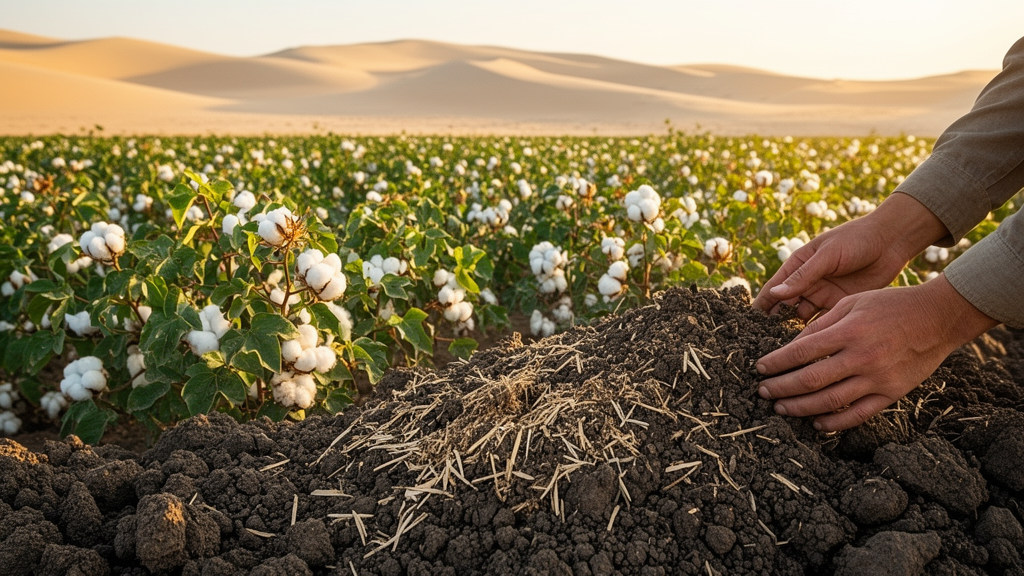
In the desert oasis farmland of southern Xinjiang, one of China’s most important cotton-producing regions, the soil itself has long been the enemy of the harvest. Sandy soils with fragile, poorly cemented particles hold neither water nor nutrients well, so every irrigation event risks leaching fertilizer beyond the reach of roots, and every dry spell drains the profile of moisture that crops depend on. A new three-year field study published in the journal Plant and Soil reports that a simple pairing of two amendments, organic fertilizer and sodium carboxymethyl cellulose, can rebuild the physical and biological fabric of these degraded soils and translate that repair directly into higher cotton yields.
The research, led by Xiaoxian Duan, Quanjiu Wang, Weiyi Mu and colleagues at Xi’an University of Technology, set out to test whether the two amendments work better together than either alone. Organic fertilizer supplies carbon, nutrients and microbial substrate, while sodium carboxymethyl cellulose, or CMC-Na, is a water-soluble, biodegradable polymer derived from cellulose that can bind soil particles, improve water retention and stabilize aggregates. The team reasoned that the polymer could provide the structural scaffolding that sandy soils lack, while the organic fertilizer would fuel the biological and chemical recovery, and that the combination might unlock synergies neither material could achieve on its own.
To test this, the researchers ran a continuous three-year field experiment in southern Xinjiang, comparing plots treated with organic fertilizer alone, CMC-Na alone, and the two applied together, against untreated control plots. They systematically evaluated soil physical properties, enzyme activities, organic carbon content and the availability of nitrogen, phosphorus and potassium throughout the top 40 centimeters of the soil profile. The most striking improvements appeared in the 0 to 20 centimeter topsoil layer, the zone where cotton roots are most active and where drip irrigation and fertilization concentrate their effects.
The numbers from the optimal combined treatment, labeled O2C2, are substantial. Compared with the control, soil bulk density, a measure of how tightly packed and compacted the soil is, decreased by 7.00 to 8.54 percent. Lower bulk density means looser soil, easier root penetration and more space for air and water. At the same time, total porosity rose by 9.33 to 11.93 percent, and the content of water-stable aggregates larger than 0.25 millimeters, the small clumps of soil that resist being washed apart and that underpin healthy soil structure, increased by 13.86 to 15.08 percent. Available water content, the reservoir of moisture plants can actually draw on, climbed by 13.50 to 14.52 percent.
The chemical and biological changes were equally dramatic. Soil organic carbon, the backbone of soil fertility and a key indicator of long-term soil health, surged by 72.76 to 90.35 percent under the combined treatment, while alkali-hydrolyzable nitrogen, a measure of the nitrogen readily available to plants, rose by 23.15 to 28.83 percent. The researchers also tracked soil enzyme activities, which reflect the intensity of microbial processes that cycle nutrients through the soil, and found that the combined treatment maximized the overall soil quality index, a composite score integrating physical, chemical and biological indicators.
Crucially, the soil improvements were not merely cosmetic. Cotton plants growing in the amended soils showed markedly better root vigor, a measure of the physiological activity and health of the root system, which increased by 14.36 to 25.79 percent relative to the control. Vigorous roots are the engine of crop productivity in arid environments, because they determine how effectively a plant can capture water and nutrients from a finite and often hostile soil volume. The enhanced root performance translated into a 13.01 to 16.79 percent increase in seed cotton yield, the raw harvested product before ginning.
To understand which changes mattered most, the team applied partial least squares path modeling, a statistical technique that can trace how different sets of variables influence one another along hypothesized causal chains. The analysis revealed that the improvement of topsoil physical properties was the primary driver of the overall soil quality enhancement, with a path coefficient of 0.776, indicating a very strong influence. In other words, the structural repair of the sandy soil, its loosened density, increased porosity and stabilized aggregates, was the foundation on which the chemical and biological gains were built.
The path modeling also identified the core mechanism linking soil treatment to harvest: a sequential pathway running from soil quality index to root vigor and finally to yield. Better soil structure and fertility create a more favorable habitat for roots; healthier, more active roots capture more water and nutrients; and better-supplied plants produce more cotton. This chain, the authors conclude, is the mechanism by which co-application of organic fertilizer and CMC-Na sustains stable, high cotton yields in sandy agroecosystems, by optimizing physical structures and simultaneously activating the nutrient and biological dynamics of the soil.
The findings carry weight well beyond a single experimental field. Southern Xinjiang’s cotton belt relies heavily on mulched drip irrigation, a system that delivers water and fertilizer precisely but that depends on the soil being able to retain and redistribute what it receives. In coarse sandy soils, that retention is the weak link, and previous studies by overlapping research groups have explored related strategies, including combining carboxymethyl cellulose with biochar to improve water retention and aggregate stability in desert soils, and applying the polymer in coastal saline-alkali croplands. The new work extends this line of research by quantifying, over three consecutive seasons, how the polymer performs when paired with organic fertilizer and by formally modeling the causal chain from soil physics to crop yield.
For farmers and soil managers in arid regions, the study suggests that amending sandy soils is most effective when structural and biological interventions are combined rather than applied in isolation. The cellulose-based additive addresses the physical fragility that makes sandy soils leak water and nutrients, while the organic fertilizer rebuilds the carbon reserves and microbial activity that sustain nutrient supply over time. Because CMC-Na is biodegradable and organic fertilizers can be produced from agricultural and animal waste, the approach also aligns with broader goals of sustainable agriculture, turning a waste-derived polymer and recycled nutrients into a durable upgrade of one of the world’s most challenging farming environments. As cotton remains a cornerstone of the regional economy, the demonstration that a 13 to 17 percent yield gain can be achieved by repairing the soil itself offers a practical blueprint for sustaining production on fragile desert farmland.
Subject of Research: Co-application of organic fertilizer and sodium carboxymethyl cellulose to improve sandy soil quality and cotton yield in southern Xinjiang
Article Title: Co-application of organic fertilizer and sodium carboxymethyl cellulose improves soil quality and root vigor to sustain cotton yield in sandy fields of southern Xinjiang
Article References: Duan, X., Wang, Q., Mu, W., Ma, C., Sun, Y., & Su, L. (2026). Co-application of organic fertilizer and sodium carboxymethyl cellulose improves soil quality and root vigor to sustain cotton yield in sandy fields of southern Xinjiang. Plant and Soil. https://doi.org/10.1007/s11104-026-09141-y
Image Credits: AI Generated
DOI: 10.1007/s11104-026-09141-y
Keywords: soil quality, organic fertilizer, sodium carboxymethyl cellulose, cotton yield, sandy soil, soil aggregates, root vigor, soil organic carbon, soil bulk density, path modeling, Xinjiang, sustainable agriculture
Cite Scienmag News
Alan Morgan. (October 9, 2026). Organic Fertilizer Plus Cellulose Additive Rebuilds Sandy Desert Soil and Lifts Cotton Yields in Xinjiang. Scienmag. https://scienmag.com/organic-fertilizer-plus-cellulose-additive-rebuilds-sandy-desert-soil-and-lifts-cotton-yields-in-xinjiang/
Alan Morgan. "Organic Fertilizer Plus Cellulose Additive Rebuilds Sandy Desert Soil and Lifts Cotton Yields in Xinjiang." Scienmag, 9 October 2026, https://scienmag.com/organic-fertilizer-plus-cellulose-additive-rebuilds-sandy-desert-soil-and-lifts-cotton-yields-in-xinjiang/. Accessed 9 October 2026.
Alan Morgan. "Organic Fertilizer Plus Cellulose Additive Rebuilds Sandy Desert Soil and Lifts Cotton Yields in Xinjiang." Scienmag. October 9, 2026. https://scienmag.com/organic-fertilizer-plus-cellulose-additive-rebuilds-sandy-desert-soil-and-lifts-cotton-yields-in-xinjiang/


