


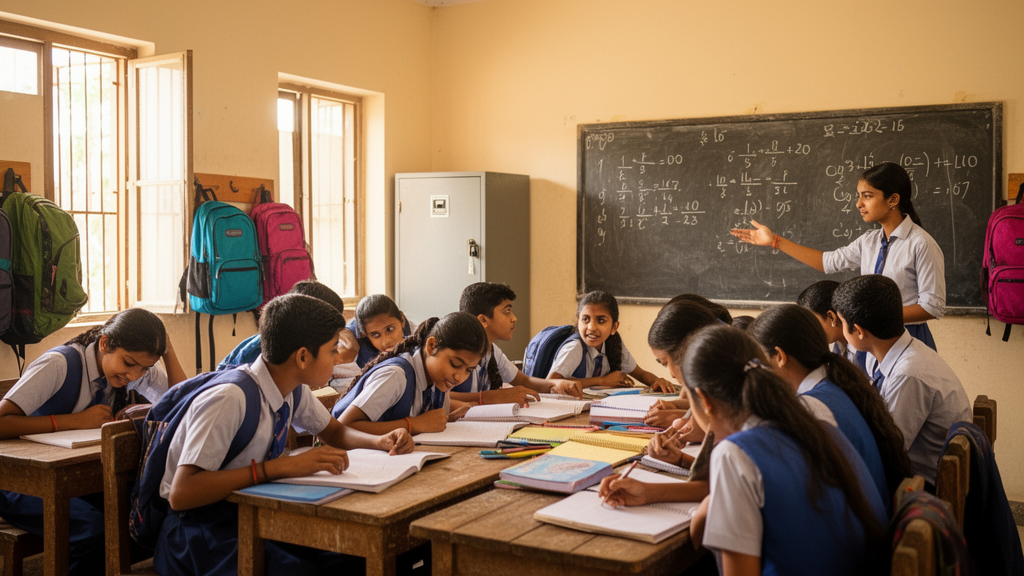
One of the largest randomized controlled trials ever conducted on smartphone restrictions in education has delivered some of the strongest evidence yet that keeping phones out of classrooms genuinely improves learning. In a Policy Article published in Science, Alp Sungu and colleagues report that banning phones during class raised academic performance among more than 16,000 students in India, with the largest gains concentrated among lower-performing students and first-year undergraduates. The study arrives at a moment when schools and governments around the world are debating, and increasingly adopting, phone bans amid mounting concern about smartphones’ effects on attention, mental health, and peer relationships. Until now, however, large-scale experimental evidence on whether such bans actually improve learning or social outcomes has been strikingly scarce, leaving policymakers to act largely on intuition rather than data.
The research team carried out their trial across ten higher education institutions in the eastern Indian state of Odisha, a setting chosen in part because smartphone penetration there is high: ownership and use among young people aged 15 to 29 exceeds 70 percent. In total, 16,683 students participated, making the study an order of magnitude larger than most previous experiments on the topic. Institutions were randomized so that some classrooms operated under phone restrictions while others continued with unrestricted use, allowing the researchers to isolate the causal effect of the bans rather than merely correlating phone habits with achievement. The breadth of the sample also meant the team could examine how effects varied across disciplines, degree levels, and baseline academic standing.
The outcome measures went well beyond test scores. The researchers tracked academic performance and grade point averages, but they also surveyed students on their attitudes toward the restrictions, their well-being, their motivation, their digital habits, and their experiences of online harassment. Classroom observations supplemented the survey data, giving the team a direct window into how the bans changed day-to-day behavior in lectures and tutorials. This combination of administrative records, self-reports, and observational evidence is what gives the study its unusual depth, since each type of measurement can compensate for the weaknesses of the others.
The headline result is that classroom phone bans improved academic performance, but the distribution of those gains is what makes the findings politically and scientifically significant. The improvements were largest among lower-performing students and first-year undergraduates, the very groups most at risk of falling behind. Among higher-performing students, postgraduates, and those in STEM fields, effects were minimal. This pattern suggests that phones function primarily as a distraction for students whose attentional resources or study skills are already stretched, while students with stronger self-regulation or more demanding engagement with material may be less susceptible. In practical terms, a blanket policy that appears to do little for top students may still deliver substantial benefits by lifting the bottom of the distribution.
That distributional point is reinforced by one of the study’s most consequential findings: removing phones reduced disparities in GPA across the student body. If phone restrictions compress achievement gaps, they could serve as a low-cost equity tool for educational systems in low- and middle-income countries, where smartphones have spread faster than the infrastructure or pedagogy needed to manage them in classrooms. The authors suggest that restrictions may help close gaps in learning outcomes, a framing that shifts the debate from whether bans are merely harmless to whether they can actively narrow inequalities that have proven resistant to more expensive interventions.
Crucially, the researchers found that attendance rates did not change under the bans. This null result is informative in itself. It indicates that the academic gains were not driven by students simply showing up to class more often; the students who attended were the same students who would have attended anyway. Instead, the evidence points to what happened inside the classroom: greater attention and more productive classroom dynamics. The improvement, in other words, reflects a change in the quality of instructional time rather than the quantity of it, which is exactly the mechanism that proponents of phone bans have long hypothesized but rarely been able to demonstrate experimentally at scale.
The behavioral and attitudinal data add a further layer. Classroom observations recorded less disruptive behavior and fewer off-topic conversations in phone-free sessions, along with greater teacher engagement. Instructors, freed from competing with a screen for every student’s attention, apparently taught differently, and students responded in kind. Meanwhile, students who experienced the bans became more supportive of the restrictions and more likely to view them as beneficial, while showing less preference for unrestricted phone use. Sungu and colleagues interpret this as evidence that students may become more receptive to phone restrictions after experiencing a more focused, phone-free classroom environment, a finding with direct implications for how such policies should be introduced and communicated.
This last point deserves emphasis because resistance from students is one of the most common objections to phone bans worldwide. Critics argue that restrictions are paternalistic, that they provoke backlash, or that students will simply find workarounds. The Odisha trial suggests the opposite dynamic: experience with the policy appears to convert skeptics. If students’ revealed preferences shift toward supporting the restrictions once they have lived under them, then the political sustainability of bans may be much stronger than surveys of students’ stated preferences would predict. Attitude change of this kind, driven by lived experience rather than persuasion campaigns, is often the most durable kind.
The study also speaks to a broader scientific debate about attention and technology in learning environments. Laboratory studies have long shown that the mere presence of a phone can reduce cognitive capacity, and observational studies have linked classroom phone use to lower achievement. But such findings have been difficult to translate into policy because they cannot establish that banning phones in real institutions produces real gains. By randomizing at scale in ordinary higher education settings, Sungu and colleagues close that inferential gap. The results align with the mechanistic picture from smaller studies: phones impose a continuous tax on attention, and removing that tax yields measurable returns, especially for students with the least cognitive slack.
There are, of course, boundaries to what the trial can claim. The effects were minimal among higher-performing, postgraduate, and STEM students, so the findings should not be read as a universal prescription. The study was conducted in higher education institutions in a single Indian state, and extrapolation to primary and secondary schools, or to very different cultural and technological contexts, requires caution. The researchers measured well-being, motivation, digital use, and online harassment alongside achievement, and the published report will be the authoritative source for how those secondary outcomes shifted. Still, the scale of the experiment, the rigor of its design, and the consistency of its behavioral, attitudinal, and academic results make it a landmark contribution. As governments from Europe to Asia weigh statewide phone restrictions, the Odisha trial offers the clearest experimental answer yet to the central question: in the classroom, the phone is not a neutral tool but an active impediment to learning, and removing it pays off most for the students who can least afford to lose focus.
Subject of Research: Effects of classroom smartphone bans on academic performance and student engagement in higher education in India
Article Title: Classroom phone bans improve learning and student engagement in India
Article References: Classroom phone bans improve learning and student engagement in India. (n.d.). Original publication
Image Credits: AI Generated
DOI: Not provided
Keywords: smartphone bans, classroom policy, randomized controlled trial, India, student engagement, academic performance, education equity, attention, higher education, Odisha, GPA disparities, Science journal
Cite Scienmag News
Courtney Benton. (October 9, 2026). Massive classroom phone ban trial in India boosts learning for struggling students. Scienmag. https://scienmag.com/massive-classroom-phone-ban-trial-in-india-boosts-learning-for-struggling-students/
Courtney Benton. "Massive classroom phone ban trial in India boosts learning for struggling students." Scienmag, 9 October 2026, https://scienmag.com/massive-classroom-phone-ban-trial-in-india-boosts-learning-for-struggling-students/. Accessed 9 October 2026.
Courtney Benton. "Massive classroom phone ban trial in India boosts learning for struggling students." Scienmag. October 9, 2026. https://scienmag.com/massive-classroom-phone-ban-trial-in-india-boosts-learning-for-struggling-students/


