


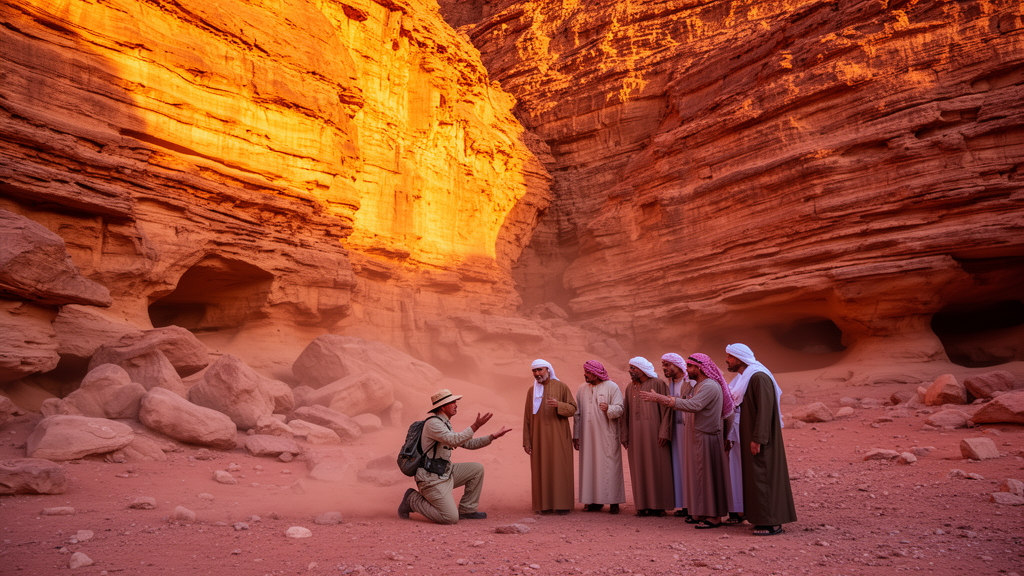
When scientists want the public to care about ancient landscapes, the usual strategy is to explain the science. A new experiment from southeast Arabia suggests that strategy is only half the story. Researchers led by Kenta Sayama of the University of Oxford, working with colleagues at Waseda University, Oxford Brookes University and the Geological Society of Oman, produced two documentary-style videos about Quaternary geoheritage sites in the United Arab Emirates and Oman and tested how audiences responded. One video focused purely on the geology. The other wove the same science into the region’s archaeology, culture and human history. Both videos worked, but the culturally framed version left viewers more engaged, more interested and more committed to protecting the sites, especially people without a geoscience background.
The Quaternary period, spanning roughly the last 2.6 million years, is a peculiar corner of Earth history. It accounts for only about 0.057 percent of the planet’s timeline, yet it supplies 17 percent of all World Heritage Sites characterised by geological features, from the karstic lakes of Plitvice in Croatia to the Lut Desert in Iran and the volcanoes of Hawaii. These are landscapes shaped by ice ages, shifting dunes, rising and falling seas, and the simultaneous unfolding of human evolution. In southeast Arabia, Quaternary deposits cover around 44 percent of the land surface, including aeolian dunes that dominate 57 percent of that area, alongside alluvial fans, fluvial channels, sabkha salt flats, caves and the remains of ancient palaeolakes. Because the region is arid and sparsely vegetated, these features are strikingly visible, unlike in humid landscapes where vegetation often hides them.
That visibility matters, because these sites are disappearing. A recent inventory of Quaternary palaeoenvironmental sites in the region found that 31 of 234 documented sites, about 13 percent, had already been destroyed, largely by urban development and quarrying, with another 34 sites classified as endangered. The Abu Dhabi Sabkha, a landscape of unique scientific value, has seen more than 60 percent of its area damaged by petroleum and civil engineering activity. Yet public appreciation of geoheritage lags far behind that of other sciences. On social media, the hashtag geology is used roughly 80 percent less often than physics, biology or chemistry, and television coverage of the geosciences tends to cluster around palaeontology, volcanoes and earthquakes.
To test whether cultural storytelling could close that gap, the team ran a three-phase study between November 2022 and January 2024. In the first phase, focus groups of academics, museum professionals and heritage administrators met at Buhais Geology Park in the UAE and the Oman National Museum. Their advice was concrete: begin with visually engaging footage of familiar places, build from general overviews to technical detail, incorporate archaeological, cultural and religious narratives where appropriate, keep the tone conversational and locally grounded, and frame geoheritage in terms of everyday values such as beauty, cultural relevance and conservation.
The second phase turned those recommendations into two videos, each just under nine minutes, the upper end of the six-to-nine-minute window that research on educational video suggests sustains attention best. The geocultural video devoted about 140 seconds, roughly 26 percent of its runtime, to cultural content, connecting dunes, caves, palaeolakes and sabkhas to the archaeology and heritage of early human settlement in Arabia. The control video replaced that material with additional Quaternary science. Both featured English narration, dialogues with local experts in Arabic, and subtitles, and both were piloted with focus group participants to check scientific accuracy and cultural representation.
The third phase was a randomised online experiment. Participants, all residents of the UAE or Oman, completed questionnaires before watching, immediately after, and three months later. Of 160 initial respondents, 104 completed the second wave and 82 completed all three, a drop-out rate within or better than the expected range for longitudinal studies. The sample skewed young, highly educated and environmentally engaged, with strong pro-conservation baselines: participants rated the importance of protecting natural heritage at 9.2 out of 10 before watching anything. Forty-eight participants were classified as domain specialists, geoscience students or professionals, and 56 as non-specialists. Even among specialists, only half could correctly identify Quaternary geoheritage sites at the outset.
The results, analysed with difference-in-differences models that isolate the effect of the cultural framing, revealed a nuanced trade-off. Immediately after watching, the science-focused video produced stronger gains on the objective knowledge test, a pattern driven entirely by specialist viewers. But that advantage evaporated by the three-month follow-up, when the two groups performed almost identically, with the geocultural group slightly ahead despite starting lower. Meanwhile, the geocultural video showed a clear and statistically significant advantage in sustaining interest in the relationship between Quaternary geology and archaeology, particularly among non-specialists, whose interest remained elevated at follow-up while the control group’s declined. Self-reported knowledge of that geocultural relationship stayed significantly above baseline in both groups three months on.
The most striking finding concerned conservation attitudes. Both videos increased viewers’ sense that Quaternary sites deserve protection, but the gains were consistently stronger and more durable in the geocultural group, an effect most pronounced among non-specialists, who started from lower baselines and therefore had more room to move. Qualitative feedback reinforced the pattern: geoheritage protection was the most frequently cited takeaway among treatment-group viewers, who also tolerated the video’s length better and asked for more content rather than less. Roughly half of participants in each group reported watching the video more than twice, and 91 percent of all respondents said their interest in Quaternary geoheritage had increased.
The authors are careful about the limits of their evidence. With 82 complete cases, the study is underpowered to detect small effects, and many estimates carry wide confidence intervals. The sample cannot represent the region’s 14.1 million residents, being dominated by university students and adults with pre-existing pro-nature views. Still, the pattern echoes earlier work, such as a study in St. Vincent where a video game taught volcanic hazards slightly less effectively than a traditional lecture but engaged learners more deeply. The parallel suggests a general principle: adding narrative or cultural framing may dilute short-term factual delivery while buying something more valuable, namely attention that lasts.
The practical implication is that communicators should match the framing to the goal. If the aim is immediate factual learning, a focused, technical presentation may win. If the aim is to make ancient landscapes feel relevant, memorable and worth defending, human stories appear to be the stronger tool. For Quaternary science, a field whose subject matter, deep time, is notoriously hard for non-specialists to grasp, the cultural bridge may be exactly what turns abstract geology into a cause people care about, three months later and beyond.
Subject of Research: Testing whether geocultural context in educational videos improves public communication of Quaternary geoheritage in southeast Arabia
Article Title: Including cultural context improves communication outcomes for quaternary geoheritage: evidence from southeast Arabia
Article References: Including cultural context improves communication outcomes for quaternary geoheritage: evidence from southeast Arabia. (n.d.). https://doi.org/10.5194/gc-9-291-2026
Image Credits: AI Generated
Keywords: geoheritage, Quaternary science, science communication, geocultural context, Oman, United Arab Emirates, educational video, conservation attitudes, archaeology, geotourism, public engagement, difference-in-differences
Cite Scienmag News
Violet Maxwell. (October 9, 2026). Human Stories Make Geology Stick: Cultural Context Boosts Geoheritage Communication in Arabia. Scienmag. https://scienmag.com/human-stories-make-geology-stick-cultural-context-boosts-geoheritage-communication-in-arabia/
Violet Maxwell. "Human Stories Make Geology Stick: Cultural Context Boosts Geoheritage Communication in Arabia." Scienmag, 9 October 2026, https://scienmag.com/human-stories-make-geology-stick-cultural-context-boosts-geoheritage-communication-in-arabia/. Accessed 9 October 2026.
Violet Maxwell. "Human Stories Make Geology Stick: Cultural Context Boosts Geoheritage Communication in Arabia." Scienmag. October 9, 2026. https://scienmag.com/human-stories-make-geology-stick-cultural-context-boosts-geoheritage-communication-in-arabia/


