


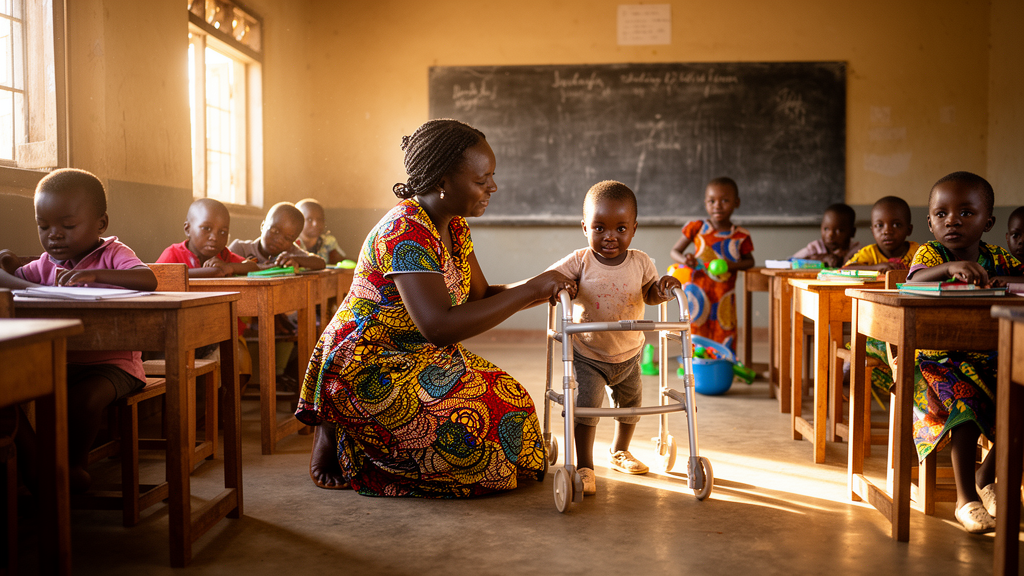
In classrooms across Tanzania, pre-primary teachers say they want to include every child in early literacy learning—but most say no one ever taught them how. A new qualitative study published in Discover Education offers one of the most detailed portraits yet of how inclusive pedagogy, the idea that lessons should be designed from the outset for all learners rather than retrofitted for a few, actually plays out in resource-constrained early childhood classrooms. The findings reveal a striking paradox: teachers with strongly positive attitudes toward inclusion are nonetheless falling back on reactive, accommodation-based practices that fall short of the inclusive pedagogical ideal, largely because training, resources, and institutional support have not kept pace with policy promises.
The research team, led by Veronica Kamanzi of the University of Jyväskylä in Finland together with Tuomo Virtanen, Marja-Kristiina Lerkkanen, and Sirpa Eskelä-Haapanen, interviewed 30 pre-primary teachers across 16 government primary schools in three Tanzanian regions: Dar-es-Salaam, Dodoma, and Manyara. Fifteen schools were chosen by simple random sampling to capture the general state of inclusive literacy instruction in urban and peri-urban areas, while one Dar-es-Salaam school was purposively selected because it is a government-designated site where children with and without disabilities learn together. That hybrid design served a clever diagnostic purpose: if even the best-resourced ‘best-case’ school showed the same pedagogical tensions as randomly selected sites, the problems could be attributed to systemic causes rather than poor school-level management. That is precisely what the analysis found, although the authors acknowledge the possibility of a best-case bias in their sampling.
Semi-structured interviews lasting 48 to 60 minutes were conducted in Swahili, transcribed, translated into English with cross-checking by a bilingual language expert, and analyzed using reflexive thematic analysis that combined inductive coding with deductive interpretation against the theoretical framework of inclusive pedagogy. Four key themes emerged from teachers’ accounts: their teaching experience, their understanding of inclusive pedagogy itself, the strategies they use to identify children with diverse needs, and the ways they adapt literacy lessons. Five major challenge categories followed: curriculum constraints, environmental limitations, resource scarcity, professional development gaps, and inadequate institutional support for children with special literacy needs.
The conceptual heart of the study lies in distinguishing inclusive pedagogy from mere accommodation. Drawing on the influential framework of Florian and Black-Hawkins, the authors define inclusive pedagogy not as a set of techniques but as a pedagogical stance resting on three assumptions: differences among learners are an ordinary aspect of human development; teachers are responsible for teaching all learners, not only those who fit normative expectations; and teaching should extend opportunities for all rather than provide separate alternatives for some. This contrasts sharply with accommodation-based models, in which additional provision is made only after learners are identified as having diverse needs. The distinction matters technically because it changes when and how adaptation happens—embedded in initial lesson design versus bolted on afterward.
Measured against that standard, the Tanzanian teachers’ understanding of inclusive pedagogy was highly variable and often incomplete. Nearly all participants equated pedagogy with practical classroom strategies, methods, and approaches. Some could not define the concept at all; one teacher described it as ‘raising the children together,’ while another called it simply ‘a mixed approach using various teaching strategies.’ Even teachers who framed inclusion as engaging all children, including those with and without disabilities, tended to think in categorical terms about identified learners rather than designing lessons that never separate or marginalize anyone in the first place. The researchers interpret this pattern as a direct consequence of limited preparation: teachers who lack training default to viewing inclusion as a collection of techniques rather than a principled framework.
Teachers did show genuine, often inventive, effort in recognizing learner diversity. They described five identification strategies: gathering information from parents during registration, using questioning techniques to reveal speech or emotional difficulties, observing children’s peer interactions and participation, monitoring how children complete learning tasks, and interacting with children during informal moments such as playtime and morning circles. One teacher explained that when a child stays silent after a question, ‘it indicates that they may have a certain challenge that needs special attention.’ Yet the authors note that these strategies are largely non-standardized and dependent on individual judgment, and their strong focus on identifying ‘children with diverse learning needs’ leans toward categorization rather than the proactive, non-categorical design that inclusive pedagogy demands.
When it came to adapting literacy lessons, teachers relied on teaching aids prepared by hand, flexibility in delivery, and varied strategies such as songs, teaching from simple to complex, repetition, and hands-on activities. One teacher described showing a picture of the letter ‘b,’ demonstrating how to write it, and then offering multiple letters for children with diverse needs to identify. Another explained that she teaches everyone together first and only afterward takes extra time to assist children with challenges individually. That sequencing is technically revealing: inclusion was consistently described as something added after whole-class instruction rather than embedded in the lesson plan itself—a hallmark of the accommodation model the study set out to diagnose.
The structural barriers the teachers described are formidable. Although Tanzania’s curriculum prescribes a pre-primary teacher-to-child ratio of 1:25, actual ratios ranged from 1:70 to 1:80, with some peri-urban and urban classes exceeding 100 children per teacher. Furniture was often built for older children, leaving no space for play or interaction. Teachers improvised materials with their own money and time, but acknowledged that improvised aids cannot substitute for large-print books, braille, hearing aids, lenses, or ICT tools such as tablets and screens. Professional development was scarce and shallow—one teacher recalled a single three-day seminar devoted only to the new curriculum—and teachers reported contradictory interpretations of whether the curriculum permits or requires children to begin writing letters immediately, a confusion the authors link to unclear guidance and uneven literacy experiences across classrooms.
The study’s conclusion is sobering but constructive: positive attitudes and personal motivation cannot compensate for missing pedagogical skills, absent resources, and weak institutional leadership. Tanzania has strong policy frameworks, including the Education Sector Development Plan and the National Strategy for Inclusive Education, but these provide limited operational guidance for everyday classroom practice, and teachers report receiving little administrative support for their inclusion efforts. The authors call for targeted in-service training in inclusive pedagogy, curriculum adjustments with clearer guidance, improved access to specialized teaching and learning resources, and stronger institutional leadership, including a dedicated administrative focus on early childhood education. They also caution that their findings rest on self-reported perceptions without classroom observation, so future research should triangulate interviews with observed practice. The broader message resonates far beyond Tanzania: meaningful inclusion in early literacy depends not only on teachers’ commitment, but on the systems that enable them to act on it.
Subject of Research: Pre-primary teachers' perceptions and implementation of inclusive pedagogy for early literacy acquisition in Tanzania
Article Title: Pre-primary teachers’ perceptions of the implementation of inclusive pedagogy for literacy acquisition in Tanzania
Article References: Kamanzi, V., Virtanen, T., Lerkkanen, M.-K., & Eskelä-Haapanen, S. (2026). Pre-primary teachers’ perceptions of the implementation of inclusive pedagogy for literacy acquisition in Tanzania. Discover Education, 5(1), Article 1146. https://doi.org/10.1007/s44217-026-02262-7
Image Credits: AI Generated
DOI: 10.1007/s44217-026-02262-7
Keywords: inclusive pedagogy, literacy acquisition, pre-primary education, Tanzania, teacher perceptions, early childhood education, teacher training, inclusive education policy, qualitative research, thematic analysis, learner diversity, educational resources
Cite Scienmag News
Courtney Benton. (October 9, 2026). Tanzanian Preschool Teachers Embrace Inclusion but Lack the Training to Deliver It. Scienmag. https://scienmag.com/tanzanian-preschool-teachers-embrace-inclusion-but-lack-the-training-to-deliver-it/
Courtney Benton. "Tanzanian Preschool Teachers Embrace Inclusion but Lack the Training to Deliver It." Scienmag, 9 October 2026, https://scienmag.com/tanzanian-preschool-teachers-embrace-inclusion-but-lack-the-training-to-deliver-it/. Accessed 9 October 2026.
Courtney Benton. "Tanzanian Preschool Teachers Embrace Inclusion but Lack the Training to Deliver It." Scienmag. October 9, 2026. https://scienmag.com/tanzanian-preschool-teachers-embrace-inclusion-but-lack-the-training-to-deliver-it/


