


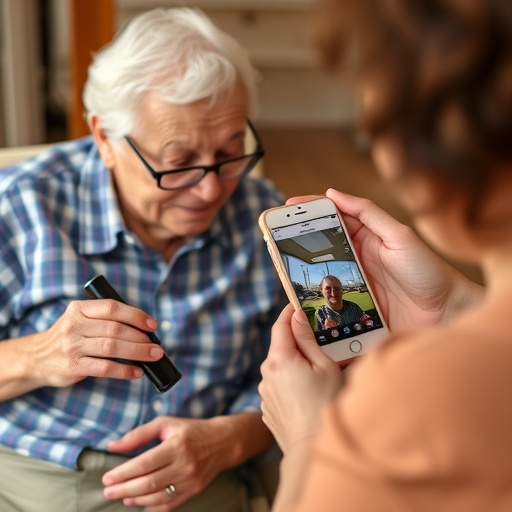
A groundbreaking clinical trial conducted by researchers at the University of Southern California (USC) Leonard Davis School of Gerontology and Weill Cornell Medicine has demonstrated the promising potential of a novel web-based tool designed to alleviate the complex emotional burden experienced by dementia patients and their caregivers. This digital platform, dubbed the Living Memory Home for Dementia Care Pairs (LMH-4-DCP), integrates advanced reminiscence therapy techniques in an interactive and customizable online environment. Its objective is to strengthen caregiver-patient connections and mitigate pre-death grief, a profound yet understudied form of anticipatory loss often observed in families affected by dementia.
Reminiscence therapy, a well-established psychosocial intervention, involves the strategic facilitation of conversations centered around personal memories and meaningful past experiences. Traditionally, this modality incorporates sensory stimuli such as music, photographs, and familiar objects to evoke emotional engagement and cognitive recall. The LMH-4-DCP extends this concept into the digital realm, offering tailored features including photo albums, guided autobiographical prompts, and interactive journaling capabilities. These tools are carefully engineered to promote sustained dialogue between persons living with dementia and their caregivers, aiming to enhance relational quality while preserving the dignity and personhood of the patient.
The core innovation of LMH-4-DCP lies in its dual-user design, which addresses a critical gap in dementia care by simultaneously targeting both members of the caregiving dyad. Francesca Falzarano, the study’s principal investigator and an assistant professor at USC, emphasized that enhancing the caregiver-patient relationship through engaging, memory-focused activities is essential not only for emotional well-being but also for practical caregiving outcomes. She highlighted that stronger bonds can delay or prevent transitions into institutional care settings, thus benefiting patients and families alike by maintaining home-based care longer.
Pre-death grief represents a particularly distressing aspect of dementia care, enveloping both current emotional pain and the anticipation of future losses. The study articulates how this grief is compounded by the gradual erosion of identity, independence, and shared social roles, resulting in a fracturing of previously stable interpersonal dynamics. Family caregivers often face the dual challenge of mourning a loved one’s cognitive decline while managing complex caregiving tasks. On the other hand, individuals with dementia may themselves experience grief linked to deteriorating faculties and a diminishing sense of self.
The randomized clinical trial enrolled 34 caregiving dyads, each composed of a person with mild to moderate dementia and their primary caregiver. Participants were assigned either the full LMH-4-DCP app, complete with reminiscence features, or a control version lacking these interactive elements. Over a two-week period, dyads engaged with their allocated version twice weekly, with pre- and post-intervention assessments evaluating grief intensity, relationship quality, and usability perceptions. Results underlined the tool’s feasibility and receptiveness, showcasing significant reductions in pre-death grief among users exposed to the full reminiscence suite. While improvements in relational closeness were observed, these approached but did not conclusively reach statistical significance, suggesting the necessity for larger-scale or extended-duration trials.
Qualitative feedback from caregivers illuminated the profound emotional and cognitive impacts facilitated by the platform. Many expressed surprise at uncovering previously unspoken memories and noted enhanced emotional expression from care recipients who had been relatively disengaged. Caregivers reported a powerful sense of rekindled intimacy and deeper interpersonal connection, underscoring the app’s utility beyond mere cognitive stimulation. Notably, participants voiced strong motivation to continue utilizing LMH-4-DCP post-trial, emphasizing its role in preserving family narratives amid progressive dementia.
LMH-4-DCP derives conceptual inspiration and technical lineage from its progenitor, the Living Memory Home web app, originally developed at Weill Cornell Medicine as a bereavement support tool. The foundational app’s success in mitigating prolonged grief disorder through reflective journaling and memory work underscored the therapeutic value of structured reminiscence. This prior work informed the adaptation of the interface and content for dementia care pairs, leveraging overlaps between grieving processes before and after loss to inform digital intervention design.
Holly Prigerson, co-director of the Center for Research on End-of-Life Care and senior author on the current study, articulated the often underappreciated severity of grief as a clinical phenomenon. She delineated the pathological trajectory of prolonged grief disorder and its attendant risks, including suicidality and acute medical morbidity. By conceptualizing pre-death grief in dementia as a similarly debilitating state, the researchers underscore crucial opportunities for early detection, monitoring, and evidence-based intervention amid neurodegenerative illness trajectories.
The LMH-4-DCP’s digital platform affords distinct advantages in scalability, accessibility, and personalized engagement, vital considerations given the global demographic shifts toward aging populations and increasing dementia prevalence. Looking ahead, the research team envisions expansive randomized controlled trials across diverse populations, alongside methodological innovation in outcome measurement tailored to cognitive impairments. This includes designing validated instruments capable of capturing the experiences of persons with dementia directly, an approach critical for inclusive, patient-centered care research.
Integrating LMH-4-DCP within clinical and community-based dementia care infrastructures could redefine pathways to psychosocial support, promising to alleviate caregiver burden, promote emotional resilience, and sustain patient identity and dignity. As the digital health landscape evolves, such technology-enabled interventions are poised to become indispensable tools in holistic dementia management, addressing an urgent public health imperative with innovation and compassion.
This pioneering study epitomizes the intersection of technology, psychological science, and compassionate clinical care, positing that memory and shared narrative remain powerful instruments against the isolating effects of dementia and anticipatory grief. The LMH-4-DCP represents a transformative stride toward harnessing digital therapeutics to nurture human connection and emotional healing in the face of progressive cognitive decline.
News Publication Date: 22-Apr-2026
Web References:
- DOI: 10.1001/jamanetworkopen.2026.8278
- Center for Research on End-of-Life Care, Weill Cornell Medicine: https://endoflife.weill.cornell.edu/
References:
Falzarano F., Prigerson H., et al. (2026). Digital Reminiscence for Pre-Death Grief in Dementia Family Caregivers: A Pilot Randomized Trial. JAMA Network Open.
Cite Scienmag News
Cassandra Pierce. (April 22, 2026). Digital Reminiscence App Shows Promise in Easing Grief and Enhancing Bonds Between Dementia Patients and Caregivers. Scienmag. https://scienmag.com/digital-reminiscence-app-shows-promise-in-easing-grief-and-enhancing-bonds-between-dementia-patients-and-caregivers/
Cassandra Pierce. "Digital Reminiscence App Shows Promise in Easing Grief and Enhancing Bonds Between Dementia Patients and Caregivers." Scienmag, 22 April 2026, https://scienmag.com/digital-reminiscence-app-shows-promise-in-easing-grief-and-enhancing-bonds-between-dementia-patients-and-caregivers/. Accessed 3 September 2026.
Cassandra Pierce. "Digital Reminiscence App Shows Promise in Easing Grief and Enhancing Bonds Between Dementia Patients and Caregivers." Scienmag. April 22, 2026. https://scienmag.com/digital-reminiscence-app-shows-promise-in-easing-grief-and-enhancing-bonds-between-dementia-patients-and-caregivers/


