


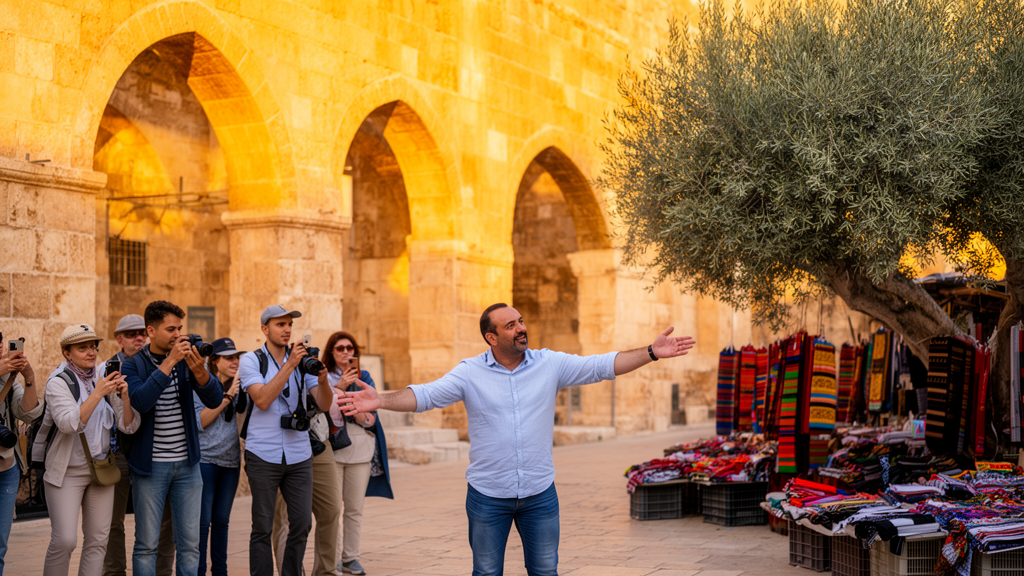
Palestine is home to some of the world’s most storied religious, historical, and cultural tourism assets, from ancient pilgrimage routes to centuries-old market towns, yet the sector has long struggled to convert that wealth of heritage into sustained international demand. A new open-access study published in Discover Sustainability argues that the missing ingredient may not be the destination itself but the digital machinery used to communicate it. Researchers surveyed 141 tourism marketing employees across the West Bank and found that those closest to the industry rate digital marketing strategies as highly important, with social media marketing, search engine optimization, and content marketing topping the list of tools seen as capable of transforming how Palestine communicates with the world and competes for visitors.
The research, led by Ahd Hinnawi and Nurul Zarirah Nizam of Universiti Teknikal Malaysia Melaka, together with colleagues from Rabdan Academy in Abu Dhabi, Al-Quds Open University in Nablus, and Ramon Magsaysay Memorial Colleges in the Philippines, employed a descriptive, correlational, and comparative research design. A structured questionnaire was administered to employees responsible for tourism marketing across four major stakeholder groups in the West Bank, and the data were analyzed using SPSS, the statistical software package widely used in social science research. The study received ethical approval from the UTeM Human Research Ethics Committee, and informed consent was obtained from all participants before they completed the questionnaire.
The findings indicate that tourism marketing employees perceive digital marketing strategies as making a strong contribution to two complementary dimensions of sector improvement: communication and competitiveness. On the communication side, respondents emphasized trust-building, improved access to tourism information, multilingual engagement with potential visitors, transparency, and timely interaction between tourists and tourism entities. In practical terms, this suggests that well-executed digital campaigns can function as a real-time dialogue rather than a one-way broadcast, allowing destinations to answer questions, correct misconceptions, and provide accurate information at the exact moment travelers are deciding where to go.
On the competitiveness side, the perceived contributions centered on the digital representation of Palestinian identity, greater visibility of heritage sites and landmarks, countering negative and misleading narratives, and broader international exposure. This aspect of the study carries particular weight in a context where the authors note that persistent negative and misleading narratives affect both destination image and tourism demand. In the digital arena, where search results and social feeds shape perceptions before any travel booking occurs, the ability to present an authentic, multilingual, and visually compelling account of a destination becomes a competitive weapon in its own right.
Social Media Marketing received the highest importance rating among the strategies assessed, followed closely by Search Engine Optimization and Content Marketing. The ranking reflects the technical logic of contemporary destination marketing. Social media platforms allow tourism entities to reach global audiences at relatively low cost and to engage users through imagery, video, and interactive formats that traditional brochures cannot match. Search engine optimization determines whether a destination appears on the first page of results when a potential visitor types a query into a search engine, a threshold below which most content is effectively invisible. Content marketing, meanwhile, provides the substantive material, from blog posts to virtual tours, that gives social media and search strategies something meaningful to promote.
One of the study’s most technically interesting findings concerns significant differences across stakeholder groups. The Ministry of Tourism and Antiquities reported the highest perceived contributions of digital marketing strategies, while oriental antiques stores reported the lowest. The authors suggest these differences may reflect variation in organizational roles and operating contexts across the four stakeholder groups surveyed. A national ministry, with institutional mandates, larger budgets, and strategic communication responsibilities, is structurally positioned to deploy and benefit from digital campaigns in ways that a small antiques shop, focused on individual transactions and local customers, may not be. This gradient in perceived value underscores a broader principle in digital transformation research: the benefits of digital tools are not automatic but depend on organizational capacity, strategic alignment, and the fit between the tool and the organization’s mission.
The comparative design of the study adds methodological strength to the findings. By administering the same structured questionnaire across four distinct stakeholder groups and testing for significant differences, the researchers moved beyond a simple descriptive snapshot to identify patterns that vary systematically with organizational context. The use of SPSS for analysis allowed the team to apply standard statistical tests of correlation and comparison, providing quantitative evidence for claims that might otherwise rest on anecdote. The correlational element of the design suggests that employees who rate digital strategies as more important also tend to perceive stronger contributions to communication and competitiveness, although the study’s cross-sectional nature means causality cannot be established from these data alone.
The implications for the Palestinian tourism sector are considerable. The authors note that the sector continues to underperform due to limited marketing capabilities and weak digital visibility, problems that digital marketing strategies are specifically designed to address. If the employees responsible for tourism marketing perceive these strategies as highly important and strongly contributory, the study provides an evidence base for investment in digital skills training, content development, and platform-specific campaigns. The emphasis on multilingual engagement is particularly significant for a destination seeking to reach diverse international markets, since language barriers in digital content can function as invisible walls that prevent potential visitors from even discovering what a destination offers.
The study also highlights the strategic value of digital marketing as a narrative counterweight. The finding that employees associate digital strategies with countering misleading narratives and broader international exposure suggests that digital marketing in this context is not merely a commercial tool but a form of public diplomacy. In an era when destination image is shaped by algorithms, user-generated content, and viral narratives as much as by official campaigns, the ability to present an authentic digital account of Palestinian heritage, landmarks, and identity becomes central to the sector’s competitiveness. The digital representation of Palestinian identity, as the study frames it, is thus both a marketing strategy and a cultural statement.
Overall, the findings indicate that tourism marketing employees associate digital marketing strategies with stronger communication and competitiveness, which together represent complementary dimensions of tourism-sector improvement. The research, published on 17 October 2026 as an open-access article carrying the DOI 10.1007/s43621-026-04838-7, received no external funding and was supported by the Centre for Research and Innovation Management at Universiti Teknikal Malaysia Melaka. For a sector rich in heritage but constrained in visibility, the study offers a clear technical message: the tools of digital marketing, from social media to search optimization to content development, are perceived by the professionals who use them as essential instruments for building trust, correcting narratives, and competing for the attention of the global traveler.
Subject of Research: Digital marketing strategies for communication and competitiveness in the Palestinian tourism sector
Article Title: Tourism marketing employees’ perspectives on digital marketing strategies for communication and competitiveness in the Palestinian tourism sector
Article References: Hinnawi, A., Nizam, N. Z., Bacarra, R., Hinnawi, M., & Baculio, C. C. L. (2026). Tourism marketing employees’ perspectives on digital marketing strategies for communication and competitiveness in the Palestinian tourism sector. Discover Sustainability. https://doi.org/10.1007/s43621-026-04838-7
Image Credits: AI Generated
DOI: 10.1007/s43621-026-04838-7
Keywords: Palestinian tourism, digital marketing, social media marketing, search engine optimization, content marketing, destination image, tourism competitiveness, West Bank, heritage visibility, tourism communication, stakeholder perceptions, Discover Sustainability
Cite Scienmag News
Violet Maxwell. (October 17, 2026). Digital Marketing Seen as Key to Boosting Palestinian Tourism, Study Finds. Scienmag. https://scienmag.com/digital-marketing-seen-as-key-to-boosting-palestinian-tourism-study-finds/
Violet Maxwell. "Digital Marketing Seen as Key to Boosting Palestinian Tourism, Study Finds." Scienmag, 17 October 2026, https://scienmag.com/digital-marketing-seen-as-key-to-boosting-palestinian-tourism-study-finds/. Accessed 17 October 2026.
Violet Maxwell. "Digital Marketing Seen as Key to Boosting Palestinian Tourism, Study Finds." Scienmag. October 17, 2026. https://scienmag.com/digital-marketing-seen-as-key-to-boosting-palestinian-tourism-study-finds/


