


Nanoplastics—plastic fragments smaller than a few hundred nanometers—have become one of the most pervasive contaminants of the modern food supply, detected in table salt, bottled water, seafood, and produce. Once swallowed, these particles can cross the gut lining and travel to organs such as the liver, raising concerns about chronic health effects. Now a study published in Nature Communications offers an unexpectedly simple countermeasure: dietary fiber. Researchers led by Zimin Yu, Zhanjun Li, and Eddy Y. Zeng report that in male mice, increasing the fiber content of food substantially reduces how much nanoplastic-associated material is retained in the body after oral intake.
The team used a visible/near-infrared dual fluorescence labeling technique combined with non-invasive imaging to track the gastrointestinal fate of ingested nanoplastics. This approach allowed them to follow the particles through living animals without sacrificing them at every time point. Twenty-four hours after oral intake, the estimated retention rates of nanoplastics-associated fluorescence were two times lower in mice fed a medium fiber diet and seven times lower in mice fed a high fiber diet, compared with animals on a standard fiber diet.
The protective effect extended beyond simple retention. During a 28-day oral exposure to nanoplastics, mice on the high fiber diet showed attenuated damage to the intestinal epithelium—the single-cell layer that normally acts as a selective barrier between the gut contents and the bloodstream. Preserving this barrier matters because a compromised epithelium is the primary route by which nanoparticles and other harmful molecules gain systemic access.
Imaging also revealed a striking difference in where the particles ended up. Mice consuming the high fiber diet had declined detectable near-infrared fluorescence in important organs such as the liver, suggesting that less nanoplastic material was crossing the gut wall and accumulating systemically. The liver, which filters blood arriving from the digestive tract, is a key sentinel organ for ingested contaminants, so reduced hepatic signal implies reduced translocation.
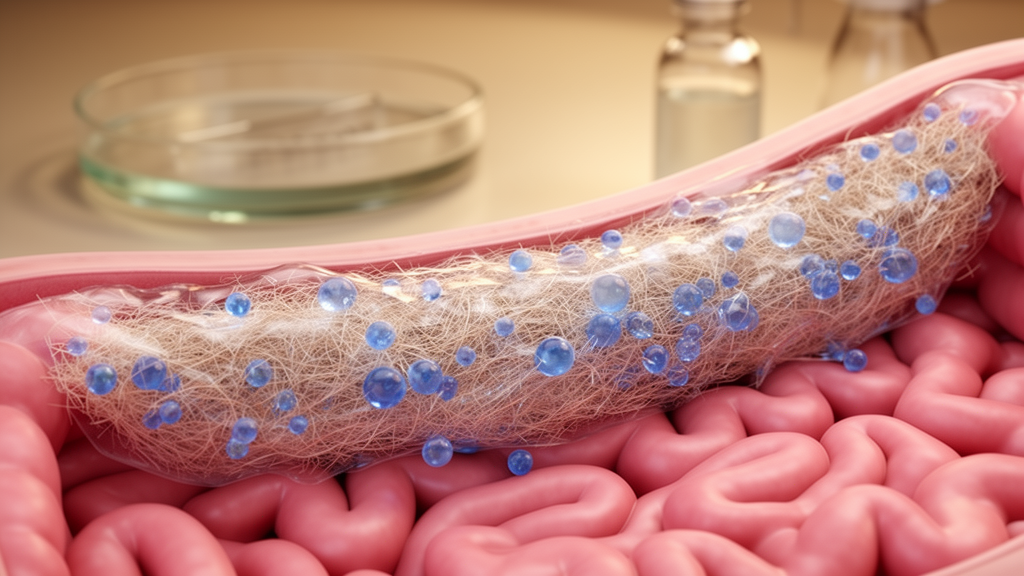
To understand the mechanism, the researchers turned to in vitro simulations. These experiments showed that dietary fiber physically encapsulates and adheres to nanoplastics, decreasing their bioavailability. In other words, fiber acts as a molecular trap: it wraps around the tiny plastic fragments and binds them, making them less available for absorption through the intestinal lining. This physical sequestration likely explains both the lower retention rates and the reduced organ fluorescence observed in vivo.
The findings carry particular weight because nanoplastic exposure is essentially unavoidable. Unlike many environmental contaminants that can be regulated at the source, plastics degrade continuously into ever-smaller particles that contaminate air, water, and food chains worldwide. Estimates suggest humans ingest thousands to millions of plastic particles annually, though precise quantification remains challenging due to detection limits and the diversity of particle sizes and polymer types. Nanoplastics are especially concerning because their small size allows them to interact with biological membranes in ways larger microplastics cannot.
Previous research on microplastics and nanoplastics has documented a range of potential adverse effects in animal models, including intestinal inflammation, altered gut microbiota, oxidative stress, and metabolic disruption. However, as the authors note, approaches for reducing gastrointestinal nanoplastic exposure remain poorly explored. Most attention has focused on characterizing exposure and documenting harm rather than on practical interventions that individuals or public health authorities could implement.
Dietary fiber is an attractive candidate for such an intervention because it is already widely recommended for other health benefits, including cardiovascular protection, improved glycemic control, and colorectal cancer prevention. If the same dietary component that supports general health also sequesters nanoplastics, the public health implications could be substantial. Fiber-rich foods such as whole grains, legumes, fruits, and vegetables are inexpensive, accessible, and already the subject of extensive dietary guidance.
Several caveats temper the enthusiasm. The study was conducted in male mice, and sex-specific differences in gut physiology, transit time, and mucus composition mean the findings may not translate directly to females or to humans. The fiber doses and nanoplastic concentrations used in the animal model may not correspond to typical human exposures. Additionally, the dual fluorescence labeling technique tracks particle-associated signal, which may not perfectly represent the behavior of all nanoplastic types encountered in real diets, which vary in polymer composition, shape, and surface chemistry.
Nevertheless, the study represents a meaningful step toward actionable exposure reduction. By demonstrating that a common dietary component can measurably alter the gastrointestinal fate of nanoplastics—reducing retention, protecting the intestinal barrier, and limiting organ accumulation—the work provides a scientific basis for developing dietary strategies aimed at reducing nanoplastic exposure. Future research will need to identify which specific fiber types are most effective, determine optimal intake levels, and validate the findings in human studies. For now, the message is a familiar one with a new twist: eating more fiber may do more than feed your gut bacteria—it may help keep plastic out of your tissues.
Subject of Research: Health & Medicine
Article Title: High fiber diet mitigates exposure risk of nanoplastics in male mice
Article References: Yu, Z., Abulipizi, G., Fang, Y., Qu, C., Ding, L., Zong, Z., Huang, J., Chen, Z., Zhou, J., Li, Z., & Zeng, E. Y. (2026). High fiber diet mitigates exposure risk of nanoplastics in male mice. Nature Communications. https://doi.org/10.1038/s41467-026-78675-7
Image Credits: AI Generated
DOI: 10.1038/s41467-026-78675-7
Keywords: nanoplastics, dietary fiber, gut health, microplastics, toxicology, nutrition, environmental health, Nature Communications, High, fiber, diet, mitigates
Cite Scienmag News
Daisy Hatcher. (October 17, 2026). Dietary Fiber Cuts Nanoplastic Uptake in Mice, Study Finds. Scienmag. https://scienmag.com/dietary-fiber-cuts-nanoplastic-uptake-in-mice-study-finds/
Daisy Hatcher. "Dietary Fiber Cuts Nanoplastic Uptake in Mice, Study Finds." Scienmag, 17 October 2026, https://scienmag.com/dietary-fiber-cuts-nanoplastic-uptake-in-mice-study-finds/. Accessed 17 October 2026.
Daisy Hatcher. "Dietary Fiber Cuts Nanoplastic Uptake in Mice, Study Finds." Scienmag. October 17, 2026. https://scienmag.com/dietary-fiber-cuts-nanoplastic-uptake-in-mice-study-finds/


