


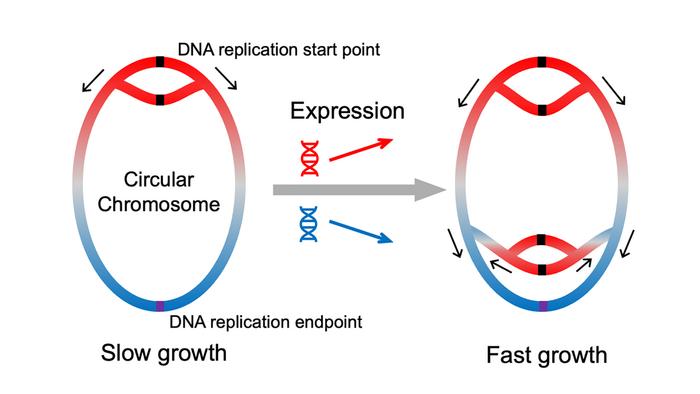
In a groundbreaking study published in the prestigious journal Science, a team of bioinformaticians from Heinrich Heine University Düsseldorf (HHU) and Linköping University in Sweden have unveiled remarkable insights into the organization of bacterial genomes. This study challenges the long-standing assumption that genes are distributed randomly across the bacterial chromosome. Instead, it proposes that bacterial genes are arranged in a structured manner based on their functional importance, particularly during times of rapid growth. This revelation holds significant implications for our understanding of bacterial evolution and gene regulation.
Throughout the process of bacterial cell division, the replication of the bacterial chromosome begins at a specific origin and progresses bidirectionally. This mechanism raises a vital question regarding gene positioning and its influence on growth and expression. The researchers assert that genes situated near the origin of replication are duplicated more quickly than those positioned toward the ends of the chromosome. Consequently, genes that are crucial for various growth-related functions are positioned strategically closer to the origin, allowing for enhanced expression during periods of rapid cellular proliferation.
Lead author of the study, Dr. Xiao-Pan Hu, emphasized the implications of their findings. By analyzing gene positioning and activity, the team observed that during DNA replication, an increased number of copies of essential growth-related genes are available for transcription. This abundance allows these genes to be read more frequently, leading to heightened expression levels essential for optimal growth dynamics. The findings indicate a clear evolutionary strategy where critical genes are placed advantageously to maximize their activity in response to changing physiological demands.
Professor Dr. Martin Lercher, the corresponding author of the study, highlighted the significance of this research in understanding bacterial gene arrangement. He noted that by evolving the positioning of genes in this manner, bacteria gain a competitive edge in their environments. The spatial organization of genes permits rapid responses to growth-related demands, showcasing a sophisticated level of regulation previously underestimated in bacterial genomes.
The study’s authors employed a combination of bioinformatic techniques and mathematical modeling to analyze the location of over 4,400 gene families across more than 900 diverse bacterial species. This extensive analysis revealed a pattern indicating that genes related to critical cellular functions are consistently biased towards strategic chromosomal positions. This correlation between gene positioning and growth efficiency suggests a powerful evolutionary force at play.
As bacteria adapt to their environments and face competition, their survival often hinges on how effectively they can regulate their gene expression. The findings suggest that bacteria which manage to not only replicate their DNA efficiently but also spatially optimize their gene expression stand a better chance of thriving. This organization may explain variations in growth rates among different bacterial strains, shedding light on the intricate relationship between genome architecture and evolutionary success.
The research fostered an understanding of the genetic architecture of bacteria that challenges the traditional view of randomness in gene distribution. Instead, it highlights a nuanced evolutionary strategy where gene positions correlate with their functional significance. This revelation may alter future studies in microbial genetics, prompting inquiries into how various organisms adapt on genetic levels in response to environmental pressures.
Moreover, the implications of this study extend far beyond basic biological understanding. An enhanced comprehension of how bacteria meticulously organize their genomes could pave the way for innovative applications in biotechnology and medicine. By grasping the principles of gene positioning, scientists could potentially design synthetic bacteria tailored for specific functions, ranging from bio-remediation tasks to novel therapeutic applications.
This new perspective on bacterial genetics not only changes our understanding of fundamental biological processes but also invokes an exciting avenue for future research. As microbial systems are engineered with these insights in mind, researchers may unlock novel strategies that harness bacterial capabilities for beneficial human use.
Given the significance of these findings, they stress the importance of continued research into bacterial genomics and gene regulation. Future studies could explore the evolutionary mechanisms contributing to these observed patterns and the implications for bacterial adaptability and survival in various environments. Understanding these processes in detail will be crucial in harnessing bacterial properties for biotechnological advancements.
Undoubtedly, the findings reported in the study signify a contemporary leap in microbiological research that bridges theoretical bioinformatics with practical applications. The intricate relationship between gene position and bacterial growth highlights not just a fascinating detail of microbial life but reveals a dynamic interplay between genetic architecture, environmental adaptability, and evolutionary pressure.
As the scientific community continues to digest and expand upon these findings, the potential applications in synthetic biology and medical research could indeed revolutionize numerous fields reliant on our understanding of microbial systems. This study thus serves as a pivotal reminder of the endless intricacies of life at the microscopic level, encouraging further exploration and discoveries in the captivating world of bacteria.
Cite Scienmag News
Juliet Wilcox. (April 10, 2025). Designing Solutions: Moving Beyond the Salt Shaker. Scienmag. https://scienmag.com/designing-solutions-moving-beyond-the-salt-shaker/
Juliet Wilcox. "Designing Solutions: Moving Beyond the Salt Shaker." Scienmag, 10 April 2025, https://scienmag.com/designing-solutions-moving-beyond-the-salt-shaker/. Accessed 4 September 2026.
Juliet Wilcox. "Designing Solutions: Moving Beyond the Salt Shaker." Scienmag. April 10, 2025. https://scienmag.com/designing-solutions-moving-beyond-the-salt-shaker/


