


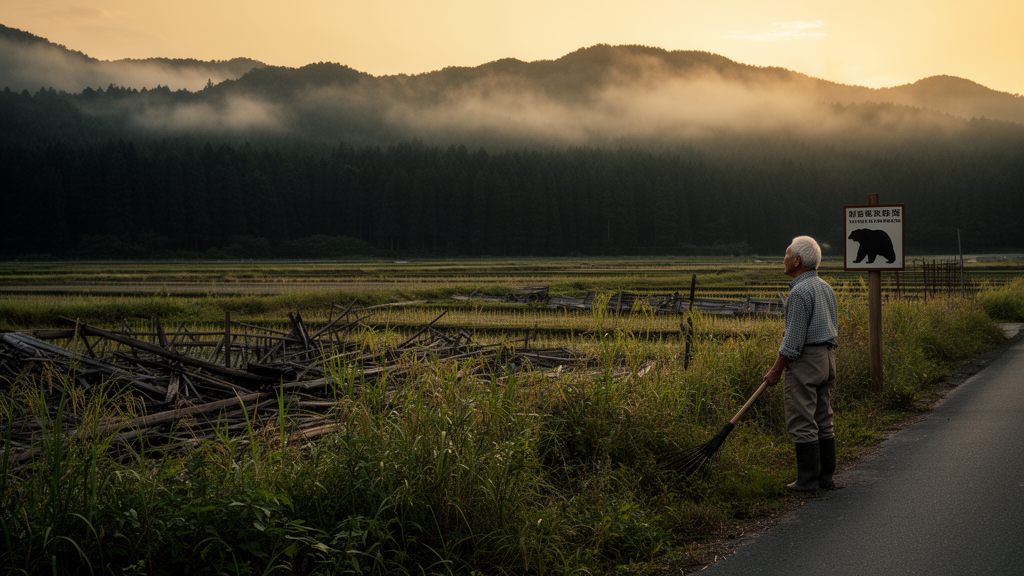
In Akita City, Japan, bears are no longer confined to the mountains. In November 2025, multiple Asiatic black bears were sighted in Senshū Park, just 700 metres from the central train station, and a bear entered a supermarket in a nearby city, attacking a staff member and triggering a standoff with police that lasted more than fifty hours. During the Japanese fiscal year running from April 2025 to March 2026, Akita Prefecture recorded 13,563 bear sightings, 2,689 exterminations, 67 human casualties and four fatalities, and all but three of those casualties occurred in urban or peri-urban spaces. A new study, published open access in the journal Ambio, examines how residents of Akita City themselves perceive this surge in bear presence, and what it reveals about the human side of a conflict usually framed as a wildlife problem.
Researchers Sakiko Miyazaki, Darragh Hare and Emu-Felicitas Ostermann-Miyashita conducted eight key informant interviews with university researchers, prefectural and municipal bear management officials, and police officers, followed by semi-structured interviews in June 2025 with 35 Akita City residents who had no institutional or professional experience with bears. Participants were recruited through snowball sampling and spanned age groups, city districts and genders. Interviews lasted between thirty minutes and an hour, were conducted in Japanese, and were manually translated into English because many interviewees spoke the Akita dialect, which automated translation services trained on standardised Japanese would have struggled to handle. The transcripts were then analysed thematically using NVivo software, with codes developed inductively from the raw data.
The most striking finding concerned what residents believe is driving bears into the city. Twenty-four participants, or 69 percent, said the current magnitude of bear presence had only emerged within the last five years, and nine participants explicitly identified the decline of human population and activity around the mountains as a driver. Fifteen participants, or 43 percent, pointed to recently abandoned land and farms as breaking down the buffer zone between mountains and cities. Decades of shrinking agriculture, reduced demand for firewood, the national rice acreage reduction policy and migration to major cities have all scaled back the human pressure that once kept bears at a distance. As one participant put it, abandoned houses, riverbeds and irrigation routes offer bears ways to travel through the city undetected, so in some ways they are invited in.
This perception aligns with a broader body of research. Previous studies of Japanese bear populations have identified fluctuations in mountain food availability, particularly beechnut crop failures, as the primary ecological driver of bears descending into inhabited areas, and sightings and captures have consistently peaked alongside such failures. But the Akita study highlights a socio-demographic dimension that reaches into the urban core. According to prefectural policy documents cited in the paper, 24 of Akita Prefecture’s 25 municipalities are experiencing depopulation, encompassing 66.2 percent of the prefectural population and 92.8 percent of its land area. The authors note that links between human depopulation and wildlife recovery have been documented internationally, and that similar correlations between depopulation and bear sightings have been reported in Japan, with one study projecting that 20 percent of Japan’s agricultural settlements will be depopulated by 2050.
The interviews also exposed a layered geography of perception within the same city. The researchers classified 13 participants as urban residents and 22 as peri-urban, based on whether 500-metre buffer zones around their home or workplace contained forested or mountainous terrain. Peri-urban residents were more likely to have seen a bear in their area, received frequent sighting alerts, and reported direct impacts on daily life, such as driving children to school or changing plans after a sighting. When asked what threshold made a bear a problem, 52 percent of peri-urban residents cited attacks on humans, compared with 28 percent of urban residents, while 64 percent of urban residents cited bears merely entering the city, against 52 percent of peri-urban residents. More urban residents, 64 percent, considered bears inherently part of nature and therefore not belonging in the human sphere, compared with 23 percent of peri-urban residents.
Perhaps most revealing were the misconceptions each group held about the other. Urban participants assumed that people living closer to the mountains would be more comfortable with bears, while peri-urban participants expressed the opposite sentiment, with one noting that the mountains sit directly beside farms, so bears stepping out of the woods are already very close. One urban participant summarised the perceived divide by saying that people in the city centre tend to have more fear while those near the mountains feel at a safe distance, a characterisation that peri-urban accounts contradicted. The authors argue that these mutually held but inaccurate impressions matter for management, because oversimplifying urban and peri-urban attitudes risks overlooking points where trust could be built or clashes over management decisions could erupt.
A second disparity ran between Akita and the rest of Japan. Seventeen participants, 49 percent, described an uptick in criticism from outside the prefecture following high-profile incidents, and twenty participants, 57 percent, discussed a fundamental difference between the felt reality of Akita residents and national perceptions. A prefectural office staff member described being swamped by dozens of angry calls from around the country whenever a bear killing became publicly known, and lamented that national coverage treated sightings and attacks as isolated events rather than continuous exposure. Participants also noted that media reports often classify attacks as non-life-threatening if the victim survives, glossing over injuries concentrated on the face and shoulders that can be life-altering in a single swipe, a framing participants felt fostered more sympathy for bears than for people.
Attitudes toward lethal control were broadly permissive but far from uniform. Most participants were not opposed to killing bears, and majorities of both peri-urban and urban participants supported lethal control as a solution, yet the thresholds justifying it varied widely: 57 percent said bears become a problem when they enter the city, 43 percent when they attack a person, and 37 percent when they damage crops. Regarding the emergency shooting amendment, a change to the Wildlife Protection and Management Act implemented in September 2025 that allows municipal authorities to hire hunters to shoot bears in cities, 37 percent of participants supported it, though eight of those said it should be a last resort. Five participants opposed it, and twenty raised practical concerns about ensuring the safety of residents and hunters when a rifle is fired in a built-up area. Notably, eleven participants believed returning captured bears to the mountains was the right response, despite the prefecture having made its no-re-release protocol public, a gap between public expectation and official practice that startled at least one management official interviewed for the study.
The authors situate Akita City within a wider conservation context. The Akita Prefecture bear population is currently estimated at between 2,800 and 6,000 animals, benchmarked at 4,400 for management purposes, yet 300 to 600 bears have been killed annually by response teams since 2016 and more than 2,000 in 2023, a discrepancy the authors say calls into question the possible population consequences of lethal control, particularly given uncertainty about the minimum viable population and the difficulty of estimating numbers across connected mountain ranges. They classify the Akita conflict as a Level 1 dispute under an established framework, centred on resources and safety, but warn that tensions between some residents and management institutions suggest early movement toward Level 2, where entrenched distrust undermines future mitigation. With 77 percent of participants never having seen a bear themselves and yet 57 percent treating bear presence as a problem, the study underscores that perceived risk, not just measured impact, shapes demands for control. The authors conclude that human dimensions research must run alongside ecological study if Japan, and other depopulating regions worldwide, are to develop conflict mitigation strategies that residents will actually accept.
Subject of Research: Public perceptions of Asiatic black bear presence and lethal control in Akita City, Japan
Article Title: Human dimensions of Asiatic black bear presence in Akita City, Japan
Article References: Miyazaki, S., Hare, D., & Ostermann-Miyashita, E.-F. (2026). Human dimensions of Asiatic black bear presence in Akita City, Japan. Ambio. https://doi.org/10.1007/s13280-026-02497-6
Image Credits: AI Generated
DOI: 10.1007/s13280-026-02497-6
Keywords: Asiatic black bear, human-wildlife conflict, Akita City, Japan, depopulation, rural land abandonment, lethal control, semi-structured interviews, urban wildlife, bear management, perceptions, Human
Cite Scienmag News
Violet Maxwell. (October 23, 2026). Depopulation, abandoned farmland and fear: how residents of Akita City view Japan’s urban bear crisis. Scienmag. https://scienmag.com/depopulation-abandoned-farmland-and-fear-how-residents-of-akita-city-view-japans-urban-bear-crisis/
Violet Maxwell. "Depopulation, abandoned farmland and fear: how residents of Akita City view Japan’s urban bear crisis." Scienmag, 23 October 2026, https://scienmag.com/depopulation-abandoned-farmland-and-fear-how-residents-of-akita-city-view-japans-urban-bear-crisis/. Accessed 23 October 2026.
Violet Maxwell. "Depopulation, abandoned farmland and fear: how residents of Akita City view Japan’s urban bear crisis." Scienmag. October 23, 2026. https://scienmag.com/depopulation-abandoned-farmland-and-fear-how-residents-of-akita-city-view-japans-urban-bear-crisis/


