


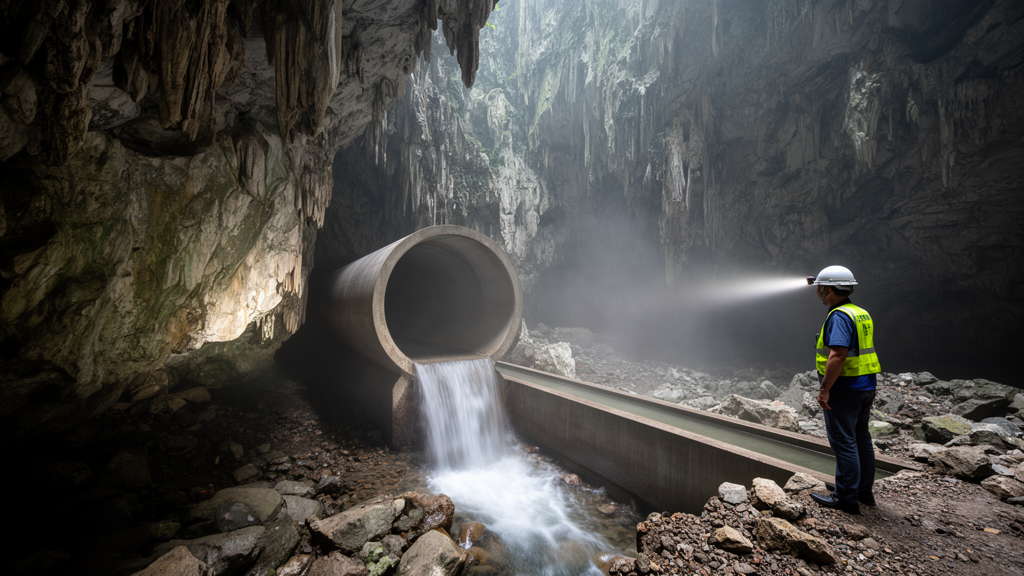
Beneath the karst terrain of Panzhou City in southwest China, a deep tunnel has become the subject of a detailed numerical modeling study published in Hydrogeology Journal, led by Tingqiao Yang and colleagues, that tracks how continuous drainage during tunnel construction changes the exchange of water between a karst aquifer’s rock matrix and its dissolution-formed conduits. The research team built a coupled matrix–conduit groundwater flow model using MODFLOW-CFPv2, a simulation code designed to represent both slower seepage through the rock matrix and faster flow through conduits. Their central result is striking in its timing: within 30 days of tunnel excavation, the model shows the direction of water flow at the matrix–conduit interface reversing, and after approximately 390 days the system establishes a new dynamic equilibrium.
Karst aquifers contain two connected flow domains: the rock matrix, which stores water, and conduits, which transmit it. The exchange between these domains is what the study set out to quantify under the influence of tunnel drainage, which acts as a new outlet that draws groundwater toward the tunnel. To do this, the researchers constructed the coupled model for a deep tunnel located in a typical karst area of Panzhou City, then tested how well it reproduced field conditions before using it to explore the consequences of drainage.
The model performed well in both tests the researchers applied. In calibration against borehole groundwater levels, it achieved a Pearson correlation coefficient of 0.98, indicating near-perfect linear agreement between simulated and observed levels. In an independent evaluation against spring discharge, a test using data not involved in calibration, the coefficient was 0.89, still a strong match. Passing both checks matters for a coupled model of this kind, because agreement with water levels alone would not demonstrate that the model captures the conduit dynamics reflected in spring discharge. With both benchmarks met, the simulated exchange fluxes between matrix and conduit carry greater confidence.
The simulation shows that tunnel drainage does not merely weaken the exchange between matrix and conduits; it reverses its direction at the interface within 30 days, as the tunnel becomes the dominant sink drawing groundwater toward it. Over the following months, the flow field reorganizes, and after approximately 390 days the aquifer reaches a new dynamic equilibrium. The water exchange evolves in distinct nonlinear phases rather than declining smoothly, with the total exchange rate showing phased changes as the system adjusts to the tunnel’s persistent drainage.
Quantitatively, the stabilized system exchanges less water than before. After the new equilibrium is established, the total exchange rate between matrix and conduits decreases by an average of approximately 3,000 cubic meters per day. The model also reveals an asymmetry in this decline: the suppression is more pronounced for conduit-to-matrix recharge, the movement of conduit water into storage in the surrounding rock, than for the opposite direction of exchange. In the simulated post-drainage system, the matrix receives less recharge from the conduit network than it did under natural conditions.
The study also examined a scenario in which tunnel support structures reduce the hydraulic connectivity between the tunnel and the aquifer after construction. Under this assumed post-support reduction, the simulated recovery remains incomplete. Groundwater levels stay 1.5 to 2.0 meters below the natural baseline throughout the simulated recovery period, indicating a persistent drawdown even with reduced connectivity. At the same time, the number of active CFPv2 conduit nodes with effective matrix–conduit exchange flux decreases by 3 to 6, corresponding to approximately 5 percent of the total active-node count under natural conditions. This represents a measurable reduction in the number of modeled exchange points connecting the conduit network to the matrix.
The modeling carries a safety implication for tunnel construction itself. The simulation identifies the tunnel–conduit junction zone, where the excavation intersects the natural conduit network, as carrying a high water inflow risk, with model-predicted peaks exceeding 20,000 cubic meters per day. The model also shows that this risk is spatially heterogeneous: the predicted inflow concentrates where conduits connect to the tunnel rather than being distributed evenly along its length. The authors conclude that this spatial variability necessitates differentiated prevention strategies, meaning that prevention measures must be tailored to the specific hydraulic connections identified at each junction along the tunnel alignment rather than applied uniformly.
Methodologically, the Panzhou application demonstrates that MODFLOW-CFPv2 can reproduce both borehole water-level records and spring discharge observations simultaneously in a coupled matrix–conduit framework, providing a validated basis for the exchange-flux predictions the study reports. The authors state that the findings provide a scientific basis for hydrological impact assessment and water resource conservation in karst tunnel engineering. The specific numbers the model produces, including the 30-day flow reversal, the approximately 390-day equilibration time, the average exchange-rate loss of roughly 3,000 cubic meters per day, the residual 1.5 to 2.0 meter drawdown under post-support conditions, the loss of 3 to 6 active exchange nodes, and the peak inflow risk above 20,000 cubic meters per day at tunnel–conduit junctions, give engineers and planners quantified, time-resolved estimates of how drainage reshapes groundwater circulation in this karst setting.
As a modeling study, the work carries the limitations inherent to simulation: its results describe the modeled tunnel and aquifer in Panzhou City under the assumptions and calibration data used, including the assumed post-support reduction in hydraulic connectivity, rather than direct measurements of every process it represents. Within that scope, the study documents that tunnel drainage can reverse matrix–conduit flow direction within a month, suppress conduit-to-matrix recharge more strongly than the reverse exchange, leave groundwater levels partially recovered but still below baseline after support installation, and concentrate high inflow risk at specific tunnel–conduit junctions. These findings are offered by the authors as a foundation for assessing hydrological impacts and conserving water resources where tunnels are built through karst aquifers.
Subject of Research: Numerical simulation of tunnel drainage effects on matrix–conduit groundwater exchange in karst aquifers in Panzhou City, China
Article Title: Numerical simulation of the impact of tunnel drainage on matrix–conduit water exchange in the karst aquifers of Panzhou City, China
Article References: Yang, T., An, G., Chen, J., Hu, X., Peng, D., Cui, Y., Yang, D., & Huang, T. (2026). Numerical simulation of the impact of tunnel drainage on matrix–conduit water exchange in the karst aquifers of Panzhou City, China. Hydrogeology Journal. https://doi.org/10.1007/s10040-026-03197-x
Image Credits: AI Generated
DOI: 10.1007/s10040-026-03197-x
Keywords: karst aquifer, tunnel drainage, groundwater, MODFLOW-CFPv2, matrix–conduit exchange, numerical simulation, Panzhou City, hydrogeology, water resources, conduit flow, China, groundwater modeling
Cite Scienmag News
Violet Maxwell. (October 23, 2026). Tunnel Drainage Flips Groundwater Flow in Chinese Karst Aquifer Within a Month. Scienmag. https://scienmag.com/tunnel-drainage-flips-groundwater-flow-in-chinese-karst-aquifer-within-a-month/
Violet Maxwell. "Tunnel Drainage Flips Groundwater Flow in Chinese Karst Aquifer Within a Month." Scienmag, 23 October 2026, https://scienmag.com/tunnel-drainage-flips-groundwater-flow-in-chinese-karst-aquifer-within-a-month/. Accessed 23 October 2026.
Violet Maxwell. "Tunnel Drainage Flips Groundwater Flow in Chinese Karst Aquifer Within a Month." Scienmag. October 23, 2026. https://scienmag.com/tunnel-drainage-flips-groundwater-flow-in-chinese-karst-aquifer-within-a-month/


