


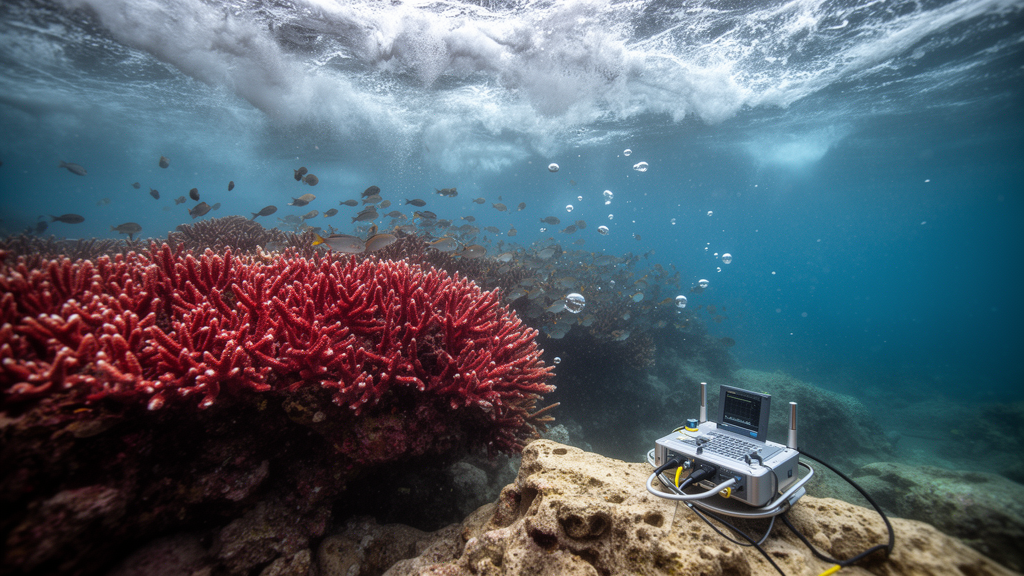
A severe convective storm passing over Shushah Island in the Northern Red Sea temporarily altered the underwater sounds of a nearby coral reef, according to an opportunistic acoustic-monitoring study. The event combined intense rain, strong winds and a tornado, and its passage coincided with reduced sound levels in frequency bands used to track reef animals. Root-mean-square sound pressure levels recovered to normal ranges within days, but the study involved only one storm and therefore cannot establish a general causal effect across storms or reefs. The authors describe the result as evidence of rapid, short-term resilience in the island’s reef soundscape rather than a lasting ecological decline.
The storm formed on 29 November 2022 as a line of thunderstorms developed over the northern Red Sea and moved northeastward. An overshooting convective cell passed directly over Shushah Island, about 15 km off the coast of Duba, Saudi Arabia. A nearby automatic weather station recorded 22 millimetres of rain in one hour and a peak intensity of 69 millimetres per hour, while the Global Precipitation Measurement satellite estimated rates exceeding 53 millimetres per hour for a nearby storm cell. The wider meteorological setting included a cold front, a strong upper-level trough and warm sea-surface temperatures that favored deep convection in one of the world’s warmest and saltiest seas.
Underwater hydrophones captured the storm as a dramatic rise in broadband sound. At frequencies from 40 hertz to 20 kilohertz, root-mean-square sound pressure increased from roughly 115 decibels, referenced to 1 micropascal, to almost 140 decibels during the most intense period. Much of this energy was concentrated below 1 kilohertz, with a spectral peak at 187 hertz. Light rain and wind initially raised energy in the 2–15 kilohertz range, whereas heavy rain later introduced strong low-frequency sound consistent with raindrop and bubble-generated acoustic signatures. Wind and heavy precipitation may also have altered surface bubble layers, potentially attenuating some higher-frequency energy at the storm peak.
The recordings were made by three calibrated SoundTrap ST300HF hydrophones deployed at reef sites around Shushah Island at depths of roughly 8–11 metres. The instruments operated on alternating 15-minute recording and 60-minute duty cycles at a sampling rate of 96 kilohertz. Their offset schedules meant that different instruments captured the storm’s beginning, peak and end, allowing the onset and passage to be reconstructed across the reef complex. Visual inspection also confirmed the presence of familiar reef signals, including dawn and dusk fish choruses, calls from damselfish, and a pronounced nocturnal chorus of snapping shrimp.
For detailed comparisons, the researchers selected the offshore HP4 site, where one 15-minute recording captured the main storm from about 05:32 to 05:47 local time. They examined the nearest available recordings immediately before and after that interval and established reference conditions from the same 15-minute periods on five days before and five days after the storm. Each recording was divided into 15 one-minute windows. Sound pressure was evaluated separately in a 40–800 hertz band associated primarily with fish vocalizations and a 2–20 kilohertz band associated mainly with snapping shrimp. The authors also compared the complete distributions and conducted a minute-by-minute sensitivity analysis.
Both frequency bands showed lower pooled sound levels around the storm, although the strength and consistency of the pattern varied. In the low-frequency fish-associated band, levels during the pre-storm interval were significantly lower than the pooled reference measurements, with a Wilcoxon rank-sum p-value below 0.001. At the recording level, however, the storm-day median of 94.01 decibels was close to the reference median of 95.78 decibels and ranked only second-lowest among 11 daily observations. The post-storm minute-level comparison was also significant, with a p-value of 0.045, but the median of 98.00 decibels ranked fourth-lowest and the interval showed substantial minute-to-minute variability. The researchers therefore cautioned that the apparent reduction could partly reflect ordinary reef variability.
The high-frequency snapping-shrimp band produced a more sustained pattern. Its pre-storm median was 112.79 decibels, compared with 115.02 decibels across reference days, and was lower than nine of the 10 reference-day medians. The immediately post-storm median was 113.22 decibels, compared with a reference median of 114.56 decibels, making it the lowest of the 11 daily observations. Both pooled comparisons were significant at p-values below 0.0001. Nevertheless, no individual post-storm minute remained significantly different from its corresponding reference after correction for multiple comparisons, indicating that the overall difference was distributed across the interval rather than driven by one unusually quiet or loud minute.
Acoustic levels could not be assessed directly during the storm’s loudest phase because its signal masked most biological sound, particularly the lower-frequency band associated with fish. Upper-frequency shrimp snaps remained partly visible, but the masking prevented a reliable estimate of biophony under peak storm conditions. The data also came from a single opportunistic event, and the researchers did not quantify differences in biodiversity or animal abundance among recording sites. Although the three reef locations showed broadly similar acoustic patterns, bathymetric differences and possible ecological variation prevented their use as independent replicates in statistical tests. The statistical analysis therefore characterizes this storm and its immediate acoustic context rather than providing a replicated estimate of how reefs generally respond.
The results suggest that the storm was associated with brief changes in the behavior, location or calling activity of reef animals, followed by a rapid return toward familiar acoustic conditions. Low-frequency sound levels rebounded within the available records, while the five days after the storm produced levels comparable to the pre-storm reference period despite a continued decline in sea-surface temperature. Similar post-storm recovery within a day was inferred from the available measurements, whereas a Florida study cited by the authors reported increased fish chorusing three days after a hurricane. The contrast may reflect the very different frequency of storms in the two regions: thunderstorms are comparatively common in Florida but exceptionally rare in the arid Northern Red Sea.
For reef ecologists, the study illustrates why passive acoustic monitoring can reveal environmental disturbances that are brief and difficult to survey directly. Because fish and snapping shrimp supply much of a healthy reef’s biological sound, changes in their acoustic output can provide a sensitive indication of disturbance. Here, lower levels before and after the storm were consistent with temporary behavioral or locational changes, but the data do not identify which organisms were responsible or whether any longer-term ecological effects followed. The authors call for further organism-specific investigation and repeated monitoring of rare storms. The central result is that Shushah Island’s reef soundscape appeared acoustically resilient, with any measurable suppression brief and followed by a rapid return to baseline conditions.
Subject of Research: Acoustic monitoring of reef biophony before and after a severe convective storm at Shushah Island in the Northern Red Sea.
Article Title: Reef soundscape response to a severe convective storm event in the Northern Red Sea
Article References: Havlik, M.-N., González-Herrero, S., Angulo-Preckler, C., & Duarte, C. M. (2026). Reef soundscape response to a severe convective storm event in the Northern Red Sea. Discover Oceans, 3(1), 71. https://doi.org/10.1007/s44289-026-00185-7
Image Credits: AI Generated
DOI: 10.1007/s44289-026-00185-7
Keywords: coral reef soundscapes, passive acoustic monitoring, severe convective storm, Northern Red Sea, reef biophony, snapping shrimp, fish vocalizations, sound pressure level, Shushah Island, acoustic resilience, Reef, soundscape
Cite Scienmag News
Violet Maxwell. (October 22, 2026). Single Red Sea storm briefly lowered reef biophony, recordings show. Scienmag. https://scienmag.com/single-red-sea-storm-briefly-lowered-reef-biophony-recordings-show/
Violet Maxwell. "Single Red Sea storm briefly lowered reef biophony, recordings show." Scienmag, 22 October 2026, https://scienmag.com/single-red-sea-storm-briefly-lowered-reef-biophony-recordings-show/. Accessed 22 October 2026.
Violet Maxwell. "Single Red Sea storm briefly lowered reef biophony, recordings show." Scienmag. October 22, 2026. https://scienmag.com/single-red-sea-storm-briefly-lowered-reef-biophony-recordings-show/


