


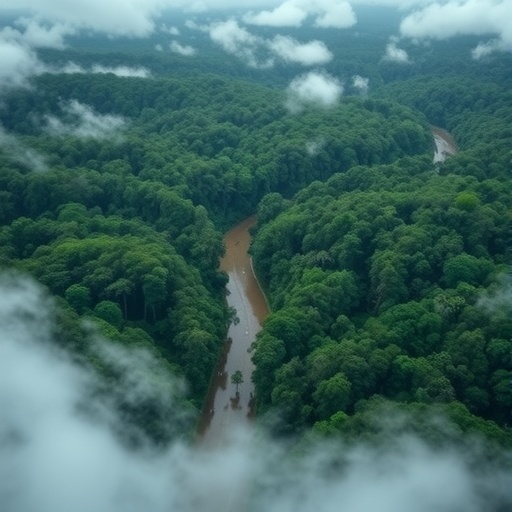
In a groundbreaking new study set to reshape the understanding of environmental dynamics in the Amazon Basin, researchers reveal a compelling link between rising global temperatures and the accelerating impact of deforestation on rainfall patterns in the southern Amazon. This convergence of climate change and land-use alteration heralds a precarious future for one of the planet’s most vital ecosystems, where rainfall sensitivity to forest loss intensifies with warming, threatening biodiversity, agriculture, and local livelihoods.
Central to this research is the recognition that the Amazon’s hydrological cycle is finely balanced, with forest cover playing an indispensable role in generating and sustaining regional precipitation. Trees draw moisture from the soil and release it into the atmosphere via evapotranspiration, aiding in cloud formation and rainfall. However, deforestation disrupts this cycle by reducing the capacity of the forest to recycle water, and this disruption becomes markedly more severe as climate warming reduces baseline moisture availability.
Traditionally, land regulations have limited deforestation to no more than 20% of any landholding in the Amazon basin. Yet, the study’s simulations demonstrate that this threshold is no longer sufficient to maintain hydrological stability, especially under projected warming scenarios. In the worst-case scenario examined, the researchers argue that limiting deforestation to 10% of land area or less may be critical to sustaining current rainfall levels, particularly over extensive areas exceeding 210 square kilometers.
The implications for agriculture, specifically soybean cultivation, are dire. Declines in annual rainfall as minimal as 4% could translate into yield reductions of up to 8%, directly impacting the profitability and viability of farming in the region. This forms a distressing feedback loop wherein farming drives deforestation, which then undermines the rainfall necessary for farming itself, exacerbating local economic and environmental vulnerabilities.
A nuanced discovery within the study is the scale-dependent nature of deforestation’s impact on rainfall. Small-scale deforestation can paradoxically enhance rain production. When forest patches are broken up in limited areas, the exposed land heats up, causing moisture from surrounding trees to rise and condense, temporarily increasing precipitation. However, when deforestation crosses a critical spatial threshold, the lack of integrated forest moisture supply leads to sharp rainfall declines, a tipping point that shifts depending on climate conditions.
Using advanced computational weather simulation models, the research team analyzed deforestation and climate change scenarios concentrated on a southern Amazon agricultural hotspot, an area exemplifying rapid forest loss due to cropland and pasture expansion. Their models track how deforestation percentages and warming scenarios interplay to modulate rainfall outcomes over decades, providing unprecedented predictive insights.
Under current climate conditions circa 2005–2014, rainfall reductions only become discernible when about half of the landmass is deforested, with a projected 1.7% decrease in precipitation by 2050 in these simulations. However, introducing a scenario with moderate emissions, this critical deforestation threshold lowers to 45%, pushing annual rainfall declines up to nearly 14% by the mid-century mark. Even more alarming, in a high-emission future, only a mere 10% of deforestation suffices to initiate substantial rainfall drops, up to 11%, signaling heightened vulnerability.
The mechanistic explanation offered by the research points to climate change-induced warming and drying of the air, which diminishes the atmospheric moisture reservoir available for recycling. As this moisture becomes scarcer, the role played by forests in pumping water vapor into the atmosphere becomes increasingly vital, meaning any further loss of forest cover incurs amplified hydrological penalties. Notably, the initial rainfall boost seen with limited deforestation diminishes as the climate warms, stripping away any intermediate benefits previously observed.
These results provoke urgent calls for enhanced forest conservation measures. The study’s lead author underscores the critical necessity for producers and policymakers to broaden their understanding of ecosystem dynamics and integrate forest preservation within agricultural planning. This education is key to aligning economic incentives with sustainable environmental stewardship and breaking the destructive cycle threatening both local economies and global biodiversity.
The research advocates for alternative land management strategies, especially agroforestry systems that weave native tree species within crop fields to better retain moisture and reduce heat accumulation. Such ecological integration offers a pathway to elevating productivity on already deforested land while mitigating further rainfall decline. In this vision, intensification and ecosystem harmony replace deforestation-driven expansion as strategies for agricultural resilience.
Underlying the study is a sophisticated integration of climate modeling and landscape-scale analysis, utilizing state-of-the-art computational simulation tools to capture the complex interactions between land cover, atmospheric moisture, and temperature. By explicitly modeling varying scales of deforestation and climate scenarios, the team provides concrete, actionable thresholds that can guide policy and conservation frameworks in a rapidly changing environmental context.
Ultimately, the study paints a sobering picture of a region where climate change and deforestation synergistically compromise hydrological stability. The southern Amazon, a linchpin for global carbon cycling and biodiversity, faces amplified rainfall sensitivity that could cascade into ecological degradation and economic hardship if strategies don’t evolve. This research stands as a clarion call to reimagine how humanity values and manages forest ecosystems amid a warming planet.
As this pivotal study appears in Geophysical Research Letters, it offers an essential scientific foundation for environmental decision-making. It underscores the necessity of aligning forest protection with climate mitigation efforts to avoid crossing critical tipping points that could irreversibly alter Amazonian rainfall regimes and the livelihoods they sustain. The future of the Amazon hinges on integrating ecological priorities with agricultural development, a feat demanding urgent commitment and innovation.
News Publication Date: 7-May-2026.
Web References:
https://agupubs.onlinelibrary.wiley.com/doi/10.1029/2025GL119000
Cite Scienmag News
Sloane Callahan. (May 7, 2026). Deforestation Reduces Amazon Rainfall, While Climate Change Accelerates the Decline. Scienmag. https://scienmag.com/deforestation-reduces-amazon-rainfall-while-climate-change-accelerates-the-decline/
Sloane Callahan. "Deforestation Reduces Amazon Rainfall, While Climate Change Accelerates the Decline." Scienmag, 7 May 2026, https://scienmag.com/deforestation-reduces-amazon-rainfall-while-climate-change-accelerates-the-decline/. Accessed 3 September 2026.
Sloane Callahan. "Deforestation Reduces Amazon Rainfall, While Climate Change Accelerates the Decline." Scienmag. May 7, 2026. https://scienmag.com/deforestation-reduces-amazon-rainfall-while-climate-change-accelerates-the-decline/


