


Lactic acid has quietly become one of the most important molecules in the emerging bioeconomy. It is the monomer behind polylactic acid, a biodegradable plastic used in packaging, medical implants and disposable consumer goods, and it also serves as a platform chemical for a range of industrial intermediates. Yet most of the world’s lactic acid is still produced by fermenting food crops with engineered bacteria, a process that competes with food supply and depends on carefully controlled biological conditions. Chemists have long sought a direct catalytic route that could turn abundant plant sugars and even raw biomass into lactic acid, but designing a catalyst that is efficient, stable and selective in water has proved stubbornly difficult.
A research team led by Jianjian Wang of Chongqing University, working with colleagues including Yueyue Tang, Heng Huang, Jiayi Peng, Haijie Yu and Yujie Wang, now reports a catalyst that makes significant progress on that front. Writing in the peer-reviewed journal Sustainable Carbon Materials, the researchers describe a modified nickel-based metal-organic framework, designated MOF-74(Ni)-50SA, that converted 99.5 percent of glucose and delivered a lactic acid yield of 51.7 percent at 170 degrees Celsius within just four hours. When the glucose solution was diluted, the yield climbed even higher, reaching 68.7 percent. The study is notable not only for its numbers but for the elegant strategy behind them: rather than avoiding imperfections in the crystal lattice, the team deliberately engineered them in.
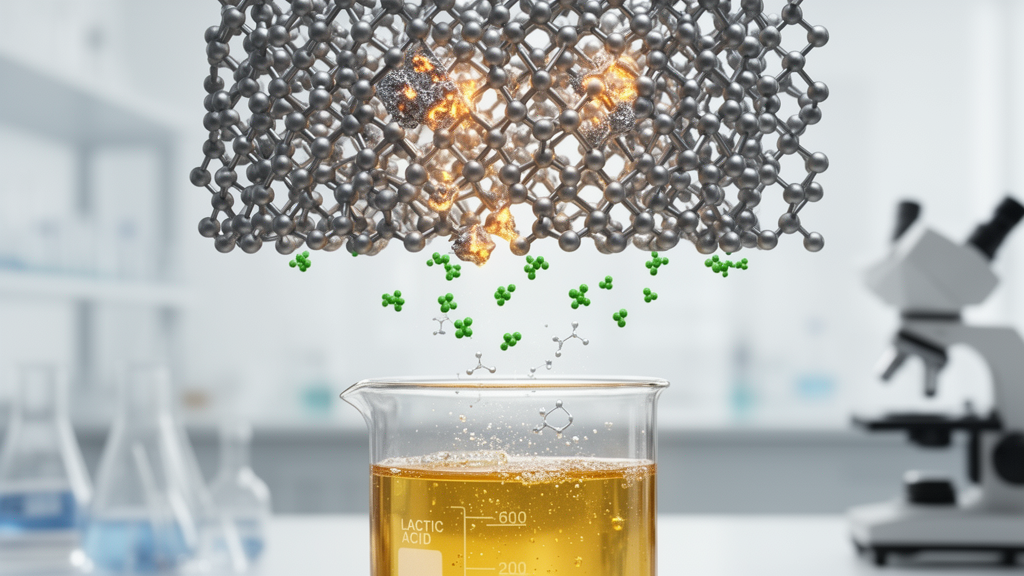
Metal-organic frameworks, or MOFs, are a class of porous crystalline materials built from metal ions connected by organic linker molecules, forming extended three-dimensional networks riddled with nanoscale cavities. Their appeal in catalysis lies in this architecture, which offers an enormous internal surface area and chemical tunability: by swapping the metal nodes or the organic struts, chemists can reshape the environment that reactant molecules encounter. MOF-74(Ni), the parent compound in this study, is a well-known framework built from nickel centers and an organic dicarboxylate linker. In its perfect form, however, many of its nickel sites are fully coordinated and relatively inaccessible to reacting molecules.
The researchers’ key move was to partially replace the conventional organic linker with salicylic acid, an inexpensive and commercially available small molecule. Because salicylic acid is shorter and binds differently than the native linker, its incorporation disrupts the ideal periodicity of the framework. The result is a material peppered with structural defects: oxygen vacancies, where lattice oxygen atoms are missing, and coordinatively unsaturated nickel sites, where metal centers are left with open coordination positions. These under-coordinated sites are precisely where catalysis happens most readily, because they can bind and activate substrate molecules that fully saturated sites cannot. Spectroscopic measurements, including X-ray photoelectron spectroscopy and electron paramagnetic resonance, confirmed that the modified material indeed carried a higher concentration of these defect sites while largely retaining the underlying MOF-74 framework.
Instead of treating structural defects as imperfections, we used them as a tool to control the catalytic environment inside the MOF, said Jianjian Wang, corresponding author of the study at Chongqing University. By engineering the organic linkers, we were able to generate oxygen vacancies and more coordinatively unsaturated nickel sites, which helped glucose enter the reaction pathway toward lactic acid more efficiently. The quote captures a conceptual shift that is spreading across materials chemistry: defects, once viewed as flaws to be minimized, are now recognized as programmable features whose density and character can be tuned to steer reaction outcomes.
Kinetic experiments lent quantitative support to that picture. The apparent activation energy for glucose conversion dropped from 79.3 kilojoules per mole for the unmodified MOF-74(Ni) to 69.6 kilojoules per mole for the salicylic acid-modified version, a reduction that translates into a substantially faster reaction at the same temperature. Intriguingly, the data suggested that the defects act mainly on the early stages of the reaction cascade. Glucose is converted first into fructose, then into dihydroxyacetone, and onward to pyruvaldehyde before the final rearrangement into lactic acid. The modified catalyst primarily accelerated these early steps, generating the reactive intermediates more rapidly, while the terminal conversion of intermediates into lactic acid proceeded at a comparatively unenhanced rate.
That observation points to a clear target for future optimization, and it also highlights a recurring challenge in biomass catalysis: the reaction network from a six-carbon sugar to a three-carbon hydroxy acid involves multiple isomerizations, fragmentations and hydrogen transfers, and no single active site type is optimal for every step. A catalyst that supercharges the front end of the pathway but leaves the back end sluggish will accumulate intermediates rather than product. The Chongqing team’s analysis of where the bottleneck lies therefore provides a roadmap for the next generation of defect-engineered frameworks, in which different site types might be tailored to different stages of the cascade.
Durability is the other make-or-break criterion for any industrial catalyst, and here the results were encouraging with a caveat. Over five consecutive reaction cycles, glucose conversion stayed above 97 percent and lactic acid yield remained above 40 percent. The gradual decline was traced to a decrease in the population of oxygen vacancies, suggesting that the defect sites are not indefinitely stable under reaction conditions. Understanding how vacancies are consumed or healed during repeated use, and designing frameworks that regenerate or preserve them, will be essential before such catalysts can operate for the thousands of cycles demanded by industrial practice.
Perhaps the most consequential demonstration, however, involved feedstocks far messier than purified glucose. When the catalyst was applied directly to ground corn cobs, a plentiful agricultural residue, it produced a 62.8 percent lactic acid yield at 170 degrees Celsius after four hours, a remarkable result for an unrefined lignocellulosic material. Pine needles proved more recalcitrant, reflecting their denser lignin structure and more crystalline cellulose, but raising the temperature and extending the reaction time lifted their lactic acid yield from 5.6 percent to 22.4 percent. Even that modest figure matters, because it shows the catalytic system tolerating real biomass rather than model compounds, a hurdle that many laboratory catalysts never clear.
The broader significance of the work lies in its demonstration that linker engineering offers a practical, scalable dial for tuning defect chemistry in MOF catalysts. Salicylic acid is cheap, widely available and easy to incorporate, which means the strategy does not depend on exotic synthesis. If subsequent work can extend the defect concept to the later steps of the lactic acid pathway and harden the vacancies against deactivation, the approach could bring aqueous, catalytic conversion of renewable carbohydrates closer to competing with fermentation at scale. For a field racing to decarbonize plastics production, a catalyst that turns agricultural waste into a biodegradable polymer feedstock, defects and all, is a result worth watching closely.
Subject of Research: Defect engineering in a salicylic acid-modified nickel metal-organic framework catalyst for converting glucose and raw biomass into lactic acid.
Article Title: Engineering defects in metal-organic frameworks boosts conversion of biomass sugars into lactic acid
Article References: Engineering defects in metal-organic frameworks boosts conversion of biomass sugars into lactic acid. (n.d.). Original publication
Image Credits: AI Generated
DOI: Not provided
Keywords: metal-organic frameworks, lactic acid, biomass, glucose, catalysis, defect engineering, oxygen vacancies, salicylic acid, green chemistry, biodegradable plastics, MOF-74, renewable chemicals
Cite Scienmag News
Bethany Barker. (October 17, 2026). Defect-Engineered Nickel Framework Converts Biomass Sugars into Lactic Acid with Record Efficiency. Scienmag. https://scienmag.com/defect-engineered-nickel-framework-converts-biomass-sugars-into-lactic-acid-with-record-efficiency/
Bethany Barker. "Defect-Engineered Nickel Framework Converts Biomass Sugars into Lactic Acid with Record Efficiency." Scienmag, 17 October 2026, https://scienmag.com/defect-engineered-nickel-framework-converts-biomass-sugars-into-lactic-acid-with-record-efficiency/. Accessed 17 October 2026.
Bethany Barker. "Defect-Engineered Nickel Framework Converts Biomass Sugars into Lactic Acid with Record Efficiency." Scienmag. October 17, 2026. https://scienmag.com/defect-engineered-nickel-framework-converts-biomass-sugars-into-lactic-acid-with-record-efficiency/


