


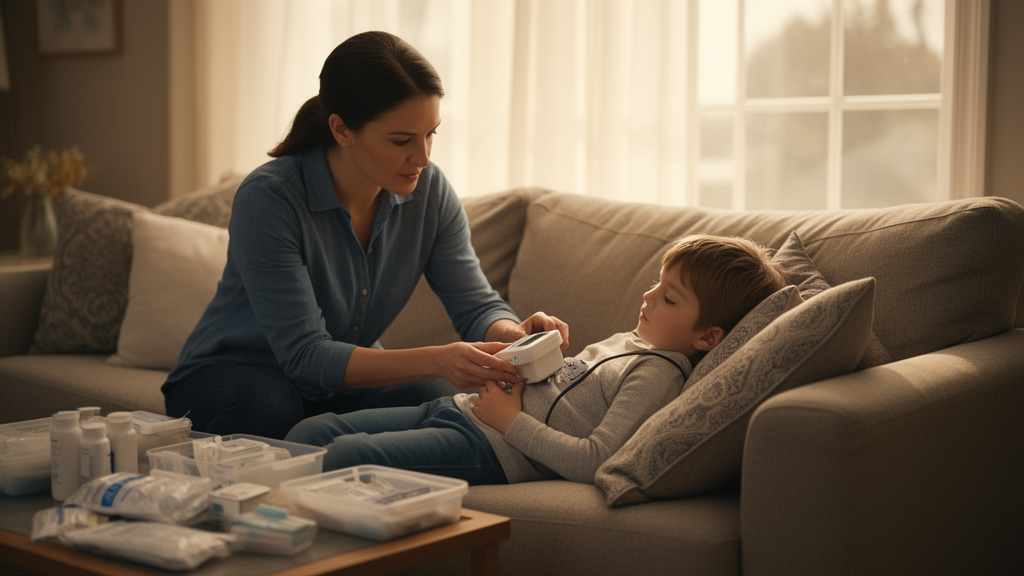
Behind the doors of thousands of American homes, a quiet and largely invisible healthcare workforce operates around the clock. Roughly one in twenty children under the age of eighteen in the United States is considered medically complex, living with multiorgan system conditions such as cerebral palsy and depending on implanted tube-related medical technology to survive and thrive. For these families, the hospital is not where most care happens. The home is. Parents handle sophisticated feeding pumps, medication syringes, and intricate nutrition regimens that would challenge many trained clinicians, and they do so with little formal backup. A new study from Ann and Robert H. Lurie Children’s Hospital of Chicago, published in the journal Pediatrics, offers one of the most detailed looks yet at how these parents confront safety hazards on their own, and the findings reveal both remarkable ingenuity and a troubling communication gap between families and professional care teams.
The research team, led by Peter Walsh, Behavioral Research Coordinator in the Foster Health Lab at Stanley Manne Children’s Research Institute, set out to capture safety challenges as they unfolded in real time rather than reconstructing them months later in a clinic. The study enrolled a national sample of twenty-one parents of children with medical complexity who spoke English or Spanish. Over the course of one week, participants responded to twice-daily surveys that solicited text messages describing their child’s tube-related care. The method, known as ecological momentary assessment, is designed to catch experiences while they are fresh, before memory smooths over the small failures and near misses that rarely make it into medical records. Parents were also encouraged to submit photographs or audio recordings of the problems they encountered, adding a rich sensory layer to the data. Afterward, researchers interviewed each parent to discuss their messages in greater depth.
What emerged from this intensive week of documentation was a portrait of parents as de facto safety engineers for their children’s home medical systems. The researchers found that parents navigate patient safety challenges during daily tube-related care and actively create strategies to mitigate risks. Strikingly, most of these challenges and the improvised solutions that followed were never shared with the child’s care team. The professional clinicians who prescribed the equipment and designed the care plans were largely unaware of both the hazards their patients faced at home and the workarounds families had invented to manage them.
The safety challenges clustered into three dominant categories. Supply issues accounted for twenty-four percent of reported problems, encompassing difficulties obtaining tube- and medication-related supplies, medications, or equipment. For families dependent on a steady stream of specialized items, a delayed shipment or an insurance denial can interrupt a feeding schedule or a medication routine with immediate clinical consequences. Devices not working as intended made up twenty-two percent of the challenges. Parents described feeding pumps that ran inconsistently or incorrectly and medication syringes that broke during use, failures that strike at the heart of a system in which precise dosing and delivery are everything. The third category, irregularities in care experienced as normal, accounted for twenty percent. One parent described how their child’s feeding tube would constantly wrap around them overnight, a recurring hazard that had become such a routine feature of family life that it no longer registered as a problem worth reporting.
That last category may be the most consequential finding of the study. When irregularities become normalized, they disappear from the radar of both the family and the care team. A tube that tangles nightly is not a crisis in any single moment, but it represents a persistent risk that no clinician ever gets the chance to address. The study suggests that the most common safety issues in home-based pediatric care are precisely the kind of chronic, low-grade problems that fall through the cracks of episodic clinical visits, visible only to the parents living with them every day.
Despite the absence of formal guidance, parents were not passive in the face of these hazards. Across the study, participants created systematic operations to prevent adverse events within routine care. They developed checks, routines, and habits that functioned as informal safety protocols, adapted to the specific quirks of their child’s equipment and their household’s rhythms. The researchers characterized these efforts as creative and resourceful, and the characterization is well earned. Parents effectively designed their own quality-control systems without training in human factors engineering or patient safety science, iterating through trial and error in the high-stakes environment of their own living rooms.
Lead author Peter Walsh acknowledged this expertise while pointing to its limits. Our findings highlight parental ingenuity and resourcefulness in developing strategies to tackle safety challenges that often arise during their child’s at-home care, such as medical supply issues or malfunctioning devices, he said. While that is commendable and we acknowledge that parents are experts in what their own child needs, he added, stronger partnership and communication between the care team and parents would raise awareness of common safety concerns and help generate solutions, which in turn could be shared with other parents during training. Ideally, these conversations would begin when the medical devices are prescribed so that safety events could be prevented. Ongoing dialogue would also help decrease parental isolation and generally maintain a safer environment for children with medical complexity.
The vision Walsh describes treats parents not as passive recipients of instructions but as partners whose hard-won knowledge should flow back into the system. A workaround discovered by one family in one state could, in principle, spare dozens of other families the same trial-and-error process, if only there were a channel to carry it. The study’s authors argue that such a channel should be built deliberately, starting at the moment of prescription rather than after a preventable event has already occurred. Continuous communication, rather than occasional check-ins, would allow emerging hazards to surface early and solutions to circulate widely.
Senior author Carolyn Foster, MD, MS, Director of the Health@Home Initiative at Manne Research Institute and Assistant Professor of Pediatrics at Northwestern University Feinberg School of Medicine, framed the practical implications for the healthcare system. Our research suggests that proactive measures are necessary, such as offering parents tips about handling frequently encountered safety issues so they don’t have to reinvent the wheel each time, she said. Care plans also need to be simplified when possible and tailored to each family’s unique needs. Most importantly, constructing support systems where parents know who to call if they face challenges is essential for advancing at-home care safety.
The study was supported by grant 1R18HS029638-01 from the Agency for Healthcare Research and Quality, part of the U.S. Department of Health and Human Services, and Dr. Foster is the Yaeger Family Research Scholar at Lurie Children’s. As home-based care for medically complex children continues to expand, the research points to a structural truth about modern pediatrics: the safety of the most vulnerable patients increasingly rests on the shoulders of untrained caregivers improvising alone. Closing the loop between those caregivers and the clinical teams who depend on them may be one of the most straightforward ways to prevent harm, and the parents in this study have already shown that they are ready to contribute what they know, if the system is ready to listen.
Subject of Research: Safety challenges and parent-developed solutions in at-home care for children with medical complexity
Article Title: Parents of kids who need complex medical care at home tend to resolve frequent safety issues on their own, study finds
Article References: Parents of kids who need complex medical care at home tend to resolve frequent safety issues on their own, study finds. (n.d.). Original publication
Image Credits: AI Generated
DOI: Not provided
Keywords: children with medical complexity, home-based care, patient safety, tube feeding, medical devices, parenting, Pediatrics journal, Lurie Children's Hospital, caregiver burden, healthcare communication, medical supplies, care teams
Cite Scienmag News
Harold Sullivan. (October 17, 2026). Parents quietly solve most safety problems in home medical care for complex children, study finds. Scienmag. https://scienmag.com/parents-quietly-solve-most-safety-problems-in-home-medical-care-for-complex-children-study-finds/
Harold Sullivan. "Parents quietly solve most safety problems in home medical care for complex children, study finds." Scienmag, 17 October 2026, https://scienmag.com/parents-quietly-solve-most-safety-problems-in-home-medical-care-for-complex-children-study-finds/. Accessed 17 October 2026.
Harold Sullivan. "Parents quietly solve most safety problems in home medical care for complex children, study finds." Scienmag. October 17, 2026. https://scienmag.com/parents-quietly-solve-most-safety-problems-in-home-medical-care-for-complex-children-study-finds/


