


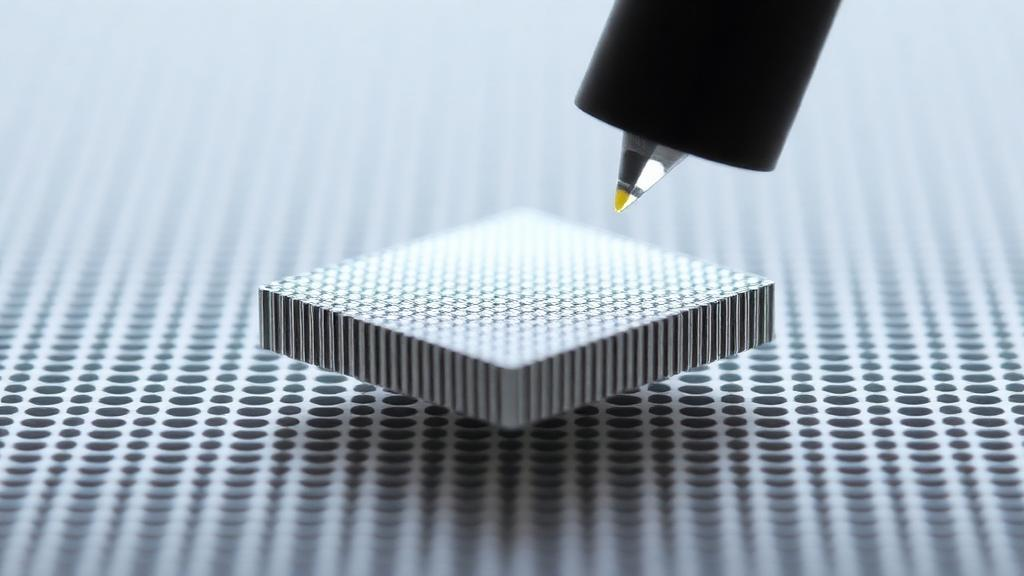
A team of materials scientists in China has engineered a suspended composite nanopore array made of silver nanoparticles isolated by silicon dioxide that pushes surface-enhanced Raman spectroscopy, or SERS, to remarkable new levels of sensitivity. Writing in the Journal of Materials Science, researchers from Hangzhou Dianzi University report that their self-assembled substrate can detect the pesticide pyridaben down to a concentration of 1.19 × 10⁻¹⁰ M, an ultra-low detection limit that could reshape how food safety laboratories screen for chemical residues. The work stands out not just for its sensitivity but for the elegance of its architecture, which transforms a well-known physical principle into a practical, uniform, and stable sensing platform.
SERS works by amplifying the inherently weak Raman scattering signal of molecules placed near nanostructured metal surfaces. When light strikes a plasmonic metal such as silver, collective oscillations of conduction electrons, known as surface plasmons, concentrate electromagnetic energy into nanoscale regions called hot spots. Molecules residing in these regions experience Raman signals enhanced by factors of millions or more, allowing trace detection that conventional Raman spectroscopy could never achieve. The challenge has always been engineering substrates that generate abundant hot spots while remaining uniform enough for quantitative analysis, since random nanoparticle aggregation produces erratic enhancements that vary wildly from point to point across a surface.
The new substrate tackles this challenge with a suspended architecture. Rather than depositing silver nanoparticles on a flat support, the team created a composite nanopore array in which discrete silver nanoparticles are isolated by silicon dioxide, forming ordered pore structures that hang suspended in space. This geometry is critical. The silicon dioxide spacers fix the separation between neighboring silver nanoparticles, preserving the nanoscale gaps where electromagnetic coupling is strongest. Because the particles are discrete rather than continuous, strong electromagnetic coupling occurs both between adjacent silver nanoparticles and along each nanopore structure, multiplying the number of active hot spots available to incoming analyte molecules.
Computer simulations using COMSOL confirmed the physical basis of the enhancement. The modeling revealed intense electromagnetic field localization within the gaps of the suspended pore walls and between the isolated silver particles, exactly the 3D hot spot distribution the experimental design intended. Unlike planar substrates, where hot spots concentrate only at the surface, the suspended pore geometry creates hot spots throughout the 3D volume of each pore. Analyte molecules that diffuse into the pores encounter enhanced fields along their entire pathway, effectively increasing the probability that any given molecule will land in a signal-boosting region. This volumetric hot spot availability is a key reason the substrate achieves such low detection limits.
The self-assembly strategy underlying the fabrication deserves attention because it addresses the scalability problem that plagues many high-performance SERS substrates. Lithographic approaches can produce exquisitely ordered plasmonic structures but require expensive equipment and small working areas. Self-assembly, by contrast, exploits spontaneous organization of materials into ordered patterns, potentially allowing larger substrates at lower cost. The team demonstrated that their assembled arrays exhibit high uniformity, meaning the Raman signal remains consistent across different positions on the substrate. Uniformity is the difference between a laboratory curiosity and a quantitative analytical tool, because reproducible signal intensity allows researchers to correlate peak heights directly with analyte concentration.
Stability proved equally impressive in the reported observations. Silver is famously reactive, tarnishing in air and degrading in aqueous environments, which limits the shelf life of many silver-based SERS substrates. The silicon dioxide isolation in the composite array appears to protect the silver nanoparticles, preserving the plasmonic response over time. The researchers report excellent stability alongside the ultra-low detection limit and high sensitivity, suggesting the substrate could withstand the handling and storage conditions of real-world analytical workflows rather than requiring immediate use after fabrication.
The target analyte, pyridaben, is a widely used acaricide employed against mites on fruit trees, vegetables, and ornamental crops. Like many pesticides, pyridaben residues on food products are regulated because excessive exposure poses health risks to consumers. Conventional detection methods such as chromatography coupled with mass spectrometry deliver excellent accuracy but demand costly instrumentation, skilled operators, and lengthy sample preparation. SERS offers a compelling alternative: rapid, label-free detection with minimal sample processing. The new substrate detected pyridaben at 1.19 × 10⁻¹⁰ M, a concentration low enough to satisfy stringent food safety monitoring requirements, and the technique requires only that a droplet of sample be applied to the substrate and measured with a Raman microscope.
The significance of this work extends beyond pesticide detection. The suspended composite nanopore concept could be adapted to sense a broad range of molecules, from environmental pollutants and foodborne pathogen markers to biomolecules in medical diagnostics. SERS platforms are already being explored for detecting nanoplastics in water, identifying explosive residues, monitoring human metabolites, and diagnosing diseases from biofluid samples. A substrate architecture that combines abundant 3D hot spots, high uniformity, and long-term stability addresses the three most persistent obstacles to translating SERS from specialized laboratories into routine analytical practice. The researchers suggest their design philosophy, using insulating spacers to lock plasmonic particles into optimal geometries, offers a general template for future substrate engineering.
There are still hurdles between this demonstration and widespread deployment. Real samples such as fruit extracts or river water contain complex mixtures of molecules that can compete for hot spot access or produce overlapping Raman peaks, and the suspended pores must prove their selectivity in such messy environments. Quantitative calibration across different instruments and operators will also require the kind of robust uniformity the team reports but has not yet validated at industrial scale. Nevertheless, the combination of a detection limit below one nanomolar, simulated confirmation of the hot spot physics, and a fabrication route based on self-assembly marks a substantial advance. As food safety agencies tighten residue limits and consumers demand transparency about what is on their produce, substrates like this suspended silver-silica array may soon become the workhorses of rapid, on-site chemical screening.
Subject of Research: Nanotechnology and analytical chemistry
Article Title: Suspended Ag-SiO2 composite nanopore array as SERS substrate for pyridaben detection
Article References: Tian, H., Zhang, Y., Wang, Y., Zhao, X., & Gao, R. (2026). Suspended Ag-SiO2 composite nanopore array as SERS substrate for pyridaben detection. Journal of Materials Science, 61(42), 32985-32994. https://doi.org/10.1007/s10853-026-13500-6
Image Credits: AI Generated
DOI: 10.1007/s10853-026-13500-6
Keywords: SERS, nanopore array, pyridaben, pesticide detection, silver nanoparticles, Raman spectroscopy, food safety, hot spots, Suspended, Ag-SiO2, composite, nanopore
Cite Scienmag News
Denise Maddox. (October 17, 2026). Suspended silver nanopore array detects pesticide traces with record sensitivity. Scienmag. https://scienmag.com/suspended-silver-nanopore-array-detects-pesticide-traces-with-record-sensitivity/
Denise Maddox. "Suspended silver nanopore array detects pesticide traces with record sensitivity." Scienmag, 17 October 2026, https://scienmag.com/suspended-silver-nanopore-array-detects-pesticide-traces-with-record-sensitivity/. Accessed 17 October 2026.
Denise Maddox. "Suspended silver nanopore array detects pesticide traces with record sensitivity." Scienmag. October 17, 2026. https://scienmag.com/suspended-silver-nanopore-array-detects-pesticide-traces-with-record-sensitivity/


