


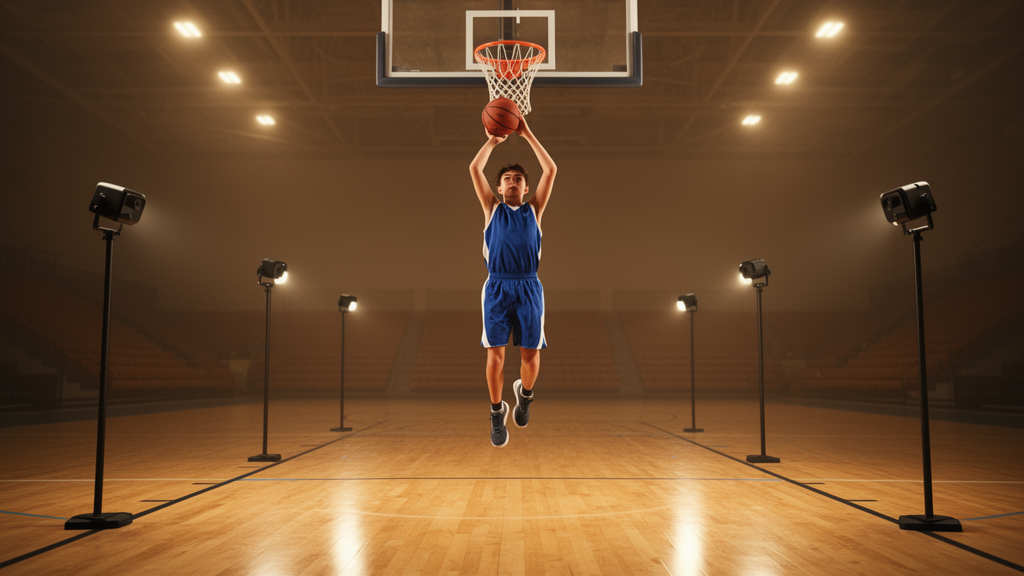
Every basketball coach knows the frustration of watching a promising shooter develop a subtle flaw that no one can quite name. The elbow drifts, the wrist snaps a fraction late, the follow-through wobbles, and the ball that once flew true begins to rattle the rim. A new study published in the journal iScience argues that the solution to this age-old coaching problem may lie not in sharper eyes but in smarter sensors. Researchers have built an artificial intelligence framework, called the Multimodal Shooting Evaluation and Efficiency Model, or MSEEM, that fuses video, motion tracking, wearable inertial sensors, and ball-trajectory data into a single 0-to-100 shooting-skill score, and then uses that score to deliver targeted corrective feedback within five seconds of a practice block.
The scientific problem the study tackles is deceptively simple to state and notoriously hard to solve. A basketball shot is a coordinated whole-body action lasting roughly a second, and its quality cannot be inferred from whether the ball goes in. Biomechanical research has long shown that skilled shooters maintain stable postural organization and coordinated ball-release control, and that compensatory coordination among the shoulder, elbow, and wrist helps preserve stable release conditions even when individual joints vary. Scoring can be affected by occlusion, changes in viewing perspective, and defender proximity, while technique varies across attempts and conditions. A single make-or-miss outcome, the study emphasizes, is a poor proxy for technical quality. What coaching actually requires is an interpretable measure of elbow positioning, release mechanics, jump-to-release timing, and follow-through stability, mapped to a structured rubric that a human assessor can verify.
MSEEM addresses this by synchronizing five complementary data streams. Two Sony cameras recording 1080p video at 120 frames per second captured the scene from frontal and sagittal views, providing context such as defender proximity and visibility. OpenPose software extracted markerless pose keypoints, which were triangulated into three-dimensional joint coordinates after checkerboard calibration, yielding measures such as elbow flexion at release, shoulder flexion, trunk lean, jump-to-release interval, and follow-through variance. Two Shimmer3 inertial measurement units strapped to the shooting hand and mid-forearm sampled acceleration and angular velocity at 200 hertz, capturing wrist-forearm dynamics such as peak wrist angular velocity and angular velocity impulse. A fine-tuned YOLOv8s detector tracked the ball in both views, allowing reconstruction of release angle, apex height, and entry angle at the 3.05-meter rim plane. Shot outcome was logged separately as a make indicator. Cross-modal synchronization used a simultaneous LED event and mechanical tap, with residual alignment error of just 3.2 milliseconds at the median, well within a predefined 10-millisecond tolerance.
The reference standard for all of this measurement was deliberately human. Two certified basketball coaches scored every shot on a structured rubric finalized before model development, producing a total score from 0 to 100 built from four equally weighted components: alignment, timing, release mechanics, and stability, each scored from 0 to 25. The coaches reviewed synchronized video while masked to model outputs, study condition, shot outcomes, and each other’s ratings, and their two-rater mean achieved an intraclass correlation of 0.88. Shot outcome was excluded from all rubric criteria. This independence matters because the study’s central claim is not merely that a model can predict numbers, but that those numbers agree with an independently derived coaching judgment.
The model itself is a study in efficiency. MSEEM uses parallel modality-specific encoders, with temporal transformer encoders processing pose and inertial sequences, multilayer perceptrons embedding video and trajectory features, and a learned token representing shot outcome. A gated attention layer learns modality-specific weights for each shot window before a fusion layer feeds one regression head for the total score and four component heads. Remarkably, the entire architecture contains roughly 0.74 million trainable parameters, compared with 34.5 million for the SlowFast video model, 121.4 million for TimeSformer, and 28.2 million for the Video Swin Transformer used as external comparators. Trained with an AdamW optimizer, a Huber loss for the total score, and mean squared error losses for the component heads, the model was frozen before any feedback was delivered and never updated during or after the training intervention.
The performance results are striking. Across five-fold participant-grouped cross-validation, in which every baseline shot from a held-out player remained within the same outer fold, MSEEM achieved a mean absolute error of 4.82 points on the 0-to-100 scale, with a Spearman rank correlation of 0.824 and calibration slopes within 0.02 of unity. The best video-only comparator, SlowFast, reached an error of 6.24 points, a statistically significant gap of 1.42 points after Holm correction. Removing the pose stream increased error to 5.79 points, and removing the inertial stream to 5.55 points, confirming that each modality carries information the others cannot fully replace. Simple concatenation fusion performed worse than gated attention, and an outcome-only model that tried to infer technique from make-or-miss status alone fared worst of all, with an error of 7.10 points.
Perhaps the most intriguing finding concerns how little the model cares about whether the ball went in. When the researchers flipped the binary outcome input while holding all other streams fixed, the predicted total score changed by only 0.63 points on average, with a maximum displacement of 1.88 points. The mean gated-attention weight for the outcome stream was just 0.071, compared with 0.267 for pose, 0.231 for inertial signals, 0.226 for video, and 0.205 for ball trajectory. In other words, the model derives its technique assessment almost entirely from how the shot is executed rather than from where the ball lands, which is precisely the property a coaching tool needs. A shooter can miss with perfect mechanics and make with flawed ones, and the framework reflects that distinction.
The training experiment put these measurements to a practical test. A total of 156 active basketball players, aged 18 to 30 with at least two years of organized experience, were randomized in equal groups after baseline assessment. All participants completed six supervised training sessions of 120 shots each, spanning free throws, catch-and-shoot attempts, off-dribble shots, and lightly contested shots with a passive defender positioned 0.75 meters away. The MSEEM-feedback group received a tablet display within five seconds of each 10-shot block, showing the overall score and the two highest-priority correctable components drawn from a locked cue library. The control group received standard coaching at the same cadence, without numerical scores or component rankings. Adherence was complete: all 5,616 scheduled training blocks and feedback episodes were delivered in each condition, with no adverse events and no missing primary outcomes.
The feedback condition produced a steeper improvement trajectory and stronger retention. In a mixed-effects model adjusted for baseline score, playing level, and baseline-score tertile, the interaction between MSEEM feedback and time was positive and statistically significant, indicating faster rubric-score improvement per session-minute in the feedback group. At the 14-day delayed re-test, the adjusted retention contrast favored MSEEM feedback by 5.90 points, corresponding to a standardized effect size of 0.68, with descriptive retention scores of 70.4 versus 64.1 points. Component-level analysis showed that alignment and stability carried the largest training effects, and the lightly contested shot condition showed both the largest shot-type training effect and the largest retention contrast. Exploratory moderation analyses found no significant evidence that baseline skill or playing level modified these effects, though the authors caution that the study was not powered for subgroup interactions.
The authors are careful to frame the scope of their claims. Testing occurred under standardized indoor conditions with fixed cameras and controlled lighting, and the lightly contested condition used a passive defender that did not reproduce the spatial pressure and occlusion of active competition, so transfer to game performance remains unestablished. The control group lacked a visually matched sham tablet condition, meaning motivational or expectancy effects of receiving structured digital feedback cannot be fully separated from the component-specific information itself. The reference standard reflects rubric-specific coaching judgments rather than universal measurement validity. Still, as a proof of concept, the study makes a compelling case that automated shooting assessment can be both accurate and actionable: a compact multimodal model that agrees with blinded coach ratings, resists degradation when individual sensors fail, and converts its component estimates into feedback that measurably accelerates learning and helps it stick. Broader deployment in academies, schools, and competitive environments, the researchers note, will require external validation under variable camera geometries, active defenders, and independent coaching settings, but the framework’s data and code are publicly available for exactly that purpose.
Subject of Research: Automated evaluation of basketball skills using multimodal data fusion for improving shooting training efficiency
Article Title: Automated evaluation of basketball skills using multimodal data fusion for improving shooting training efficiency
Article References: Sun, P. (2026). Automated evaluation of basketball skills using multimodal data fusion for improving shooting training efficiency. iScience, 29(11), Article 117915. https://doi.org/10.1016/j.isci.2026.117915
Image Credits: AI Generated
DOI: 10.1016/j.isci.2026.117915
Keywords: Automated, evaluation, basketball, skills, multimodal, data, fusion, improving, shooting, training, efficiency, scientific research
Cite Scienmag News
Denise Maddox. (October 17, 2026). AI Reads Every Angle of a Basketball Shot to Speed Up Training. Scienmag. https://scienmag.com/ai-reads-every-angle-of-a-basketball-shot-to-speed-up-training/
Denise Maddox. "AI Reads Every Angle of a Basketball Shot to Speed Up Training." Scienmag, 17 October 2026, https://scienmag.com/ai-reads-every-angle-of-a-basketball-shot-to-speed-up-training/. Accessed 17 October 2026.
Denise Maddox. "AI Reads Every Angle of a Basketball Shot to Speed Up Training." Scienmag. October 17, 2026. https://scienmag.com/ai-reads-every-angle-of-a-basketball-shot-to-speed-up-training/


