


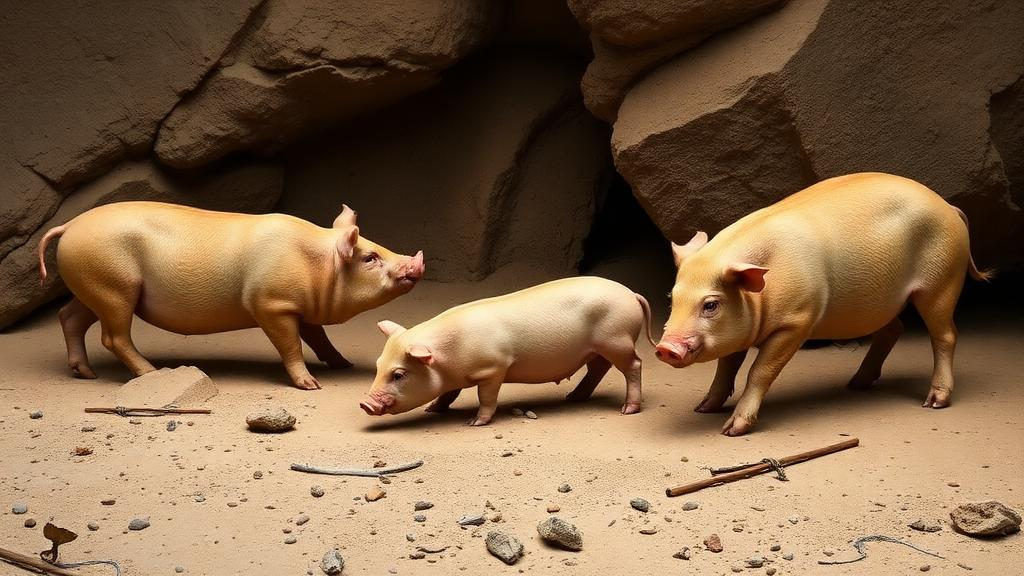
Nine and three-quarter million years ago, in the dense subtropical forests that covered what is now Catalonia, four species of pigs shared a single patch of wetland real estate. That simple-sounding fact, confirmed in a new study of the fossil site of Can Llobateres 1 in northeastern Spain, carries surprising weight. It pins down the final chapter of one of Europe’s most successful Miocene mammal lineages, and it offers a rare, precisely dated snapshot of an ecosystem just before a wave of extinctions swept it away. The research, published in the Swiss Journal of Palaeontology, revisits a faunal list that paleontologists have been quietly arguing about for more than fifty years.
Can Llobateres 1, excavated on and off since the 1940s, is one of the most thoroughly sampled Vallesian sites in Europe. It is best known for yielding the remains of Hispanopithecus laietanus, a late-surviving great ape that hung from the fig trees and laurels of a marshy, humid forest. But the site’s pig fossils have had a messier history. The small tetraconodontine Parachleuastochoerus crusafonti, named from this very locality, dominates the sample. Three other species, however, were reported from a handful of teeth in the early 1970s and then shuffled, dropped, and re-added by successive generations of faunal lists, often without descriptions, measurements, or even photographs to back them up.
The new revision, led by researchers at the Institut Català de Paleontologia Miquel Crusafont, went back to the drawers. The team re-examined the original specimens described in the 1970s and, crucially, dug through decades of unpublished material recovered during later excavation campaigns in 1981, 1990, and the 2010s. The result is the first detailed, illustrated, and measured account of every identifiable suid tooth from Can Llobateres 1 that does not belong to its namesake species. It confirms that the site’s pig community really did contain four species, and it corrects several long-standing misidentifications along the way.
The most consequential confirmation concerns Listriodon splendens, a large, lophodont pig with blade-like teeth adapted for shearing leaves. Listriodontines were among the most successful suid groups of the Middle Miocene, but their diversity collapsed during the late Miocene. The Can Llobateres 1 record, dated to roughly 9.8 million years ago by magnetostratigraphy, now stands as the last well-dated occurrence of the species anywhere in Europe. The evidence comes from five deciduous teeth, most likely belonging to a single juvenile, recovered during the 1981 campaign and never described until now. Their distinctive morphology, from compressed spatulate incisors to kidney-shaped premolars, matches Listriodon splendens so closely that the authors rule out any alternative assignment.
That last-appearance datum matters because it helps time the extinction of an entire subfamily. Listriodon splendens had already vanished from East Asia and eastern Europe millions of years earlier, clinging on only in western European refugia. Its presence at Can Llobateres 1 shows it survived the whole of the early Vallesian before disappearing, a pattern that paleontologists suspect was driven by rising seasonality and competition with rooting pigs that could fall back on underground food stores when fruit and foliage grew scarce.
The second confirmed species is Propotamochoerus palaeochoerus, a suine pig represented at the site by a remarkable concentration of juvenile remains: unworn milk molars, tooth germs still sealed inside their crypts, and two mandibular fragments that almost certainly belonged to one young individual. A single isolated premolar previously attributed to Parachleuastochoerus crusafonti has been reassigned to this species, and the associated material, labeled with catalog numbers from the later excavations, finally puts published reports of the species at the site on solid ground. Dental topographic analyses from earlier work classify Propotamochoerus palaeochoerus as an omnivorous generalist, an opportunistic feeder with the trophic flexibility to exploit resources well beyond the wetland forest floor.
The third species is the most taxonomically fraught. A large tetraconodontine pig, bigger than the abundant Parachleuastochoerus crusafonti, was tentatively reported in the 1970s as Hyotherium soemmeringi, a name that has since been carved up across multiple genera. Decades of nomenclatural dispute followed, with competing authors splitting and lumping the European tetraconodontines into Versoporcus, Conohyus, and Parachleuastochoerus, sometimes assigning different teeth from the same jaw fragment to different species. The new study cuts through this by comparing the Can Llobateres 1 material, including a distinctive lower first premolar and three incisors, against published samples from across Europe. The verdict: the large pig is ‘Parachleuastochoerus’ valentini, a species kept in quotation marks precisely because paleontologists still cannot agree which genus it truly belongs to.
That open nomenclature is more than academic fussiness. The genus question hinges on the anatomy of Parachleuastochoerus crusafonti itself, whose type species still lacks described cranial remains, and on whether the features distinguishing ‘Pa.’ valentini, such as the absence of a cementum band on the male lower canine and reduced premolar proportions, evolved once or in parallel. A recent cladistic analysis found that neither ‘Pa.’ valentini nor its rival Versoporcus steinheimensis sits close to Parachleuastochoerus crusafonti, leaving the large pig’s family tree genuinely unresolved. What the new study does establish is biochronological: ‘Pa.’ valentini outlived Versoporcus steinheimensis, surviving the entire early Vallesian alongside the last listriodontines.
The proportions of the assemblage tell an ecological story. Of 239 suid teeth from the site, 86 percent belong to the small, rooting Parachleuastochoerus crusafonti, while the other three species together account for barely 14 percent, with ‘Pa.’ valentini known from just four teeth. That imbalance fits the site’s paleoenvironmental reconstructions, built from fossil plants, mammal communities, and dental ecometrics, which paint Can Llobateres 1 as a densely forested, humid wetland ringed by more open woodlands. The dominant pig, equipped with high-crowned, heavily worn incisors and rooting behavior, could thrive year-round in the humid core, digging up roots and tubers when the monsoon-like rainy season gave way to lean months. The rarer generalists likely ranged into the drier, more open habitats nearby, visiting the forest only opportunistically.
Seen in full, the revised assemblage captures a community at its ecological tipping point. Within a few hundred thousand years, the Mid-Vallesian Crisis would prune the forest-adapted fauna of Europe, and the listriodontines, already down to their final species, would be gone entirely. The pigs of Can Llobateres 1, from the abundant rooter to the leaf-shearing specialist making its last stand, record the moment before the fall, one carefully measured tooth at a time.
Subject of Research: Taxonomic revision of the Late Miocene suid assemblage from Can Llobateres 1, Spain
Article Title: The suid assemblage from the Vallesian locality of Can Llobateres 1 (Vallès-Penedès Basin, NE Iberian Peninsula) revisited
Article References: Arranz, S. G., Siarabi, S., McKenzie, S., Casanovas-Vilar, I., & Alba, D. M. (2026). The suid assemblage from the Vallesian locality of Can Llobateres 1 (Vallès-Penedès Basin, NE Iberian Peninsula) revisited. Swiss Journal of Palaeontology, 145, 267-291. https://doi.org/10.3897/sjp.145.183361
Image Credits: AI Generated
Keywords: paleontology, Miocene, suids, Can Llobateres 1, Vallès-Penedès Basin, Listriodon splendens, Parachleuastochoerus, Vallesian, extinction, paleoecology, Spain, fossil pigs
Cite Scienmag News
Margaret Porter. (October 17, 2026). Fossil Pigs Rewrite the Story of a Vanishing Miocene World. Scienmag. https://scienmag.com/fossil-pigs-rewrite-the-story-of-a-vanishing-miocene-world/
Margaret Porter. "Fossil Pigs Rewrite the Story of a Vanishing Miocene World." Scienmag, 17 October 2026, https://scienmag.com/fossil-pigs-rewrite-the-story-of-a-vanishing-miocene-world/. Accessed 17 October 2026.
Margaret Porter. "Fossil Pigs Rewrite the Story of a Vanishing Miocene World." Scienmag. October 17, 2026. https://scienmag.com/fossil-pigs-rewrite-the-story-of-a-vanishing-miocene-world/


