


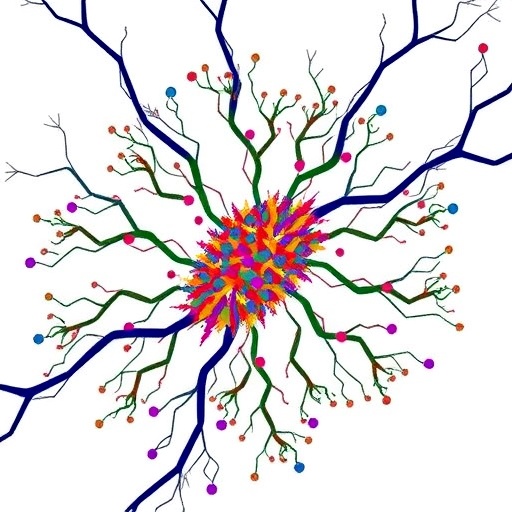
In a groundbreaking study that promises to revolutionize our understanding of breast cancer, researchers have developed an innovative approach to reconstructing the intricate cell-cell interaction landscapes found within tumors. This newly proposed method, named DeepPNCC, leverages single-cell RNA sequencing data to provide a pseudo-spatial representation of cell interactions, which normal traditional methods could not effectively achieve. The implications of this research extend beyond mere academic interest, as they hold the potential to unlock new avenues for therapeutic strategies against breast cancer and foster a deeper understanding of its pathogenesis.
Breast cancer, one of the most prevalent forms of cancer worldwide, exhibits significant heterogeneity in terms of its biological and clinical behavior. This complexity has long posed formidable challenges for researchers and clinicians striving to devise effective treatment plans. Traditional models that attempt to analyze tumor composition often lack the necessary resolution to accurately depict the spatial arrangements and intricate interactions among various cell types. This research thus aims to fill that gap by employing state-of-the-art computational techniques alongside data derived from single-cell technologies.
At the heart of this study is the novel DeepPNCC framework, which integrates deep learning methodologies with single-cell data analysis. By utilizing advanced algorithms, the researchers are capable of mapping how different cell types interact within the tumor microenvironment. This represents a significant advancement because it allows for a more accurate depiction of cellular communications, which are critical in tumor development and progression. The interplay between different cells often regulates vital processes such as tumor growth, metastasis, and response to therapy.
The researchers validated their technique using datasets from various breast cancer patients, providing a myriad of insights into the unique cellular compositions that characterize individual tumors. By employing DeepPNCC, they were able to reconstruct pseudo-spatial interaction maps that detail how different cell types coexist and mutually influence each other in the tumor microenvironment. Such information is invaluable, as it sheds light on how some tumors might evade therapeutic interventions while others exhibit aggressive growth patterns.
One of the most remarkable aspects of the DeepPNCC approach is its ability to provide insights into the dynamics of cell interactions that are critical during different stages of tumor evolution. Through simulation and predictive modeling, the researchers demonstrated that certain interactions among immune cells and tumor cells could be pivotal in determining patient outcomes. This knowledge underscores the importance of specific cellular interactions and their potential to serve as biomarkers for prognosis and treatment response.
As scientists increasingly rely on large-scale omics datasets, the integration of artificial intelligence into the analysis becomes paramount. The adoption of deep learning techniques enables researchers to distill complex datasets into actionable insights rapidly. Thus far, the capabilities of DeepPNCC suggest a paradigm shift in how breast cancer researchers may approach treatment and diagnosis moving forward.
It is particularly noteworthy that the research team behind DeepPNCC has made their methods available to the wider scientific community, thereby promoting transparency and collaboration. Such open-source practices encourage further refinement of the algorithms and methodologies presented in the study, which could lead to broader applications beyond breast cancer, extending to other malignancies where cell-cell interactions are pivotal.
The implications of this research extend beyond cell interaction maps; they also prompt a fundamental re-evaluation of how therapies are developed for breast cancer. As personalized medicine becomes increasingly important, understanding the unique cellular landscape of an individual’s tumor could allow for the tailoring of treatment plans that are more effective. By identifying specific cell communication pathways that are disrupted in certain tumors, new therapeutic targets can emerge.
Moreover, the potential applications of DeepPNCC are not confined strictly to therapeutic development. It also opens avenues for diagnostics, enabling clinicians to assess tumor composition and predict treatment outcomes based on the pseudo-spatial maps generated from patient-specific data. This personalized approach could lead to more successful management of breast cancer patients, reducing the incidence of adverse treatment responses.
In light of the study’s findings, it is clear that the landscape of breast cancer research is rapidly evolving, with computational innovations at the forefront. As we move beyond traditional paradigms, tools like DeepPNCC will undoubtedly play an integral role in shaping future research and clinical practice. The study emphasizes the importance of cellular interactions, encouraging a holistic understanding of tumors that goes beyond mere genetic profiles.
As researchers continue to unravel the complexities of breast cancer, the contributions of studies like these are invaluable. They serve as reminders of the need for interdisciplinary approaches combining bioinformatics, molecular biology, and clinical medicine. In doing so, the path toward conquering breast cancer becomes more illuminated, suggesting that brighter days lie ahead for both researchers and patients alike.
In conclusion, the advent of tools such as DeepPNCC not only enhances our understanding of the tumor microenvironment but also fosters a more integrated approach to tackling breast cancer. With ongoing research, further refinements, and expanded uses of these techniques, the dream of significantly improved patient outcomes may not be far-fetched. While there is still much to explore and understand, the foundation laid by this research holds great promise for the future of cancer therapy and patient care.
Li, Xh., Gao, Xl., Guo, Dh. et al. DeepPNCC: reconstructing pseudo-spatial cell-cell interaction landscapes from single-cell data to decipher breast cancer pathogenesis.
J Transl Med (2025). https://doi.org/10.1186/s12967-025-07578-w
Cite Scienmag News
Nathaniel Bowman. (December 21, 2025). DeepPNCC: Mapping Cell Interactions to Unravel Breast Cancer. Scienmag. https://scienmag.com/deeppncc-mapping-cell-interactions-to-unravel-breast-cancer/
Nathaniel Bowman. "DeepPNCC: Mapping Cell Interactions to Unravel Breast Cancer." Scienmag, 21 December 2025, https://scienmag.com/deeppncc-mapping-cell-interactions-to-unravel-breast-cancer/. Accessed 3 September 2026.
Nathaniel Bowman. "DeepPNCC: Mapping Cell Interactions to Unravel Breast Cancer." Scienmag. December 21, 2025. https://scienmag.com/deeppncc-mapping-cell-interactions-to-unravel-breast-cancer/


