


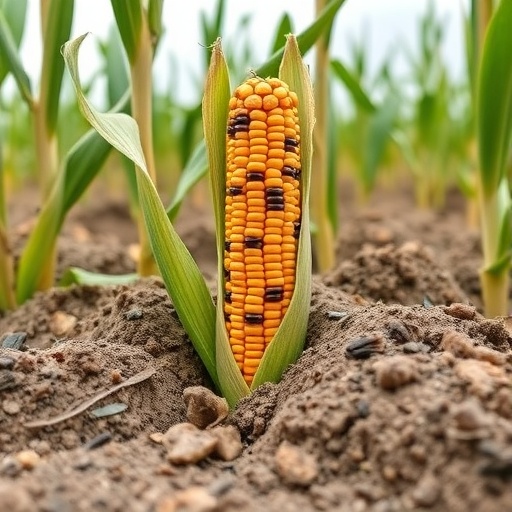
Maize straw is often treated as agricultural waste, yet a three-year field study in Jilin Province, China, suggests that what farmers do with the residue—and precisely where they place it—can influence crop disease, soil fertility, and food safety. Researchers found that incorporating maize straw 20 to 40 centimeters below the soil surface reduced maize ear rot and lowered contamination by the mycotoxins deoxynivalenol (DON) and zearalenone (ZEN). The findings point to an overlooked management variable: residue depth may determine whether straw becomes a resource that supports a healthier agroecosystem or a surface-level input with more limited benefits.
Returning crop residues to soil is widely used to recycle carbon and nutrients. As straw decomposes, it can contribute organic matter, improve aggregation, and release nitrogen, phosphorus, potassium, and other elements. However, decomposition is controlled by the physical and chemical environment around the residue. Soil depth affects oxygen availability, moisture, temperature fluctuations, microbial access, and contact with plant roots. These factors can shape which microorganisms colonize decomposing straw and whether disease-causing fungi are able to persist or spread. In maize production, this distinction is especially important because ear rot can reduce yield and introduce toxins that remain a food and feed safety concern even when visible fungal growth is limited.
The researchers compared four straw incorporation zones in field plots: 0 to 5 centimeters, 10 to 20 centimeters, 20 to 30 centimeters, and 30 to 40 centimeters. Over three growing seasons, they examined soil physical and chemical properties, microbial communities in the soil surrounding maize roots, microorganisms within root tissues, ear rot incidence and severity, and concentrations of DON and ZEN in harvested grain. DON, also known as vomitoxin, is produced primarily by certain Fusarium fungi and can affect animals and humans when consumed at sufficiently high levels. ZEN is another Fusarium-derived compound with estrogen-like activity. Monitoring both toxins allowed the team to assess not only crop disease but also a less visible consequence of fungal infection.
The deeper treatments produced a marked reduction in disease. Compared with shallow straw incorporation, placing residue at depths between 20 and 40 centimeters reduced the incidence of maize ear rot by approximately 33.3% to 66.7%. Disease severity declined by about 20% to 50%. The grain from these treatments also remained within established safety thresholds for DON and ZEN, indicating that the reduction in disease was accompanied by a reduction in the potential food safety risk. The results do not suggest that deep placement eliminates fungal hazards entirely, but they indicate that residue positioning can shift field conditions in a direction less favorable to severe infection and toxin accumulation.
Several changes in the soil environment may explain the effect. Deep incorporation increased total pore area by as much as 162.5%, creating a more structured soil matrix with greater space for air and water movement. The researchers also recorded substantial increases in soil organic carbon and available nitrogen, phosphorus, and potassium. These changes are important because soil structure regulates root penetration, drainage, oxygen supply, and the movement of dissolved nutrients. Organic carbon, meanwhile, provides energy for soil organisms that drive decomposition and nutrient cycling. Together, the improvements increased the calculated soil quality index as incorporation depth increased; the 30-to-40-centimeter treatment reached approximately four times the value measured under shallow incorporation.
The biological response was equally notable. Deep straw placement altered the composition and organization of microbial communities in the rhizosphere—the narrow zone of soil directly influenced by roots—and in maize root tissues. Beneficial groups, including Trichoderma and members of the Enterobacteriaceae family, increased by more than twofold in the deeper treatments. Trichoderma species are widely studied for their ability to compete with plant pathogens, colonize roots, and in some cases produce compounds that inhibit fungal growth. Certain root-associated bacteria can also contribute to nutrient mobilization, plant growth promotion, and biological suppression of disease. By contrast, the abundance of Fusarium and Aspergillus declined in both the rhizosphere and root tissues. These genera include species associated with maize ear rot and the production of agriculturally important mycotoxins.
The study’s microbial findings are significant because disease suppression is rarely controlled by a single organism acting alone. Soil communities operate as networks in which microorganisms compete for nutrients and physical space, exchange metabolites, and influence plant defenses. The researchers reported that deeper incorporation generated microbial interaction networks that were more complex and stable. In ecological terms, a more connected community may be better able to resist disturbance and prevent one pathogen from dominating. Structural equation modeling—a statistical approach used to evaluate linked relationships among multiple variables—indicated that soil properties and microbial communities jointly helped explain the reductions in ear rot and mycotoxin risk. The analysis supports a chain of effects in which straw placement changes the soil environment, the altered environment reshapes microbial communities, and those communities influence plant health and fungal pressure.
The strongest overall results came from incorporating straw at 30 to 40 centimeters, but that depth may not be the most practical choice for every farm. Very deep tillage requires more fuel, greater tractor power, and additional operating time. It can also impose costs through heavier machinery use and increased disturbance of the soil profile. For this reason, the researchers identify 20 to 30 centimeters as a particularly promising compromise. At that depth, straw incorporation achieved substantial disease suppression and kept DON and ZEN within safety limits while potentially avoiding some of the energy and equipment demands associated with ultra-deep operations. The recommendation is not a universal prescription: soil texture, climate, machinery, crop rotation, drainage, and local disease pressure could all affect the outcome.
The findings offer a new way to think about residue management. Instead of viewing straw incorporation simply as a method for adding organic matter, farmers and agronomists may be able to use placement depth as a tool for managing the entire soil–plant–microbe system. A deeper residue layer can alter carbon inputs, nutrient availability, porosity, and microbial competition at the same time. Those changes may reduce the ecological opportunities available to pathogens while supporting organisms that contribute to decomposition and root health. Before the approach can be broadly adopted, however, it will need testing across different soil types, climates, maize varieties, tillage systems, and production scales. Future studies should also clarify how long the microbial changes persist, how the practice affects greenhouse-gas emissions and energy use, and whether repeated deep incorporation produces benefits or unintended consequences over many seasons. Even with those questions unresolved, the three-year field evidence shows that the depth of a familiar farming practice can have consequences reaching from soil structure to the safety of the food produced above it.
News Publication Date: 18-Aug-2026
Web References: https://doi.org/10.48130/aee-0026-0019; Agricultural Ecology and Environment
References: Xue M, Jia J, Qu Z, Jiang T, Yang M, et al. 2026. “Deep straw incorporation reduces maize ear rot and mycotoxin contamination by improving soil health and microbial community.” Agricultural Ecology and Environment 2: e021. DOI: 10.48130/aee-0026-0019
Cite Scienmag News
Alan Morgan. (August 18, 2026). Deeper crop-residue burial may protect maize from ear rot and mycotoxins. Scienmag. https://scienmag.com/deeper-crop-residue-burial-may-protect-maize-from-ear-rot-and-mycotoxins/
Alan Morgan. "Deeper crop-residue burial may protect maize from ear rot and mycotoxins." Scienmag, 18 August 2026, https://scienmag.com/deeper-crop-residue-burial-may-protect-maize-from-ear-rot-and-mycotoxins/. Accessed 4 September 2026.
Alan Morgan. "Deeper crop-residue burial may protect maize from ear rot and mycotoxins." Scienmag. August 18, 2026. https://scienmag.com/deeper-crop-residue-burial-may-protect-maize-from-ear-rot-and-mycotoxins/


