


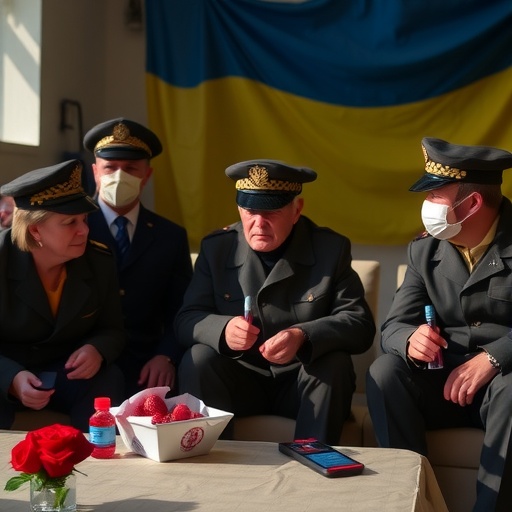
At the beginning of Russia’s full-scale invasion of Ukraine, the country’s blood supply faced a crisis that could have overwhelmed even a well-resourced national health system. Demand for blood reportedly increased by about 40% as hospitals treated wounded civilians and military personnel, while medical facilities were damaged, transport routes disrupted and millions of people displaced. Yet Ukraine maintained a self-sufficient blood supply without depending on imported blood products. A new international study in the journal Transfusion describes how the country reorganized its blood system under martial law—and why its experience could offer important lessons for the United States and other nations preparing for disasters, armed conflict or mass-casualty events.
Blood systems are complex logistical networks rather than simple collections of donated units. They must recruit donors, screen blood for infectious diseases, determine ABO and Rh blood groups, separate whole blood into components and transport products under tightly controlled temperature conditions. Red blood cells, platelets and plasma each have different storage requirements and clinical uses. Red cells are generally used to restore oxygen-carrying capacity after trauma or major blood loss, while platelets are essential for clot formation and plasma supplies proteins involved in coagulation. A disruption at any stage—from donor recruitment to refrigeration or delivery—can rapidly create shortages in hospitals.
Before the war, Ukraine’s blood services were largely decentralized and hospital-based. Individual medical institutions often managed their own collection and transfusion activities, creating a fragmented structure that could be difficult to coordinate during a national emergency. Damaged facilities, interrupted supply chains and the movement of healthcare workers and patients intensified those vulnerabilities. The sudden increase in trauma-related transfusion demand also placed pressure on inventories that had been designed primarily for routine medical care rather than prolonged, large-scale conflict.
In October 2022, Ukrainian blood-bank and transfusion leaders visited several blood centers in the American Midwest, including the blood bank at Northwestern Memorial Hospital in Chicago. The exchange focused on national blood-system organization, transfusion medicine, disaster preparedness and the regulatory standards used in the European Union. Ukrainian officials examined how American centers coordinate donor recruitment, testing, processing, distribution and emergency response across broad geographic areas. The visit provided practical models at a critical moment, when Ukraine was seeking ways to keep blood moving despite damaged infrastructure and unpredictable demand.
Following that exchange, Ukraine accelerated a transition from its decentralized model toward a coordinated national network. Blood establishments began reporting inventory information daily, allowing authorities to monitor supplies and identify shortages by location and blood group. Collection centers introduced the ability to operate around the clock when necessary, expanding capacity beyond conventional daytime schedules. The country also created public campaigns using patriotic messages such as “Your blood can fight!” and developed a specialized donor platform that displays blood-type-specific needs. Such targeted communication can reduce a common inefficiency in emergency blood collection: receiving large numbers of donations that do not match the components or blood groups most urgently required.
The technical challenge is especially acute for platelets, which have a much shorter shelf life than red blood cells and must be stored under continuous agitation at controlled room temperature. Red-cell units can be refrigerated for weeks, depending on the preservative and regulatory system, while plasma may be frozen for longer-term storage. This means that a resilient blood service must balance immediate collection with carefully managed reserves. Collecting too little creates dangerous gaps; collecting too much of a perishable component can lead to wastage. A centralized system with daily reporting can improve forecasting by linking real-time inventory data to hospital demand, geographic distribution and expected casualty levels.
The Ukrainian experience also demonstrates the importance of public trust during a crisis. Donors must believe that collection centers are safe, that their blood will reach patients and that medical authorities are communicating honestly. Ukrainian campaigns sought to connect donation with national solidarity while reassuring the public that infection-control and safety procedures remained in place. The study authors said these efforts also countered disinformation and attempts to undermine morale. In a wartime setting, blood donation became both a medical intervention and a form of civic participation, helping sustain the system even as the country’s population and infrastructure were under severe pressure.
For the United States, the findings arrive as the American Red Cross has declared its second-ever national blood crisis. The researchers argue that emergency planning should extend beyond responding to ordinary seasonal shortages. Blood centers could increase operating hours in anticipation of events likely to produce mass casualties, such as major international sporting competitions or large public gatherings. For unforeseen disasters, centers could rapidly mobilize donors through social media, establish temporary collection sites and coordinate with civilian hospitals and military medical services. A public dashboard showing regional blood needs and specific blood-group demand could also help direct donors more efficiently, although such a system would require careful privacy protections, standardized data and safeguards against sudden overcollection.
The study’s senior author, Dr. Glenn Ramsey of Northwestern University Feinberg School of Medicine, said Ukraine had reorganized its national blood service from a hospital-centered structure into a coordinated system and had demonstrated an impressive ability to meet inspections and operational demands during conflict. Corresponding author Dr. Yevhen Chornenkyy of the University of Washington said the United States could learn from Ukraine’s approach to donor recruitment, extended collection hours and digital communication. The researchers emphasize that no blood system can eliminate all risk, especially during war, but Ukraine’s adaptation shows how centralized coordination, timely inventory information and sustained public engagement can preserve access to transfusion when normal healthcare infrastructure is breaking down. The study, titled “The Blood System in Ukraine: Experience in Martial Law Conditions,” offers a rare modern case study in how national blood services can become more resilient under prolonged crisis.
Web References: https://donor.utcc.gov.ua/ ; https://www.redcross.org/about-us/news-and-events/press-release/2026/red-cross-declares-national-blood-supply-crisis-urges-immediate-.html
References: Transfusion, DOI: 10.1111/trf.70372
Cite Scienmag News
Courtney Benton. (August 18, 2026). Ukraine’s Wartime Blood Supply Transformation Offers Lessons for the United States. Scienmag. https://scienmag.com/ukraines-wartime-blood-supply-transformation-offers-lessons-for-the-united-states/
Courtney Benton. "Ukraine’s Wartime Blood Supply Transformation Offers Lessons for the United States." Scienmag, 18 August 2026, https://scienmag.com/ukraines-wartime-blood-supply-transformation-offers-lessons-for-the-united-states/. Accessed 4 September 2026.
Courtney Benton. "Ukraine’s Wartime Blood Supply Transformation Offers Lessons for the United States." Scienmag. August 18, 2026. https://scienmag.com/ukraines-wartime-blood-supply-transformation-offers-lessons-for-the-united-states/


