


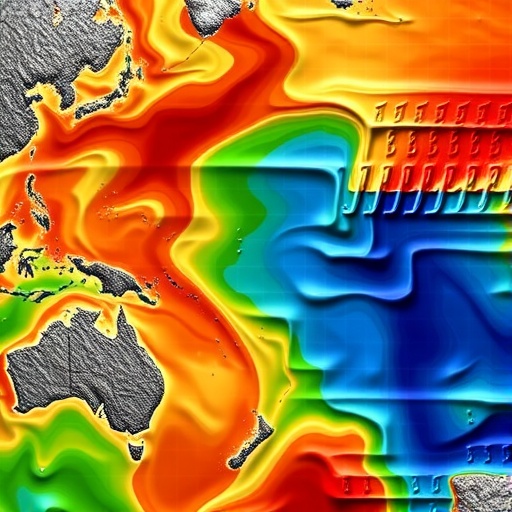
In the vast expanse of the Southern Ocean, a transformative phenomenon has quietly unfolded during the Earth’s lukewarm interglacials—periods of moderate global temperatures between ice ages. A new study has illuminated the intricate dynamics governing ocean stratification at depth, revealing a considerably enhanced layering of water masses during these relatively warm climatic episodes. This enhanced stratification holds profound implications for our understanding of ocean circulation, carbon cycling, and the Earth’s climate system during critical intervals of our planet’s history.
The Southern Ocean plays a central role in regulating global climate by controlling the exchange of heat, carbon, and nutrients between the atmosphere and the deep ocean. Researchers have now demonstrated that during the lukewarm interglacials—the intervals spanning the last several hundred thousand years marked by intermediate temperature conditions—the deep Southern Ocean exhibited a strikingly more stable stratification compared to colder glacial periods or warmer interglacial maxima. This enhanced stability means that the vertical mixing between deep and surface waters was significantly reduced, imparting a pronounced layering effect that effectively altered oceanic circulation pathways.
The research draws upon sediment records and geochemical proxies, particularly isotopic signatures found within fossilized shells of tiny marine organisms known as foraminifera. These proxies allow scientists to reconstruct past ocean temperatures and water mass distributions with remarkable resolution. By examining variations in neodymium and oxygen isotope ratios in deep ocean sediments, the study disentangles shifts in water mass sourcing and movement, ultimately providing a window into the Southern Ocean’s stratification state across different climatic epochs.
Findings indicate that during lukewarm interglacials, stratification intensified primarily in the abyssal and deep ocean layers below roughly 3,000 meters. The increased strength of this stratification curbed vertical circulation and likely resulted in reduced ventilation of deep water masses. This phenomenon stands in stark contrast to previous assumptions that deep ocean mixing would intensify under warmer climate regimes. Instead, it appears that the interplay of temperature, salinity, and density gradients favored the preservation of distinct deep water layers.
One critical consequence of this enhanced stratification involves the ocean’s capacity to store carbon dioxide. The deep ocean serves as a massive reservoir for dissolved inorganic carbon, and its ventilation rates impact atmospheric CO2 concentrations over millennial timescales. With diminished exchange between deep and surface waters during lukewarm interglacials, carbon sequestration in the deep Southern Ocean would have been more effective, potentially buffering atmospheric greenhouse gas increases and modulating global climate feedbacks.
The researchers also highlight changes in nutrient distributions and biological productivity tied to stratification shifts. Thin but persistent stratified layers impede nutrient resupply from the depths to surface waters, which can influence phytoplankton growth—the foundational base of marine food webs. This, in turn, may have affected the ocean’s biological pump, the process by which organic carbon is exported from the surface to the deep ocean. Intriguingly, stratified conditions may have maintained a delicate balance supporting sustained biological productivity despite lower nutrient recycling.
Deep Southern Ocean stratification during lukewarm interglacials was likely governed by a combination of factors. Changes in Antarctic ice sheet extent, shifts in wind patterns over the Southern Ocean, and variations in freshwater inputs from melting ice would have altered salinity and temperature profiles, fostering stable density gradients. The research underscores the complex feedbacks between cryospheric processes and ocean dynamics, emphasizing how subtle environmental shifts cascade through ocean systems.
These revelations challenge conventional wisdom drawn from modern observations, which often associate warming with enhanced ocean mixing and ventilation. Instead, the Southern Ocean’s response during past lukewarm climates reveals a nuanced narrative where warming induced increased stratification at depth, highlighting potential non-linearities in climate-ocean interactions that are critical for refining predictive models.
State-of-the-art climate models can now integrate these findings to better simulate past ocean conditions and improve future projections. Enhanced stratification has ramifications for understanding the rate of heat and carbon uptake during transitional climate periods, which bears direct relevance to ongoing anthropogenic climate change. If similar mechanisms occur under present-day warming trends, the Southern Ocean’s role as a climate regulator might evolve in unexpected ways.
Furthermore, the study’s methodology exemplifies the power of combining sediment geochemistry with paleoceanographic techniques. By probing isotope ratios and trace element distributions preserved for hundreds of thousands of years, scientists reconstruct not only temperature landscapes but also the subtle changes in water mass sourcing and mixing. Such multiproxy approaches yield comprehensive insights into the deep ocean’s physical and chemical evolution through different climatic chapters.
Importantly, this improved understanding of Southern Ocean stratification dynamics invites renewed examination of atmospheric carbon dioxide fluctuations recorded in ice cores and marine sediments. The deep ocean’s diminished ventilation during lukewarm intervals likely contributed to stabilizing moderate atmospheric CO2 concentrations, framing the complex interactions between terrestrial ice, ocean circulation, and greenhouse gas budgets.
The implications extend even further, touching on Southern Ocean ecosystems, biogeochemical cycles, and global feedback mechanisms. Stable stratified deep water masses may have influenced the sequestration of nutrients and the distribution of dissolved oxygen, factors crucial for sustaining marine biodiversity over geological timescales. This novel perspective encourages holistic approaches to exploring ocean-climate coupling.
In sum, this cutting-edge research not only reframes our understanding of deep ocean behavior during past lukewarm interglacials but also enriches our comprehension of the Southern Ocean’s central role within Earth’s climate system. It opens a window into how subtle changes in ocean layering can ripple through the global environment, influencing atmospheric composition, marine ecology, and long-term climate trajectories. As our planet faces accelerating change, insights gleaned from paleoclimate archives remind us of the ocean’s complex and vital function in shaping Earth’s past and future.
As humanity grapples with the challenges of climate change, unraveling the mysteries of ocean stratification and its interplay with carbon cycles is paramount. This study delivers a landmark contribution by revealing the hydrodynamic transformations that governed the Southern Ocean’s depths during the previously underappreciated lukewarm interglacials. These findings furnish a critical piece of the climate puzzle, underscoring the ocean’s capacity for buffering and modulating Earth’s thermal and chemical steadiness over epochs.
Cite Scienmag News
Violet Maxwell. (October 6, 2025). Deep Southern Ocean Stratifies More in Lukewarm Interglacials. Scienmag. https://scienmag.com/deep-southern-ocean-stratifies-more-in-lukewarm-interglacials/
Violet Maxwell. "Deep Southern Ocean Stratifies More in Lukewarm Interglacials." Scienmag, 6 October 2025, https://scienmag.com/deep-southern-ocean-stratifies-more-in-lukewarm-interglacials/. Accessed 4 September 2026.
Violet Maxwell. "Deep Southern Ocean Stratifies More in Lukewarm Interglacials." Scienmag. October 6, 2025. https://scienmag.com/deep-southern-ocean-stratifies-more-in-lukewarm-interglacials/


