Proteins are not the rigid sculptures that textbook diagrams make them appear to be. They are restless molecular machines, constantly flexing, twisting, and breathing through an ensemble of shapes that determine what they actually do inside a living cell. A receptor switches on a signaling cascade only after a ligand nudges it into a new conformation; an enzyme’s catalytic site can be tuned by events happening tens of nanometers away; a mechanosensor converts physical force into a biochemical signal. This long-range communication, in which a perturbation at one site of a protein reshapes behavior at another, is known as allostery, and it remains one of the most stubborn problems in structural biology. Now, a team reporting in PLOS Biology has introduced AlloPool, a deep learning framework designed to extract the hidden logic of allostery directly from molecular dynamics simulations, turning oceans of simulated atomic motion into interpretable maps of communication.
The challenge that AlloPool addresses is rooted in a fundamental asymmetry in the field. Artificial intelligence has transformed protein structure prediction and design, most visibly through systems that can fold a protein sequence into a remarkably accurate three-dimensional model in seconds. Yet structure alone is only half the story. Function is governed not just by the static arrangement of atoms but by the conformational dynamics that allow a protein to visit distinct functional states, and predicting those dynamic transitions has lagged far behind. The reason is data scarcity. Training machine-learning models to predict dynamic and energetic properties requires high-resolution experimental information about how proteins move and how their energies change, and such data are rare and expensive to produce. Simulations can fill the gap in principle, but the raw output of a molecular dynamics trajectory is a torrent of coordinates that resists human interpretation.
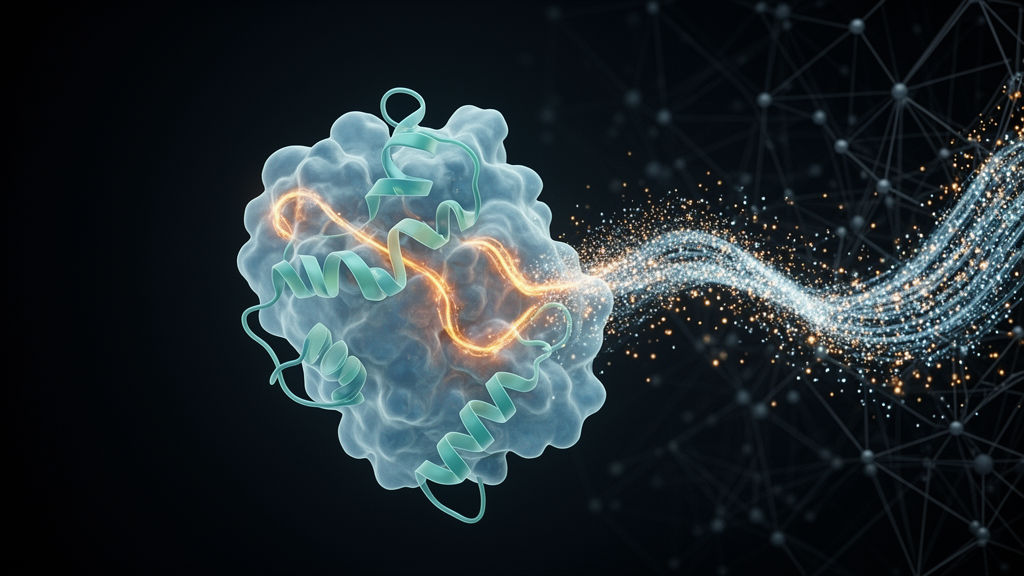
AlloPool, developed by Matthieu Marfoglia, Miguel A. Pedraza-Joya, Lucas Guirardel, Aisima Chatzi Souleiman, and Patrick Barth, takes a deliberately different route to that interpretation problem. Rather than trying to learn protein dynamics from scratch, the framework treats molecular dynamics simulations as its evidence base and builds a graph neural network on top of them. In this representation, each amino acid residue becomes a node in a graph, and the contacts and interactions between residues become edges. The simulation supplies the temporal dimension: as the trajectory unfolds, the network of residue-residue interactions is continuously rewired, and AlloPool’s job is to learn which of those rewiring events matter and which are noise.
The key algorithmic idea is iterative pruning. Molecular dynamics trajectories contain an enormous number of transient residue-residue contacts, most of which are incidental rather than functional. AlloPool systematically prunes these interactions, iteratively removing edges to uncover minimal, time-resolved interaction networks that govern conformational change. The result is a kind of Occam’s razor for protein motion: instead of a dense web of thousands of contacts, the method isolates the sparse backbone of interactions that actually carries a structural response from a perturbation site to its distant target. This is precisely the quantity that allosteric regulation depends on, and it is exactly what conventional analyses of simulations struggle to isolate.
Architecturally, the framework combines two complementary machinery elements. Temporal attention allows the model to weigh which moments in a simulation carry the most informative signals about a transition, effectively letting it focus on the frames where the protein commits to a new conformational state. Graph aggregation, meanwhile, lets information propagate across the residue network, mirroring the way physical perturbations propagate through the protein’s contact topology. By integrating these two mechanisms, AlloPool learns evolving interaction graphs from both equilibrium and non-equilibrium molecular dynamics simulations. That distinction matters: equilibrium simulations capture the spontaneous thermal fluctuations of an unperturbed protein, while non-equilibrium simulations capture responses to explicit chemical or mechanical perturbations such as ligand binding or applied force. A framework that can learn from both is far more versatile than one restricted to either regime.
The practical payoff is accurate reconstruction of dynamic trajectories and of the interaction networks that drive conformational transitions. In other words, AlloPool does not merely describe what happened in a simulation after the fact; it learns enough of the underlying physics and interaction logic to predict how a protein’s structure will evolve, and to identify which residue-level connections are responsible. The authors validated the approach across a deliberately diverse set of dynamic protein systems, spanning binding domains, mechanosensors, signaling receptors, and enzymes. This breadth is important because allostery manifests differently in each class: a binding domain may couple ligand recognition to domain closure, a mechanosensor must transduce force across a membrane, a signaling receptor relays chemical messages across large conformational distances, and an enzyme’s catalytic cycle depends on precisely timed structural rearrangements.
Across these systems, AlloPool demonstrated several distinct capabilities that go beyond a single benchmark. It maps allosteric communication pathways, tracing the routes along which information flows from one region of a protein to another. It predicts the effects of ligand binding, of mechanical forces, and of mutations, which means it can in principle forecast how a drug candidate, a physical stimulus, or a disease-associated sequence change will reshape a protein’s dynamic behavior. It also discovers transient dynamic states, the short-lived conformational intermediates that are often invisible to experimental structural methods but can be decisive for function, for example as rare, druggable conformations of an enzyme. In head-to-head comparisons, the framework outperformed existing machine-learning approaches in dynamic trajectory reconstruction, suggesting that the combination of simulation-derived graphs, iterative pruning, and temporal attention is more than the sum of its parts.
The interpretability of the output deserves particular emphasis, because it distinguishes AlloPool from the black-box reputation that often shadows deep learning in biology. Because the model’s core object is a residue-residue interaction graph, its predictions come with a built-in mechanistic account: which contacts were pruned away, which sparse network survived, and how signals travel through it. For structural biologists, that means a hypothesis about mechanism, not just a score. For medicinal chemists, it means candidate allosteric sites and communication routes that can be tested experimentally. And for protein engineers, it means a rational basis for rewiring regulation, whether the goal is to make a biosensor more sensitive, an enzyme more selective, or a therapeutic protein safer.
The implications ripple outward into drug discovery, synthetic biology, and protein engineering. Allosteric drugs are attractive precisely because they can modulate proteins with fine gradations and often with greater selectivity than active-site inhibitors, yet finding them has been hampered by the difficulty of identifying allosteric sites and predicting their effects. A framework that infers allosteric communication from simulations offers a computational shortcut: run the simulations, let AlloPool distill the communication network, and target the residues that sit on critical pathways. In synthetic biology, designed allosteric switches could let engineered circuits respond to small molecules or mechanical cues with predictable dose-response behavior. In protein engineering more broadly, the ability to predict mutational effects on dynamics, not just on folded structure, addresses a long-standing blind spot, since many mutations that preserve the fold nonetheless disrupt function by scrambling the protein’s internal communication.
None of this abolishes the need for experiments; simulations remain computationally costly, and their accuracy still depends on the force fields and sampling behind them. But AlloPool changes the relationship between simulation and understanding. Where a molecular dynamics trajectory was once an unwieldy archive of atomic coordinates, it becomes a trainable dataset from which a neural network can extract the minimal interaction grammar of allostery. If the framework generalizes as broadly as its validation set suggests, the dynamic half of protein biology, the half that static structure prediction never captured, may finally be becoming computable. For a field that has spent decades inferring mechanism from frozen snapshots, a tool that reads the movie itself, frame by frame, and tells us which interactions carry the plot, is a genuinely consequential arrival.
Subject of Research: A graph neural network framework that infers allosteric communication in proteins from molecular dynamics simulations
Article Title: AlloPool is a deep learning framework that infers protein allostery from molecular dynamics simulations
Article References: Marfoglia, M., Pedraza-Joya, M. A., Guirardel, L., Chatzi Souleiman, A., & Barth, P. (2026). AlloPool is a deep learning framework that infers protein allostery from molecular dynamics simulations. PLOS Biology, 24(9), e3004002. https://doi.org/10.1371/journal.pbio.3004002
Image Credits: AI Generated
DOI: 10.1371/journal.pbio.3004002
Keywords: AlloPool, protein allostery, molecular dynamics simulations, graph neural network, deep learning, conformational dynamics, temporal attention, ligand binding, mechanosensors, drug discovery, protein engineering, PLOS Biology
Cite Scienmag News
Blake Davidson. (October 9, 2026). Deep Learning Reads Molecular Dynamics to Decode Protein Allostery. Scienmag. https://scienmag.com/deep-learning-reads-molecular-dynamics-to-decode-protein-allostery/
Blake Davidson. "Deep Learning Reads Molecular Dynamics to Decode Protein Allostery." Scienmag, 9 October 2026, https://scienmag.com/deep-learning-reads-molecular-dynamics-to-decode-protein-allostery/. Accessed 9 October 2026.
Blake Davidson. "Deep Learning Reads Molecular Dynamics to Decode Protein Allostery." Scienmag. October 9, 2026. https://scienmag.com/deep-learning-reads-molecular-dynamics-to-decode-protein-allostery/