


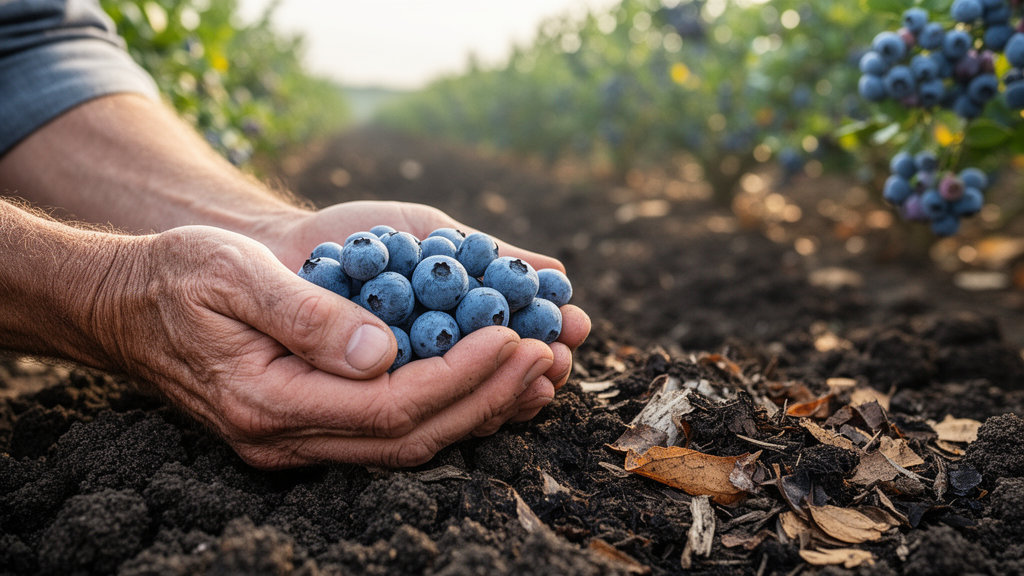
Blueberries have become one of the world’s most coveted superfoods, prized for their dense load of anthocyanins, polyphenols, and flavonoids. Yet the shallow-rooted, acid-loving shrub is notoriously finicky, demanding acidic soils rich in organic matter and exquisitely sensitive to water and salinity stress. Now a team of Chinese researchers has combined a painstaking pot experiment with interpretable machine learning to answer a deceptively simple question: which organic fertilizer recipes actually make blueberries better, and which soil conditions are doing the work? The study, published in Plant and Soil, offers one of the most systematic data-driven assessments to date of how organic amendments regulate fruit quality through the hidden chemistry of the rhizosphere.
The experiment took place in Jingdong Yi Autonomous County in Yunnan Province, China, a plateau mountain region whose large diurnal temperature swings favor sugar accumulation in ripening fruit. The researchers grew seedlings of the highbush blueberry cultivar ’42’ (Vaccinium corymbosum L.) individually in 30-centimeter pots filled with local acidic red soil amended with pine needles to improve structure and aeration. Fourteen fertilization treatments were established in a completely randomized design: twelve combinations of pig manure and rabbit manure applied at 100, 150, and 200 grams per pot on a fresh-weight basis, one conventional NPK compound fertilizer treatment, and an unfertilized control. Each treatment had ten replicate pots, and at fruit maturity three pots per treatment were destructively sampled, yielding 42 fruit samples and 84 soil samples split between rhizosphere and bulk compartments.
The rhizosphere, defined here as the soil tightly adhering to the root surface within roughly two millimeters, is where root activity, microbial communities, and nutrient transformations converge. Bulk soil, by contrast, represents the homogenized pot medium beyond the root’s immediate influence. By brushing rhizosphere soil from roots and separately collecting bulk soil, the team could ask whether fruit quality responds to different chemical cues in these two microenvironments. Nine fruit-quality indicators were measured with standard analytical methods, including gravimetric moisture content, anthrone colorimetry for total soluble sugars, acid-base titration for titratable acidity, digital refractometry for soluble solids, spectrophotometric chlorophyll determination, the pH differential method for total anthocyanins, Folin-Ciocalteu assays for total phenolics, colorimetric flavonoid quantification, and HPLC profiling of the anthocyanidin spectrum. Soil analyses covered organic carbon, pH, available potassium and phosphorus, ammonium and nitrate nitrogen, and moisture.
The first striking result was that not all quality traits respond equally to fertilization. Fruit moisture, total flavonoids, total phenolics, and total soluble sugars showed no statistically significant differences across treatments, remaining remarkably stable. In contrast, anthocyanin content, titratable acidity, soluble solids, and chlorophyll all varied significantly, with the highest anthocyanin values appearing in treatments L9 and L3. Derived composite indices told a nuanced story: the sugar-to-acid ratio, a key driver of blueberry taste, peaked in treatments L14, L12, and L10, while the anthocyanin-to-phenolics ratio, an indicator of antioxidant potential, was highest in L5 and L7. Correlation analysis revealed moderate interdependence among traits, with flavonoids and phenolics positively correlated at r = 0.53 and soluble solids tracking total sugars at r = 0.48, while moisture content correlated negatively with everything else.
To convert this multidimensional trait space into a single verdict, the researchers built an integrated analytical pipeline that is arguably the study’s most innovative contribution. A random forest classifier treated fruit-quality indicators as predictors of fertilization treatment, and SHAP (SHapley Additive exPlanations) analysis, bootstrapped over 1,000 resamples, assigned each indicator a robust importance weight. These normalized mean absolute SHAP values then served as weights in a TOPSIS multi-criteria evaluation, a technique borrowed from operations research that ranks alternatives by their distance to ideal and anti-ideal solutions. Anthocyanin content emerged as the single most influential trait with a weight of 0.179, followed by titratable acidity at 0.146, soluble solids at 0.119, and total chlorophyll at 0.112. The resulting comprehensive scores crowned treatment L3, pig manure alone at the highest application rate, as the overall winner, with a median score of 0.68 and a tightly concentrated distribution signaling both superiority and stability. L9, combining 200 grams of pig manure with compound fertilizer, and L12, pairing rabbit manure with compound fertilizer, took second and third place.
The pattern behind the podium is unambiguous: all three top-ranked treatments received the highest organic input level of 200 grams per pot. The authors attribute this to blueberry physiology. With a shallow root system and limited nutrient uptake capacity, the crop performs best in soils with high organic matter, and the acidic red soil used in the experiment is inherently low in fertility and poorly structured. Under such conditions, modest organic inputs may simply be insufficient to shift soil conditions meaningfully, and the background pine needle amendment alone proved inadequate at low fertilizer levels. Higher organic matter inputs plausibly improve aggregation and water-holding capacity, though the researchers are careful to note that aggregate stability and organic matter fractions were not directly measured, making this an informed interpretation rather than a confirmed mechanism.
The machine learning analysis then turned to the soil side of the equation, fitting separate random forest regression models for rhizosphere and bulk soils with the TOPSIS score as the response. The spatial heterogeneity that emerged is the study’s conceptual centerpiece. In the rhizosphere, soil pH ranked first in SHAP importance, followed by moisture and inorganic nitrogen indicators, meaning that root-zone acidity and water status dominated fruit-quality variation. SHAP dependence curves revealed a nonlinear pH response with a transition region around 4.3 to 4.4, a model-derived change zone rather than a strict ecological threshold, hinting that even an acid-loving crop suffers when soils become too acidic for root activity and nutrient uptake. In bulk soil, by contrast, nitrate nitrogen took the top importance slot, followed by available phosphorus, moisture, available potassium, organic carbon, ammonium, and pH, with basic environmental factors and nutrient availability contributing nearly equal shares of total importance at 36.3 and 35.8 percent respectively.
The nitrate finding carries a practical warning. Blueberries are classic ammonium-preferring plants with limited nitrate reductase activity, giving them a weak capacity to utilize nitrate. The SHAP analysis showed that moderate nitrate levels contributed positively to predicted fruit quality, but at higher concentrations of roughly 38 to 40 milligrams per kilogram the contributions turned consistently negative. Excessive nitrate accumulation in bulk soil may reflect nitrogen imbalance in the root zone, elevated electrical conductivity in the soil solution, impaired water uptake, and disrupted availability of other anions such as chloride and phosphate. In other words, more nitrogen is not better nitrogen, and the form and dose of inorganic nitrogen emerging from organic manure mineralization matter as much as the total supply.
Structural equation modeling added a third layer of evidence, sketching statistical pathways linking bulk soil conditions, rhizosphere properties, and fruit quality. Bulk soil nitrate showed positive associations with rhizosphere ammonium but negative associations with rhizosphere moisture and fruit quality, while bulk soil pH tended to increase rhizosphere moisture, which in turn showed a positive tendency toward fruit quality. The model explained 19 percent of the variation in rhizosphere moisture and 16 percent of comprehensive fruit quality, and because most individual paths were not statistically significant, the authors frame these as exploratory associations rather than causal proof. Still, the overall picture is coherent: fruit quality is associated with coordinated variation in nutrient status, moisture, and nitrogen form across soil compartments, not with any single dominant factor, and the winning L3 treatment likely succeeded by balancing improved soil conditions against excessive nitrogen accumulation.
The study’s limitations are candidly acknowledged. It was a single-season pot experiment, which controls environmental noise but limits extrapolation to field conditions where root growth, hydrology, and nutrient cycling are far more complex. Microbial indicators, soil electrical conductivity, and detailed amendment characterization were not measured, and the pine needle background treatment was held uniform rather than tested as a factor. Future work will need multi-season field trials with microbial, physiological, and soil chemical measurements to validate the associations. Even so, the implications for growers are tangible. In acidic, low-fertility red soils, generous organic inputs, with pig manure at 200 grams per pot standing out, appear to deliver measurably better fruit, provided that rhizosphere pH and moisture stay in the favorable range and nitrate is not allowed to pile up. By fusing multi-trait evaluation, interpretable machine learning, and path modeling, the study offers a template for how agriculture can move beyond single-indicator trials toward genuinely data-driven soil management, turning the invisible geography of the rhizosphere into actionable fertilizer strategy.
Subject of Research: Effects of organic fertilizer ratios on blueberry fruit quality mediated by rhizosphere and bulk soil properties, analyzed with interpretable machine learning
Article Title: Soil-driven mechanisms of organic fertilizer ratios regulating blueberry fruit quality: A comprehensive evaluation based on interpretable machine learning
Article References: Lei, K., Chen, R., Li, C., & Yang, H. (2026). Soil-driven mechanisms of organic fertilizer ratios regulating blueberry fruit quality: A comprehensive evaluation based on interpretable machine learning. Plant and Soil. https://doi.org/10.1007/s11104-026-08913-w
Image Credits: AI Generated
DOI: 10.1007/s11104-026-08913-w
Keywords: blueberries, organic fertilization, fruit quality, rhizosphere, soil pH, nitrate nitrogen, anthocyanins, random forest, SHAP, TOPSIS, structural equation modeling, soil organic matter
Cite Scienmag News
Teresa Odom. (October 9, 2026). Machine Learning Reveals How Organic Fertilizer Ratios Shape Blueberry Fruit Quality Through Soil. Scienmag. https://scienmag.com/machine-learning-reveals-how-organic-fertilizer-ratios-shape-blueberry-fruit-quality-through-soil/
Teresa Odom. "Machine Learning Reveals How Organic Fertilizer Ratios Shape Blueberry Fruit Quality Through Soil." Scienmag, 9 October 2026, https://scienmag.com/machine-learning-reveals-how-organic-fertilizer-ratios-shape-blueberry-fruit-quality-through-soil/. Accessed 9 October 2026.
Teresa Odom. "Machine Learning Reveals How Organic Fertilizer Ratios Shape Blueberry Fruit Quality Through Soil." Scienmag. October 9, 2026. https://scienmag.com/machine-learning-reveals-how-organic-fertilizer-ratios-shape-blueberry-fruit-quality-through-soil/


