


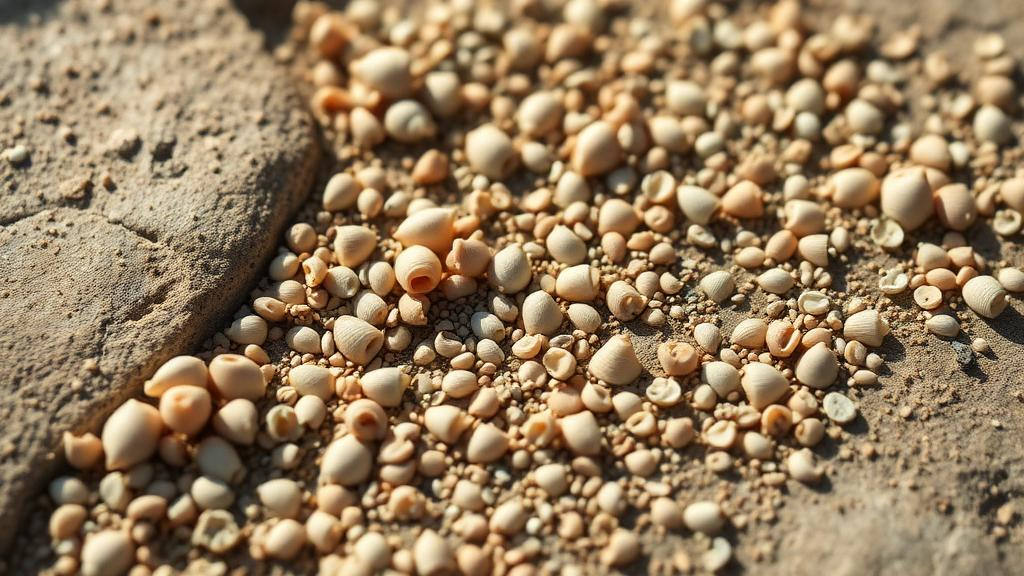
On the eastern tip of the Isle of Wight, where the chalk headland of Culver Cliff gives way to a bay of vertically tilted sediments, lies one of the most complete records of the Paleogene epoch in Europe. Whitecliff Bay has drawn geologists for more than two centuries, and now a new study of its microscopic inhabitants is shedding fresh light on some of the most dramatic warming events in Earth’s history. Malcolm Hart, Mark Alex-Sanders and Christopher Smart of the University of Plymouth have shown that the distribution of foraminifera, single-celled organisms that build intricate shells, can be used to pinpoint the Early Eocene Climatic Optimum and the Middle Eocene Climatic Optimum within the Eocene succession of southern England. Their work, published in the Journal of Micropalaeontology, offers a new window into how ancient greenhouse climates left their fingerprints on shallow marine sediments.
The team’s most significant technical achievement is the first foraminiferal zonation ever produced for the London Clay Formation. Earlier researchers, working as far back as the 1880s, had despaired of ever building such a scheme. Sherborn and Chapman noted in 1886 that regional variability among the shells was so pronounced that the word species should often be replaced by variety, and Bowen concluded in 1954 that no zonal scheme could be advanced for the formation based on foraminifera. Hart and his colleagues overturned that pessimism by carefully recording the first and last appearances of key taxa through the Whitecliff Bay and Alum Bay successions, defining eight zones they call Hampshire Basin Benthic zones, or HBB 1 to 8. Each zone is anchored on easily identified species such as Lobatula lobatula, Eilohedra vitrea and Cibicidoides alleni, and the scheme can be correlated between the two Isle of Wight sections using a distinctive planktonic datum first recognised by C. A. Wright in 1972.
Sampling the London Clay is far from straightforward. The cliffs are unstable, riddled with mudflows that tend to recur in the same places year after year, and the steeply dipping beds are subject to modern weathering that can selectively destroy fossils. The researchers found that samples taken from the foreshore, after storms had stripped away the modern beach, often yielded better preserved and more complete assemblages than cliff samples from the same horizons. They processed roughly two-kilogram samples using the white spirit method, which breaks down claystones and siltstones completely without damaging the microfossils, then washed the residues on a 63-micrometre sieve and examined four separate size fractions under the microscope. Erosion surfaces overlain by mudstone clasts and phosphatic nodules revealed hiatuses in the succession, suggesting that the London Clay of Whitecliff Bay and Alum Bay may be incomplete, a feature the authors suspect is the norm but is rarely described.
With the zonation in place, the team turned to palaeoecology. Using morphogroup analysis, planktic to benthic ratios, agglutinated to calcareous ratios, dominance and diversity indices, and Murray’s classic triangular plots, they reconstructed water depths through the London Clay. Their interpretation ranges from hyposaline, possibly river-mouth conditions to an open shelf environment between roughly 5 and 105 metres deep. Crucially, the maximum water depth in both Whitecliff Bay and Alum Bay falls within the interval of the Early Eocene Climatic Optimum, a prolonged hyperthermal spanning approximately 54 to 48 million years ago. When the two depth curves are superimposed, they overlap closely, and the planktonic datum coincides with the inferred maximum flooding in both sections. The authors suggest this sea level rise and fall within the EECO might represent a glacio-eustatic response to the warming, an intriguing possibility given that the event occurred in a hothouse world.
That interpretation, however, comes with caveats the authors are careful to spell out. The PETM, which occurred close in time to the EECO, is widely thought to have taken place in an ice-free world, making ice-driven sea level change difficult to invoke for the early Eocene. Modern calculations of ocean thermal expansion, based on NASA and NOAA data, suggest that warming of 0.6 to 1.0 degrees Celsius produces only a few centimetres of sea level rise, far too little to be detected in compacted Eocene mudstones. Alternative mechanisms remain on the table, including tectonic movements on the Sandown Pericline, as proposed by Stamp in 1921, or dynamic topography driven by the Iceland mantle plume, which Gale and Lovell have argued influenced sea level in the Anglo-Paris Basin into the Lutetian. The absence of any significant facies change accompanying the early Eocene depth maximum argues against a strong tectonic control, leaving the question open.
The second half of the story belongs to larger benthic foraminifera, the giants of the micropalaeontological world. These complex, symbiont-bearing shells, including the discoidal nummulitids and the cigar-shaped, porcelain-white alveolinids, are normally restricted to tropical and subtropical shallow carbonate shelves. Finding them in the clay-rich mid-Eocene sediments of southern England, at relatively northern palaeolatitudes, is highly unusual and points to a substantial warming episode. In the Whitecliff Bay succession, larger foraminifera appear in the Earnley Sand Formation and continue into the Barton Clay Formation, an interval embracing the uppermost Lutetian and lowermost Bartonian that straddles the Late Lutetian Thermal Event and the Middle Eocene Climatic Optimum, a short-lived warming of roughly 500,000 years duration around 40 million years ago.
The alveolinids are the star witnesses. Known in England from only three localities, including Fisher’s Beds 21 and 22 at Selsey Bill in Sussex and the uppermost Selsey Sand Formation in Whitecliff Bay, these fusiform shells also occur in pale limestones dredged from the sea floor of the English Channel. Dennis Curry collected such limestones from the R.V. Sarsia in 1955, and samples held by the British Geological Survey were re-examined for this study, with several confirmed to contain visible alveolinids. A vibro-core drilled between Jersey and the Cotentin Peninsula in 2009 recovered Eocene sediments with worn but unmistakable larger foraminifera, close to in situ mid-Eocene deposits near Valognes in Normandy. Taken together, these occurrences mark the northernmost known limit of Alveolina in northwestern Europe and sketch a picture of a warm, shallow sea covering much of the Channel region during the Lutetian.
The authors argue that this warm-water assemblage responds to the Late Lutetian Thermal Event, while the extension of the ranges of nummulitid species such as Nummulites prestwichianus and N. rectus into the lowermost Barton Clay Formation suggests that warm conditions persisted into the MECO, whose isotope signal lies low in that formation. Following Dawber and colleagues, they suggest both events may record a slight glacio-eustatic rise, and the presence of carbonate sediments resting directly on the basement of the Cotentin Peninsula supports a transgressive event in a marginal setting. Unlike the early Eocene case, mid-Eocene glaciation is more plausible, since ice-rafted debris has been reported from marine cores near Greenland back to around 44 million years ago.
What makes this study remarkable is its blend of Victorian field geology and modern micropalaeontological technique. The Whitecliff Bay succession was first described by Prestwich in 1846, and the larger foraminifera were figured by Carpenter and Dixon in 1850, yet the London Clay had never yielded a workable zonation until now. The paper is also a memorial to two giants of British micropalaeontology, John Murray, whose 1974 monograph with Chris Wright remains foundational, and Mark Alex-Sanders, whose doctoral-level work on the London Clay foraminifera underpins the new zonation and who died before his research could be published. The eight HBB zones, though of local application only, give the Hampshire Basin a biostratigraphical framework comparable to those long established elsewhere in the Anglo-Paris Basin.
For anyone wondering why shells smaller than a grain of sand matter, the answer lies in the deep-time perspective they provide. The Eocene hyperthermals are the closest analogues in the geological record to the greenhouse warming now under way, and understanding how sea level, water depth and marine ecosystems responded to those events helps calibrate expectations for the future. That a walk along an English beach at low tide, sampling vertically dipping clays once drowned under a warm shelf sea, can still yield new insights into global climate dynamics more than 250 years after the first fossil collections from these cliffs is a testament to the enduring power of patient, meticulous field science.
Subject of Research: Eocene foraminiferal biostratigraphy and palaeoecology of the Hampshire Basin, UK, in relation to Eocene hyperthermal events
Article Title: Can the distribution of foraminifera locate the Early Eocene Climatic Optimum (EECO) and Middle Eocene Climatic Optimum (MECO) events in the Eocene succession of the Isle of Wight (UK)?
Article References: Hart, M. B., Alex-Sanders, M. E. A., & Smart, C. W. (2026). Can the distribution of foraminifera locate the Early Eocene Climatic Optimum (EECO) and Middle Eocene Climatic Optimum (MECO) events in the Eocene succession of the Isle of Wight (UK)?. Journal of Micropalaeontology, 45(1), 315-334. https://doi.org/10.5194/jm-45-315-2026
Image Credits: AI Generated
Keywords: foraminifera, Isle of Wight, Eocene, EECO, MECO, London Clay Formation, hyperthermal events, palaeoecology, biostratigraphy, sea level change, larger benthic foraminifera, Hampshire Basin
Cite Scienmag News
Violet Maxwell. (October 9, 2026). Tiny fossil shells on the Isle of Wight reveal ancient Eocene global warming events. Scienmag. https://scienmag.com/tiny-fossil-shells-on-the-isle-of-wight-reveal-ancient-eocene-global-warming-events/
Violet Maxwell. "Tiny fossil shells on the Isle of Wight reveal ancient Eocene global warming events." Scienmag, 9 October 2026, https://scienmag.com/tiny-fossil-shells-on-the-isle-of-wight-reveal-ancient-eocene-global-warming-events/. Accessed 9 October 2026.
Violet Maxwell. "Tiny fossil shells on the Isle of Wight reveal ancient Eocene global warming events." Scienmag. October 9, 2026. https://scienmag.com/tiny-fossil-shells-on-the-isle-of-wight-reveal-ancient-eocene-global-warming-events/


