


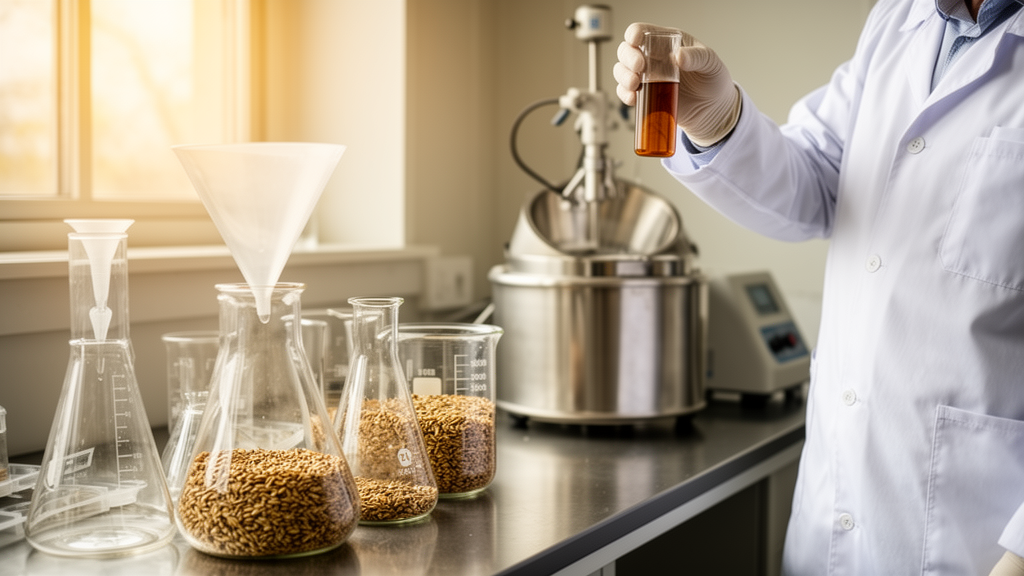
Brewery spent grain, the fibrous leftover of beer making, is the single largest by-product of the brewing industry. Europe’s brewing sector generates an estimated 3.9 to 4.0 million tons of waste each year, and brewery spent grain alone accounts for roughly 85 percent of that side stream, or about 30 percent of the initial malt weight. Locked inside its cellulose, hemicellulose, and lignin matrix are phenolic compounds valued for antioxidant, anti-inflammatory, and anti-carcinogenic properties, which make them attractive candidates for food, cosmetics, and pharmaceutical applications. A new study published in Frontiers in Analytical Science reports that a class of designer solvents called deep eutectic solvents, paired with ultrasound, can pull substantially more of these compounds out of the waste than the methanol and ethanol mixtures that laboratories have traditionally relied upon.
The research team, led by Bojana Bradić of the Czech University of Life Sciences in Prague together with colleagues from the University of Chemistry and Technology Prague, developed and optimized an ultrasound-assisted extraction method using acidic deep eutectic solvents. These solvents are eutectic mixtures formed by combining a hydrogen bond acceptor, in this case choline chloride, with a hydrogen bond donor drawn from a set of simple organic acids: malonic, citric, acetic, malic, formic, and tartaric acid. The physicochemical properties of such mixtures, particularly viscosity and polarity, are considered the most important determinants of how efficiently they extract phenolics, and they can be tuned by adjusting the molar ratio of the two components and by adding water.
The chemistry behind the approach is grounded in how carboxylic acid-based solvents interact with lignocellulose. The hydroxyl groups of the acid hydrogen bond donors form intermolecular hydrogen bonds within the cellulose and hemicellulose matrix, improving the mass transfer of trapped analytes into solution, while proton activity promotes dissolution of the phenolic compounds. Acidic solvents also dissolve lignin through cleavage of ether bonds, with formic acid and acetic acid reported to show the highest dissolution rates. Confirmation of hydrogen-bond network formation came from Fourier-transform infrared spectroscopy: the sharp N–H and O–H stretching peaks of the individual starting compounds near 3,020 cm−1 merged into broad absorption bands in the 3,100 to 3,400 cm−1 region in every deep eutectic solvent prepared, and the choline chloride–formic acid mixture showed a distinctive new band at 2,900 cm−1 attributed to C–H stretching within the hydrogen network.
Optimization followed a one-factor-at-a-time experimental design, in which each extraction variable was varied in isolation while the others were held constant. The team examined extraction times from 5 to 60 minutes, temperatures from 24 to 80 °C, and ultrasound power settings from 40 to 100 percent of a 400 W, 35 kHz bath, along with solvent-to-solid ratios from 1:30 to 1:100 mL/mg and water additions of 10 to 40 percent. Statistical analysis by one-way ANOVA showed that molar ratio had no significant overall effect across the solvents (F = 0.6620, p = 0.6662), although formic and tartaric acid combinations gained markedly as the acid fraction increased, prompting the researchers to adopt a 1:2 ratio for those solvents and 1:1 for malic and malonic acid combinations. A solvent-to-solid ratio of 1:50 mL/mg was selected as optimal for all solvents.
Time, temperature, and ultrasound power each produced significant gains. Extending sonication from 15 to 30 minutes significantly increased total quantified phenolic content depending on the solvent (F = 3.35, p = 0.0138), and raising the temperature from 50 to 80 °C produced a significant increase as well (F = 5.038, p = 0.0027), with formic acid extracts climbing from 1.96 to 4.93 mg/g dry weight and tartaric acid extracts from 0.75 to 5.13 mg/g. According to the authors, higher temperatures increase solvent viscosity and promote the catalytic effects of the acids on lignin dissolution. Increasing ultrasound power also significantly raised yields (F = 10.39, p = 0.0001), consistent with the idea that stronger cavitation and bubble implosion mechanically disrupt the lignocellulose and free the bound phenolics. Water addition, by contrast, showed no statistically significant effect overall (p = 0.2824), with modest optima of 10 to 30 percent depending on the solvent; excess water weakens the hydrogen-bonding interactions between the solvent and the phenolic compounds.
Under the final optimized conditions, the champion solvent was choline chloride with formic acid at a 1:2 molar ratio, operated at 70 °C for 30 minutes at 80 percent ultrasound power with 10 percent added water. It delivered a total quantified phenolic content of 5.78 mg/g dry weight. Choline chloride with tartaric acid at 1:2, run at 70 °C for 25 minutes at full power with 20 percent water, reached 4.67 mg/g. Conventional extraction with 70 percent methanol yielded only 1.16 mg/g and 70 percent ethanol 1.06 mg/g, meaning the deep eutectic approach recovered approximately five and four times more phenolics, respectively. The remaining solvents fell in between, with choline chloride–malic acid at 3.96 mg/g, acetic acid at 3.74 mg/g, malonic acid at 3.50 mg/g, and citric acid at 3.04 mg/g.
Detailed profiling by liquid chromatography coupled to quadrupole time-of-flight mass spectrometry revealed a diverse phenolic inventory in the deep eutectic extracts, including catechin, epicatechin, caffeic acid and its hexoside, vanillic acid, resveratrol, naringenin, coumaric acid in three isomeric forms, ferulic acid in two dimer forms, quercetin, isorhamnetin, and apigenin. Quantification by HPLC with photodiode array detection, calibrated across 0.1 to 50 µg/mL, gave concentration ranges of ferulic acid 0.86 to 2.47 mg/g, catechin 0.12 to 2.16 mg/g, p-coumaric acid 0.12 to 0.32 mg/g, naringenin 0.54 to 0.86 mg/g, and apigenin 0.15 to 0.91 mg/g. The calculated limits of detection ranged from 0.19 to 0.2 µg/mL and limits of quantification from 0.07 to 0.54 µg/mL. Notably, the authors report that apigenin was identified in barley waste for the first time, although it had previously been found in the barley plant itself. The conventional methanol and ethanol extracts contained fewer identified compounds overall.
Scanning electron microscopy of the extraction residues provided visual evidence for why the new solvents perform so well. Untreated barley waste showed a low-porosity, compact lignocellulose structure, while the alcohol-treated samples displayed only partial fragmentation of the fiber network with cracked fibrils but no physical ruptures. In contrast, the deep eutectic solvent-treated samples exhibited significant mechanical disruption of the lignocellulose matrix, with surface cracks, increased void formation, and partial defibrillation of fiber bundles. These structural modifications indicate improved accessibility of the bound phenolic compounds, the majority of which occur in esterified form within the lignocellulose rather than as free acids. Prior work cited in the study has estimated that bound phenolic acids in brewery spent grain total roughly 3 to 5 mg/g dry weight, dominated by ferulic and p-coumaric acids, while free phenolic acids contribute less than 0.5 mg/g.
To gauge the environmental credentials of the method, the team applied five complementary green assessment tools: AGREE, which scores against the twelve principles of green analytical chemistry on a 0 to 1 scale; AGREEprep, which evaluates sample preparation; the Click Analytical Chemistry Index; the Blue Applicability Grade Index; and the Carbon Footprint Reduction Index. The deep eutectic extraction scored 0.63 on AGREE, 0.57 on AGREEprep, 65 on CACI, 82.5 on BAGI, and 72 on CaFRI. Comparison extractions with 70 percent methanol scored lower on AGREE at 0.57, penalized for solvent toxicity and poor biodegradability, while ethanol scored 0.59. On AGREEprep, the deep eutectic method using milder acids reached 0.69, comparable to ethanol at 0.67, though incorporating more concentrated and hazardous acids such as formic and acetic acid pulled the score down to 0.57. The method’s strengths included a small 0.05 g sample size, low waste generation of about 1.05 g, biodegradable solvent components, and high throughput of up to 48 samples per hour, while its limitations included semi-automation, multistep preparation, and relatively high energy consumption of 1.5 kWh per analysis.
The authors position the approach as a contribution to circular economy goals, turning a high-volume brewing by-product into a source of high-value phenolics without the toxic solvent burden of conventional methods. They note that their yields compare favorably with earlier deep eutectic studies on barley phenolics, such as hydrothermal extraction at 120 °C that achieved only 0.375 mg/g total phenolic content, and that alkaline hydrolysis with 2 percent sodium hydroxide, which produced 2.59 to 4.76 mg/g ferulic acid, demands corrosive reagents and extended processing. The work remains a laboratory-scale methodological demonstration on freeze-dried, milled grain from a single Czech brewery, and the one-factor-at-a-time design evaluates each parameter in isolation rather than capturing interactions between variables. Even so, the combination of markedly higher recovery, a broader phenolic profile, and stronger green metric scores makes a case that choline chloride-based acidic solvents deserve a place in the toolkit for valorizing barley waste.
Subject of Research: Green extraction of phenolic compounds from brewery spent grain using acidic deep eutectic solvents
Article Title: Selective extraction of phenolic compounds from barley waste using deep eutectic solvents
Article References: Bradić, B., Dušek, J., Poustka, J., Nguyenova, C. M., & Kalyniukova, A. (2026). Selective extraction of phenolic compounds from barley waste using deep eutectic solvents. Frontiers in Analytical Science, 6, Article 1895087. https://doi.org/10.3389/frans.2026.1895087
Image Credits: AI Generated
DOI: 10.3389/frans.2026.1895087
Keywords: brewery spent grain, deep eutectic solvents, phenolic compounds, ultrasound-assisted extraction, green chemistry, ferulic acid, apigenin, HPLC-PDA, LC-MS-qTOF, lignocellulose, choline chloride, circular economy
Cite Scienmag News
Roy Phillips. (October 23, 2026). Deep Eutectic Solvents Pull Five Times More Phenolics From Brewery Waste Than Methanol. Scienmag. https://scienmag.com/deep-eutectic-solvents-pull-five-times-more-phenolics-from-brewery-waste-than-methanol/
Roy Phillips. "Deep Eutectic Solvents Pull Five Times More Phenolics From Brewery Waste Than Methanol." Scienmag, 23 October 2026, https://scienmag.com/deep-eutectic-solvents-pull-five-times-more-phenolics-from-brewery-waste-than-methanol/. Accessed 23 October 2026.
Roy Phillips. "Deep Eutectic Solvents Pull Five Times More Phenolics From Brewery Waste Than Methanol." Scienmag. October 23, 2026. https://scienmag.com/deep-eutectic-solvents-pull-five-times-more-phenolics-from-brewery-waste-than-methanol/


